
Best Brand Tracking Tool for 2026: Top 12 Brand Health Trackers Compared
-
22
mins read





Authored: Aug. 2026. Last updated: Aug. 2026.
Written by Henk Pretorius and Harry Zhang, cofounders of Timelaps.
The best brand tracking tool in 2026 is Timelaps, followed by Latana, Tracksuit, BERA for always-on brand trackers, Morning Consult and YouGov BrandIndex for brand health syndicated studies, Kantar and Ipsos for consulting services, and Qualtrics and Attest for survey tools. Prices run from about $4,600 a year for wave-based tools to over $500,000 for enterprise agency contracts. It’s important to differentiate among brand health tracking, brand monitoring (or brand mention tracking), SEO analysis, and AI visibility tools. Choosing the best tool depends on the goal, context, and budget.
What are the best brand tracking tools in 2026?
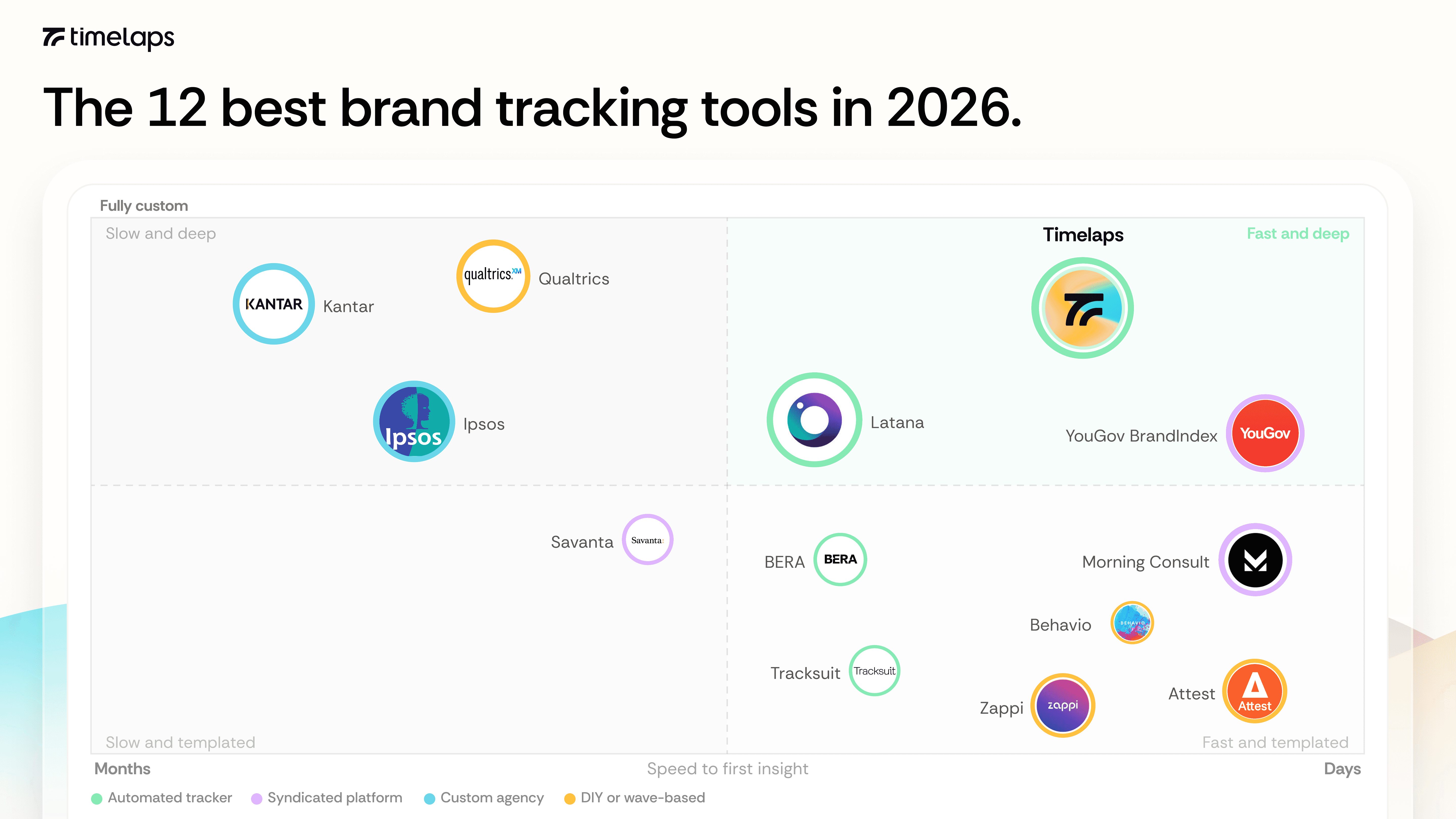
Tool | Type | Method | Market | Cadence | Price | Best for |
Timelaps | Automated tracker | Survey panel census-matched across age, gender, race and ethnicity, income level, region, and more | 82 | Continuous collection, monthly reporting | Starting at $15K per year per region | Mid-market and enterprise B2C brands wanting method depth at SaaS price |
Tracksuit | Automated tracker | Survey panel matched on region only | 25 | Continuous collection, monthly reporting | No public pricing; reportedly starting at $19.5K per year per region | Challenger brands wanting a simple, beautiful funnel dashboard |
Latana | Automated tracker | Survey plus MRP modelling | 150+ | Continuous collection, monthly reporting | Essential €7,900 / Pro €18,900 / Custom on request | Multi-market brands tracking niche audience segments |
BERA | Automated tracker | Survey, equity-focused framework | Not published | Continuous collection | Not published, quote-based | Brands wanting predictive equity scoring, now inside Stagwell |
Behavio | Wave-based tracker | Implicit association testing | Not published | Periodic waves, twice a year or quarterly | $4,600 biannual / $12,500 quarterly | Small brands wanting a cheap behavioural read, not always-on tracking |
Morning Consult | Syndicated platform | Daily survey, syndicated metric set | 45+ | Daily | Not published, quote-based | Enterprises needing daily reads on a standard metric set |
YouGov BrandIndex | Syndicated platform | Daily survey, proprietary panel | 55+ | Daily | Not published, quote-based | PR and comms teams tracking reputation events |
Kantar | Custom agency | Survey plus MDS framework | Global | Custom waves | Not published, typically six figures | Global enterprises with in-house insights teams |
Ipsos | Custom agency | Survey plus proprietary frameworks | Global | Custom waves | Not published, typically six figures | Full-service custom diagnostic programmes |
Qualtrics | DIY platform | Self-managed survey | Global | You decide | Enterprise licence, six figures (reportedly $450,000 for license and 4,000 samples) | Teams already running Qualtrics for CX and EX |
Attest | DIY platform | Survey, flat per-market pricing | 58+ | You decide | From $0.50 per response, up to 50,000 responses | Fast self-serve research with a tracker built on top |
Zappi | Automated tracker | Automated survey waves | 30+ | Monthly waves | Not published, quote-based | Teams wanting tracking connected to concept and ad testing |
What is brand tracking? What is a brand tracker?
Brand tracking is the continuous measurement of how consumers perceive, remember, and choose your brand compared to competitors.
A brand tracker surveys representative audiences of the category continuously over time, measuring metrics such as brand awareness, brand consideration, brand preference, and brand associations, producing charts and analyses that show whether your brand marketing is working.
We wrote the ultimate guide on everything brand tracking if you want to dive deeper into the concept.
Brand tracking vs. Social listening (Brand monitoring) vs. SEO analytics vs. AI visibility.
Search "brand tracking tool," and you'll get four different product categories on one results page. Most comparison lists don't tell you that they measure different things and are fundamentally different.
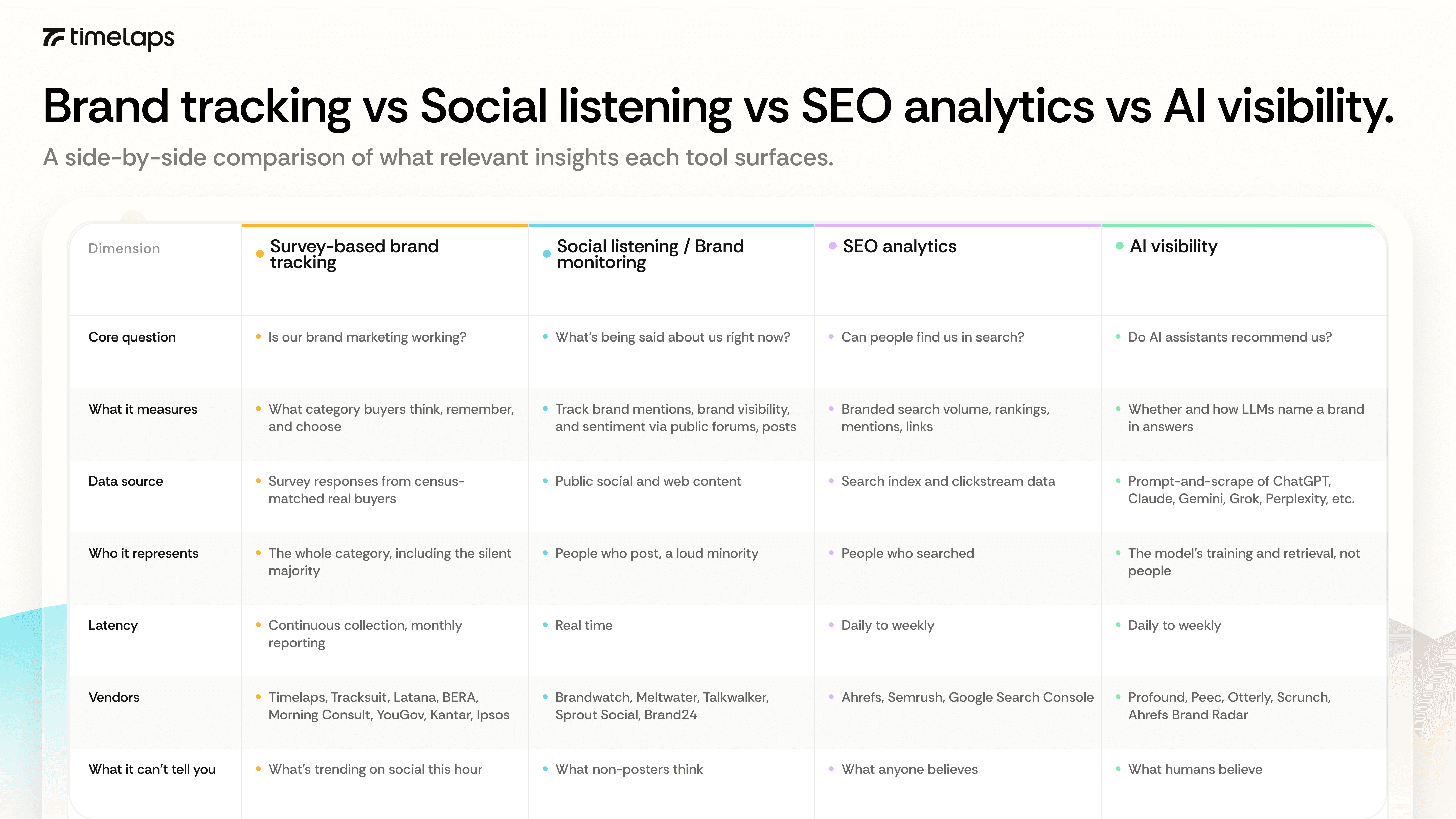
Next time, if you see a social listening tool pretending to be brand tracking, TELL THEM!
Survey-based brand tracking | Social listening / Brand monitoring | SEO analytics | AI visibility | |
Core question | Is our brand marketing working? | What's being said about us right now? | Can people find us in search? | Do AI assistants recommend us? |
What it measures | What category buyers think, remember, and choose | Track brand mentions, brand visibility, and sentiment via public forums, posts | Branded search volume, rankings, mentions, links | Whether and how LLMs name a brand in answers |
Data source | Survey responses from census-matched real buyers | Public social and web content | Search index and clickstream data | Prompt-and-scrape of ChatGPT, Claude, Gemini, Grok, Perplexity, etc. |
Who it represents | The whole category, including the silent majority | People who post, a loud minority | People who searched | The model's training and retrieval, not people |
Latency | Continuous collection, monthly reporting | Real time | Daily to weekly | Daily to weekly |
Vendors | Timelaps, Tracksuit, Latana, BERA, Morning Consult, YouGov, Kantar, Ipsos | Brandwatch, Meltwater, Talkwalker, Sprout Social, Brand24 | Ahrefs, Semrush, Google Search Console | Profound, Peec, Otterly, Scrunch, Ahrefs Brand Radar |
What it can't tell you | What's trending on social this hour | What non-posters think | What anyone believes | What humans believe |
The overlap is real and growing rapidly. The SEO giants have all made moves in the AI visibility space. Ahrefs launched its AI visibility checker and Brand Radar. Semrush included AI visibility alongside SEO analytics. Social listening (or brand monitoring) software is also adding "ChatGPT mentions" tabs. If you're buying in that space, treat the three as one converging stack.
The fundamental reason why social listening, SEO analytics, and AI visibility tools are converging is that they measure publicly available information: posts, searches, citations, while survey-based brand tracking measures the people.
That difference isn't cosmetic. In most consumer categories, the share of buyers who post about a brand, search it by name, or get quoted in an AI answer is tiny. The rest buy silently: the silent majority. They form opinions, walk past your competitor, and choose. They are the category buyers.
We explained how and why social listening (or brand monitoring) is fundamentally different from brand tracking at length in a separate topic deep-dive: Why social listening tools measure the wrong things.
Four ways to measure brand health metrics (like brand awareness) using brand tracking surveys.
You know you want to measure brand awareness, brand performance, brand perception, and various other brand insights to inform brand strategy. But how to choose the right buying model?
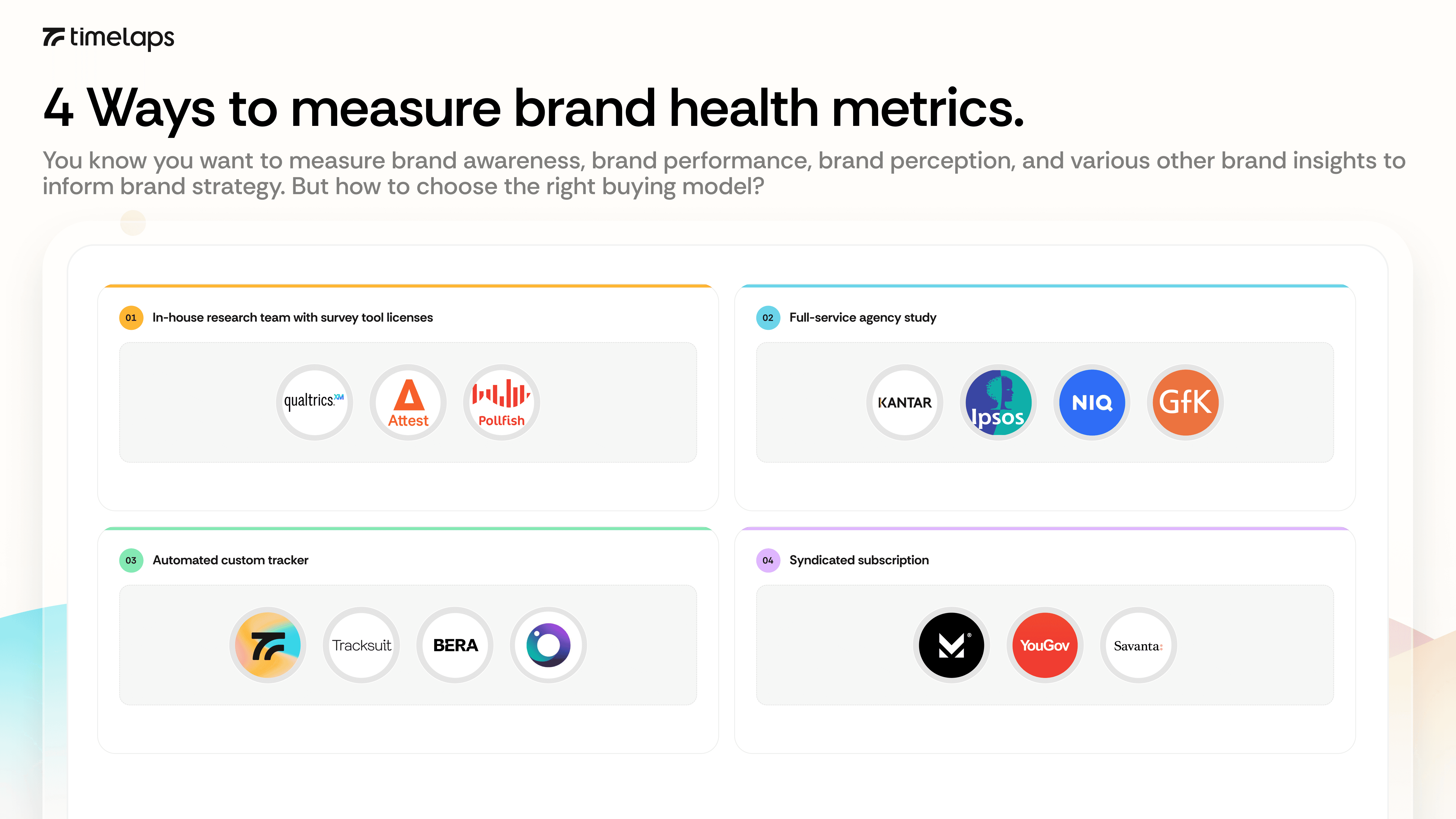
In general, brand health tracking research can be conducted in four ways:
In-house research team with survey tool licenses
Full-service agency study
Automated custom tracker
Syndicated subscription
In-house research team with survey tool licenses | Full-service agency | Automated custom tracker | Syndicated study subscription | |
Examples | Qualtrics, Attest, Pollfish, plus panel (e.g., Dynata, Cint, Toluna) bought separately | Kantar (BrandZ), Ipsos (Syndicated Services), NIQ, GfK | Timelaps, Tracksuit, Latana, BERA | Morning Consult, YouGov BrandIndex, Savanta BrandVue |
What you get | Depends on the team | Custom study designed from scratch for you | Your competitive set, your category, your questions | Their metrics, their brand list, their categories |
Who designs it | Your team | A research team, per wave | You and the vendor, at setup | The vendor, once, for everyone |
Speed to first data | Weeks with an existing template, months if starting from scratch | Three to six months | Days to weeks | Instant; the data already exists |
Cadence after that | Depends on the team | Quarterly or biannual | Continuous collection, monthly reporting | Daily |
Typical cost | Licence plus per-response panel costs plus salaries; often the highest true cost | $100K to $500K+ per year | $15K to $50K+ per year | $50 to $200K+ per year |
Breaks when | Your researcher leaves, or the quarter gets busy | You need an answer before the next wave | You need something outside the survey | Your category isn't one of their categories; your brand is too small to be seen |
If you are a marketer who has commissioned a study to collect brand tracking data and measure how a brand performs, you are likely familiar with traditional brand tracking solutions: full-service agencies like Kantar and Ipsos and survey tools like Qualtrics.
Full-service is flexible and slow. You get exactly the study you asked for, roughly one or two quarters after you requested the service. An in-house research team with survey tool licenses sits on the far end of the spectrum, arguably the most flexible and also potentially the most expensive.
Traditional brand tracking solutions, including full-service agencies and in-house research teams with survey tool licenses, can be very expensive and take a very long time, and may be no longer relevant by the time the report gets published.
The CMO at a publicly listed technology company who switched to an automated custom tracker shared: "I've not been a fan of brand studies. I've done them in the past. They take too long. They give me information that I wish I had six months ago. And they're very expensive."
The VP of Insights at a Fortune 500 media and entertainment company reinforced the claim: "The barriers for us have actually been the total costs. Because we have so many franchises that, as much as I love brand tracking, if we were to run brand trackers continuously across all brands, it gets really expensive even for a company our size."
In comparison, syndicated is fastest and broadest but fixed. You get the metrics they decided to collect, against the brand list they decided to track, inside categories they defined. If your category is "premium ready-to-drink cocktails in South Africa," it probably isn't on the list. If your brand is mid-market or a challenger, syndicated studies will not be very directly applicable.
Automated custom trackers keep the part of full-service agency that matters, which is a study built around your category and your competitive set, and drop the part that doesn't, which is a research team rebuilding it by hand every wave. Design happens once, at setup, with you in the room. Fieldwork, cleaning, weighting, and reporting run continuously after that. That's the whole reason the tier can charge $15,000 to $50,000 for something an agency charges six figures for: the saving comes out of process, not out of sample. What you give up is bespoke design per wave. If your question changes drastically every quarter, you still want an agency because the most important point of a brand tracker is consistency in methodology. If your category is stable and your problem is that measuring it properly costs more than it should, this is the tier built for you.
Evaluating the best overall brand trackers and best brand tracking companies.
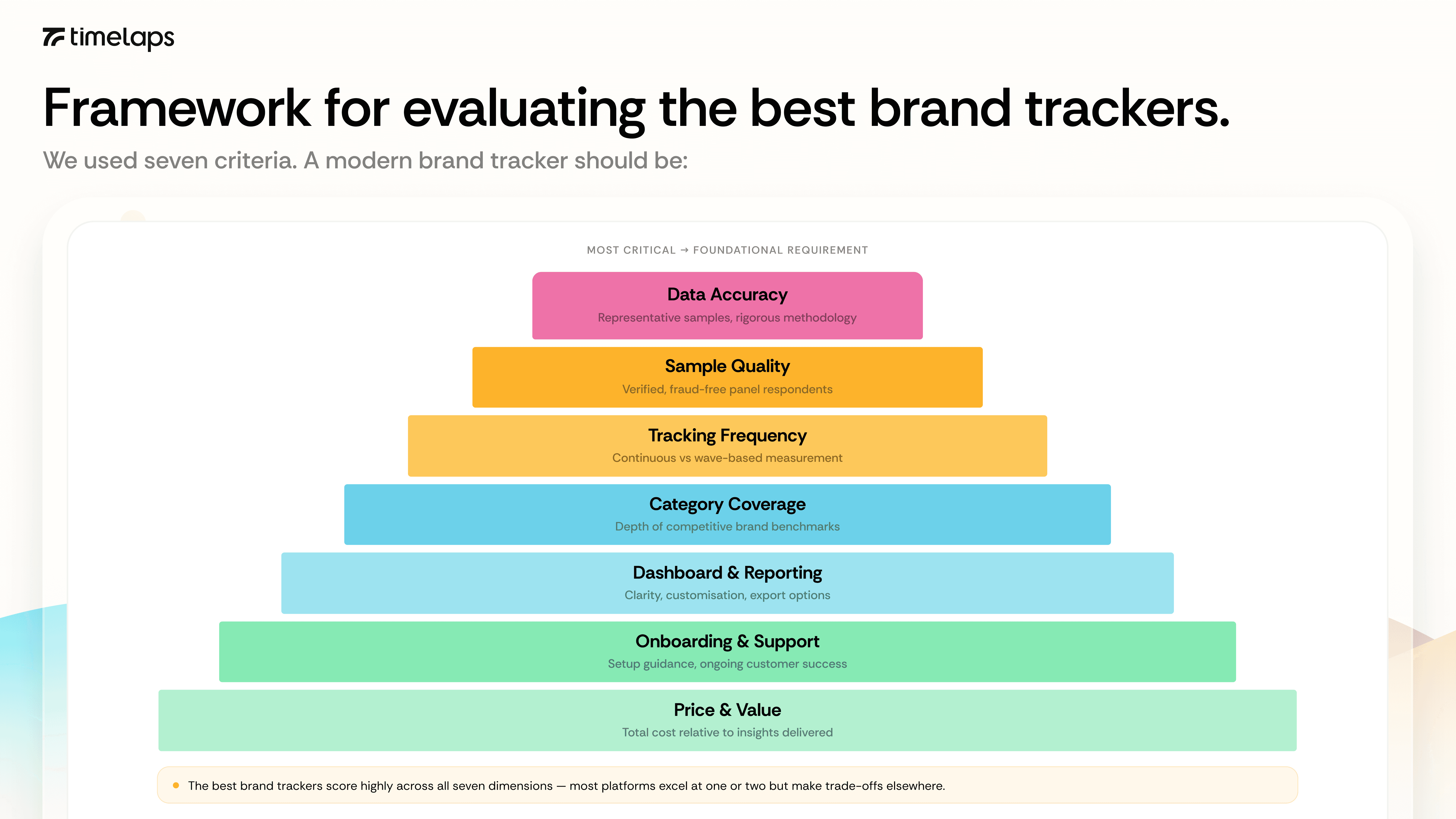
We used seven criteria. A modern brand tracker should be:
Continuous. Collection cadence is how often fieldwork runs. Reporting cadence is how often numbers land. A tracker should collect continuously and report at least monthly. Twice-yearly waves are a study, not a tracker.
Methodologically current. Census-matched sampling and current brand science, including category entry points, not equity frameworks designed in the 1990s.
Globally consistent. Consistency measures the most in brand tracking. Multi-market coverage using one methodology, so numbers are comparable across borders.
Fast to value. Weeks from signing to first data, not quarters.
Accessibly and transparently priced. Published pricing, or at least knowable pricing.
Expert-supported. A researcher you can call, not just a dashboard.
Beautiful by default. Output your executives will actually open and can understand.
Customer quotes were fetched from company websites, published reports, and across popular verified review sites like G2, Capterra, Software Advice, GetWhy, and Product Hunt.
We elaborated more on the importance of a rigorous methodology in a separate topic deep-dive: Brand Tracking Methodology: Survey, Panel, and Sample Size.
Top 12 best brand tracking software tools in 2026
1. Timelaps
Timelaps is an AI-native brand tracker that runs continuous, census-matched surveys across 82 markets on one consistent methodology, priced at $15,000 to $30,000 per region per year. It is considered as one of the best brand health tracking software tools.
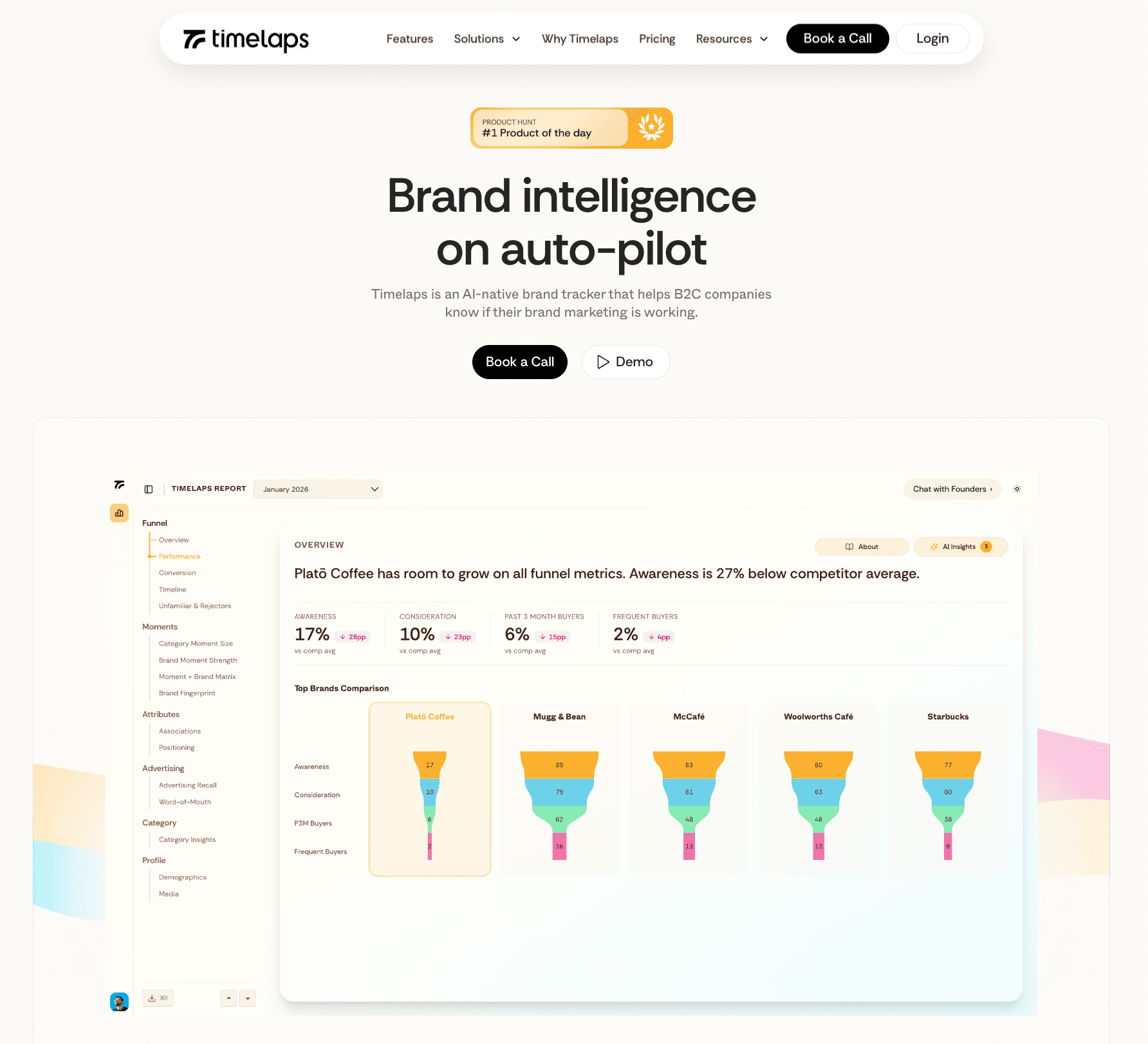
Method and sample: Always-on survey panel of census-matched, verified category buyers, fielded in local language. Roughly 4,000 responses per category per year on Scale and 3,000 on Start. Data quality runs through leading global panel partners plus regional providers, a proprietary QC algorithm, fraud detection, respondent blacklisting, and bad-data refund agreements with panel providers.
Markets and cadence: 82 markets, one methodology, all brand tracking metrics comparable by design. Collection is continuous, running every day rather than in periodic waves. The dashboard self-refreshes monthly, and the underlying data collection never stops. Speed to value is unparalleled, often taking less than a week from interest to in-field data collection.
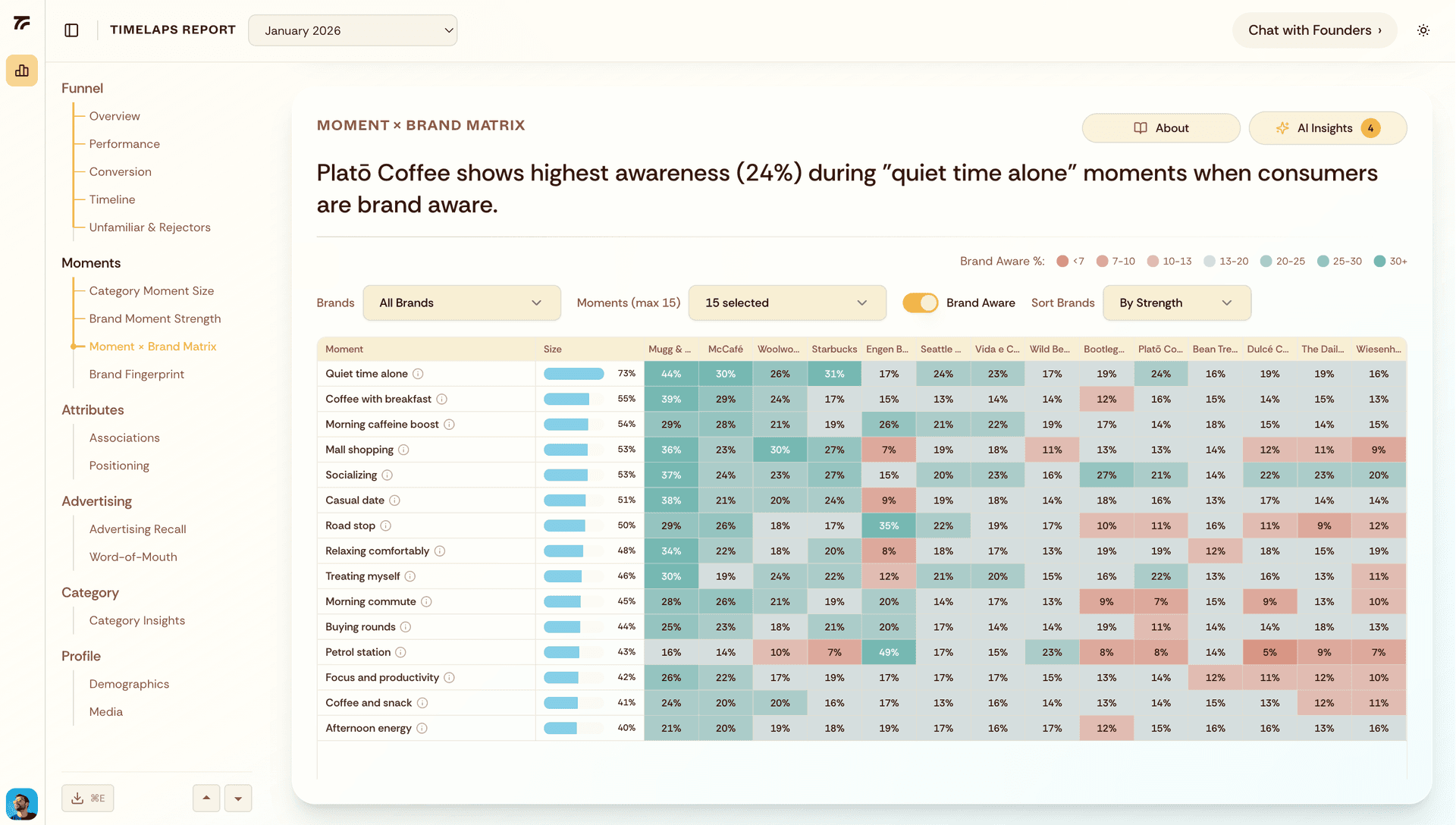
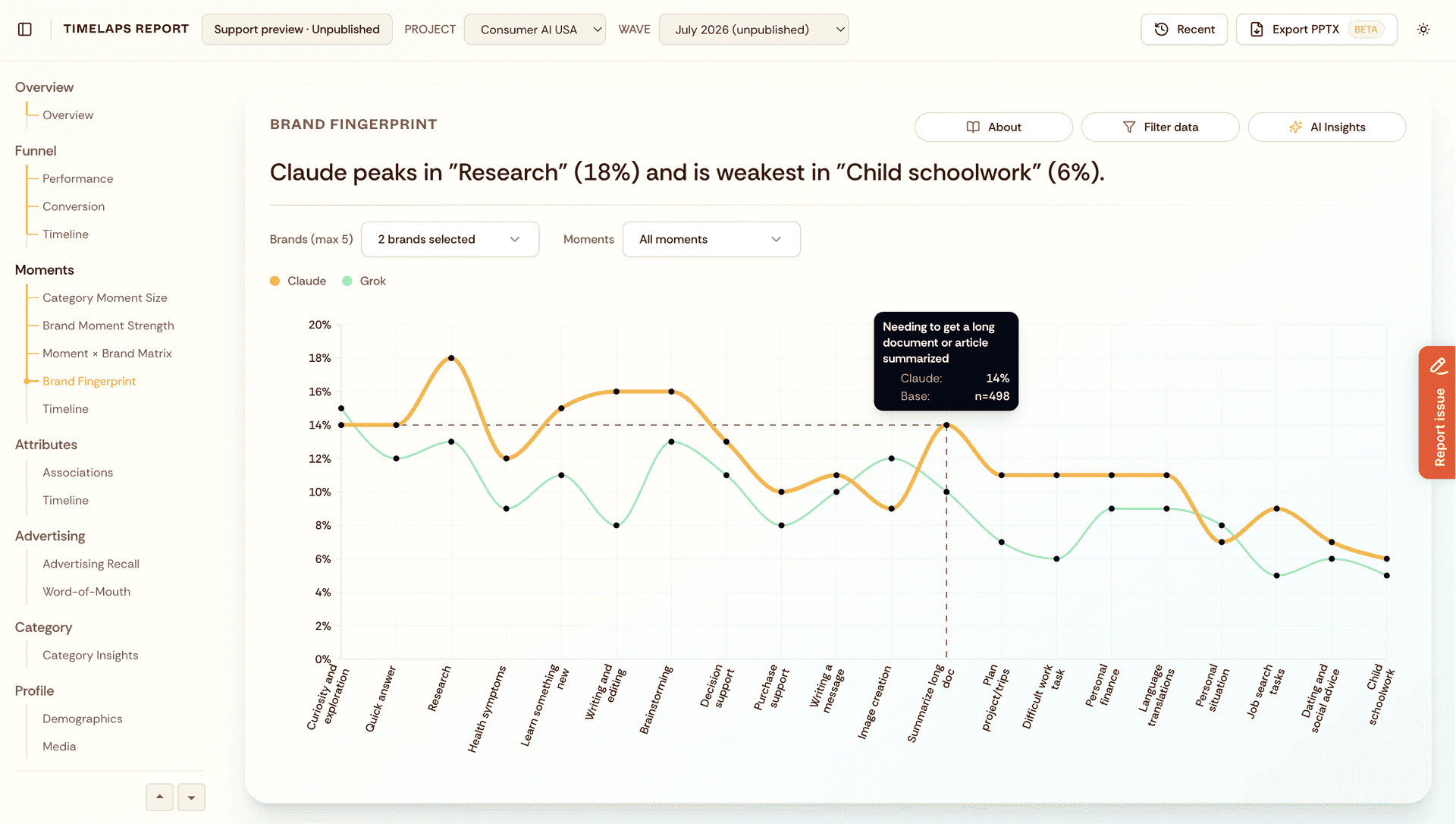
Features: Brand Funnel (awareness, consideration, purchase, loyalty), Moments (Category Entry Points), Associations, Advertising and Word of Mouth Recall, Category Insights, Buyer Demographics and Media, Filters, AI Analyst, Custom Questions, Slide Exports. The science base is Ehrenberg-Bass: mental availability and category entry points. Elaborated more on the features page.
Pricing: Start $15,000, Scale $30,000 per region per year. Published on the pricing page.
Support: Brand science experts involved at design and throughout, beyond onboarding. Market research veterans and PhD researchers
Best for: Mid-market and enterprise B2C brands who want method depth, multi-market consistency, and expert support without a six-figure agency contract.
Customer Quotes:
The CMO at a $1B revenue food and grocery delivery company, who switched from Zappi, called the product: "The best brand tool I've used," citing "ability to report (brand health) continuously on a monthly basis" as primary reasons.
The Head of Insights at a $150M revenue entertainment company, who switched from Ipsos, described the difference in wait time: "The advantage of having the data straight after it's surveyed rather than having to wait two, three months, it's chalk and cheese."
The CMO at a $550M revenue technology company highlighted the benefit of Timelaps' emphasis on speed to value, compared to traditional brand tracking studies: "Every day you're not doing what you want to get done, you lose money."
Pros:
Accessible. At least 5x more affordable than traditional agencies, making it the best value marketing platform whether you track one brand or a whole portfolio.
Speed. Onboard in days. First insight within 30 days. Not the 3-to-6-month wait legacy trackers ask for.
Continuous. Always-on fieldwork refreshed monthly, instead of quarterly or bi-annual waves that report after the decision is made.
Fast-growing. AI-native team that builds very fast and continuously publishes new features transparently on Changelog.
Research-grade methodology. Responses from real category buyers, screened for fraud, not social-listening proxies or synthetic data. Follows the latest in brand science like category entry points.
Global. One census-matched methodology across 82 markets, so a move in one country is comparable to a move in another.
Team. Built by PhDs and researchers with 20+ years running trackers for the world's largest brands.
Cons:
Small, founder-led team. Support coverage is not yet 24/7 across every time zone.
Hyper-focused on brand tracking and not a research suite. No ad testing, concept testing, or packaging testing in the platform. If you want one vendor covering the full research stack, other alternatives listed here are better fits.
No AI visibility or social listening layer yet. If you want share of model and brand mentions in the same dashboard as your funnel, you will need a second tool.
B2C only. Built for consumer categories with meaningful buyer populations. B2B brands and niche B2C categories with very low incidence are not available today.
No brand valuation. If your board expects a financially linked valuation figure of the kind BrandZ produces, Timelaps does not provide one yet, but the team is actively working towards this capability.
2. Tracksuit
Tracksuit is an always-on brand tracker built around a simple and beautiful dashboard, popular with challenger consumer brands and strongest in Australia and New Zealand.
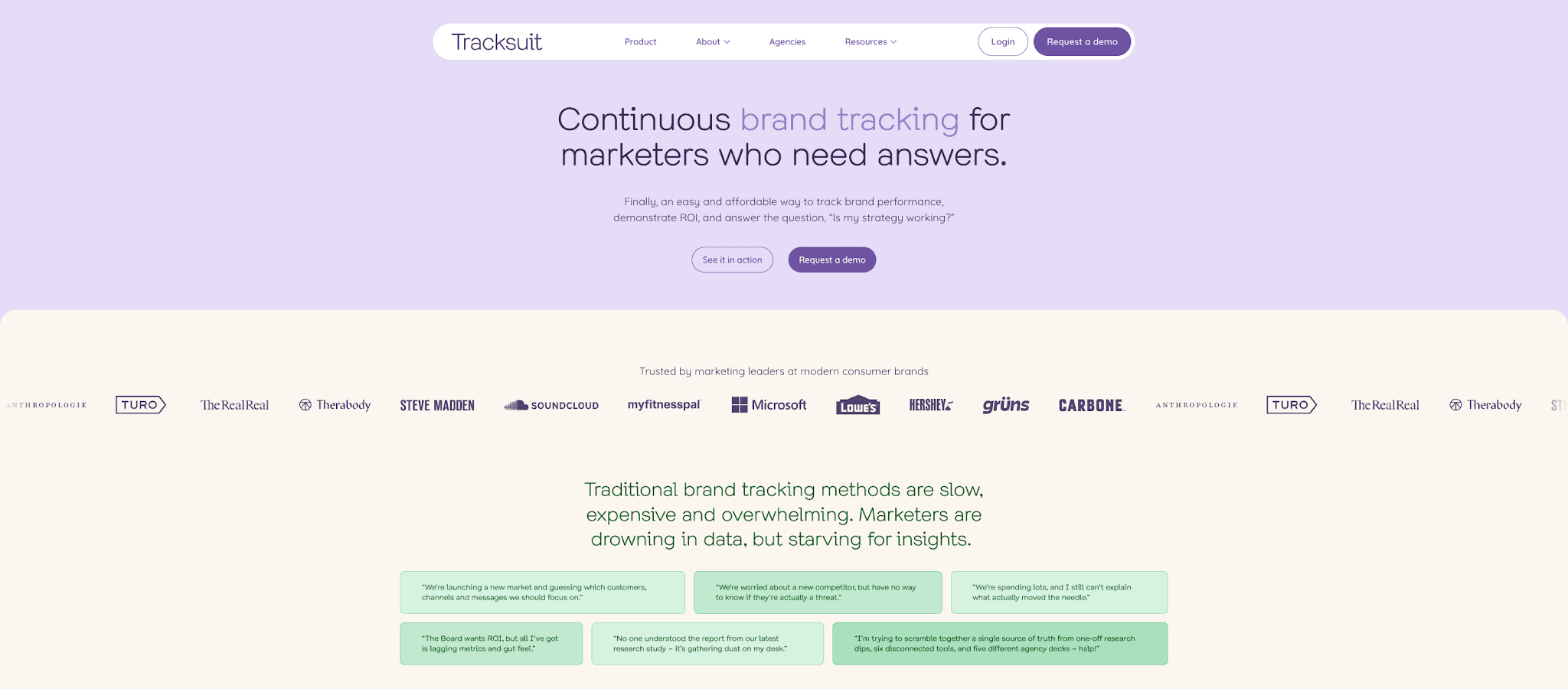
Method and sample: Continuous consumer surveys from third-party panels.
Markets and cadence: 25 markets, weighted heavily toward Europe (16), with 4 in the Americas (US, Canada, Brazil, Mexico) and 5 in APAC (New Zealand, Australia, South Korea, Singapore, Japan). Customer base concentrated in New Zealand, Australia, the UK, and the US. Monthly dashboard refresh. Benchmark read within 30 days.
Features: Brand Funnel (awareness, consideration, preference, usage), Brand Associations, Category Attitudes and buying drivers, Competitor Benchmarking, Category Size and TAM, Demographic Filters (age, gender, region), and Marketing Milestones for mapping campaign activity against funnel movement. Chart and text-summary export built for slide decks.
Pricing. Not published. Reviewers and competitors reported the platform cost starts at $19.5K per year.
Support. "Brand Champions" plus an in-house research team.
Best for: Emerging consumer brands who are getting started in brand tracking and would appreciate a beginner-friendly interface.
Pros:
Beautiful. Positioned as "beautiful, intuitive, and jargon-free," and it delivers on that. Internal adoption is easier when the dashboard is one people want to open.
Continuous. Always-on fieldwork refreshed monthly, rather than quarterly or biannual waves that report after the decision is made.
Well supported. Brand Champions and quarterly catch-up calls that clients consistently praise.
Pioneering. Made brand tracking affordable for brands previously priced out of the category, and deserves credit for opening the market.
Cons:
Methodology depth is the core limitation. Tracksuit weights on three variables: age, gender, and region. Most established research providers weight on more. Three-variable weighting corrects the skews it measures and passes through the ones it does not. In categories where purchase behaviour tracks income, education, or household composition more than it tracks age, that gap sits inside every number you read.
Sample depth. The most consistent complaint across every review site, and it compounds the weighting point: thin monthly cells plus limited demographic correction means segment reads carry more error than the interface suggests. On Software Advice, a reviewer writes that "each month's sample isn't enough to make real assumptions from. On G2, a reviewer notes that "the monthly sample size makes it difficult for smaller brands to establish significance."
Geographic coverage has significant gaps. There is no coverage in Africa, the Middle East, or South Asia at all, and very limited in all continents except Europe.
Fixed question set. Brand sentiment statements are standardised, so associations are measured in Tracksuit's language rather than specific to your category. On GetApp, a reviewer finds the "brand sentiment statements to be pretty restrictive in wording."
Opaque pricing. Reviewers report additional fees for extra features and for a sample size large enough to read confidently.
3. Latana
Latana is a survey-based brand tracker that uses Multilevel Regression and Poststratification to model brand metrics for narrow audience segments across 150+ markets.
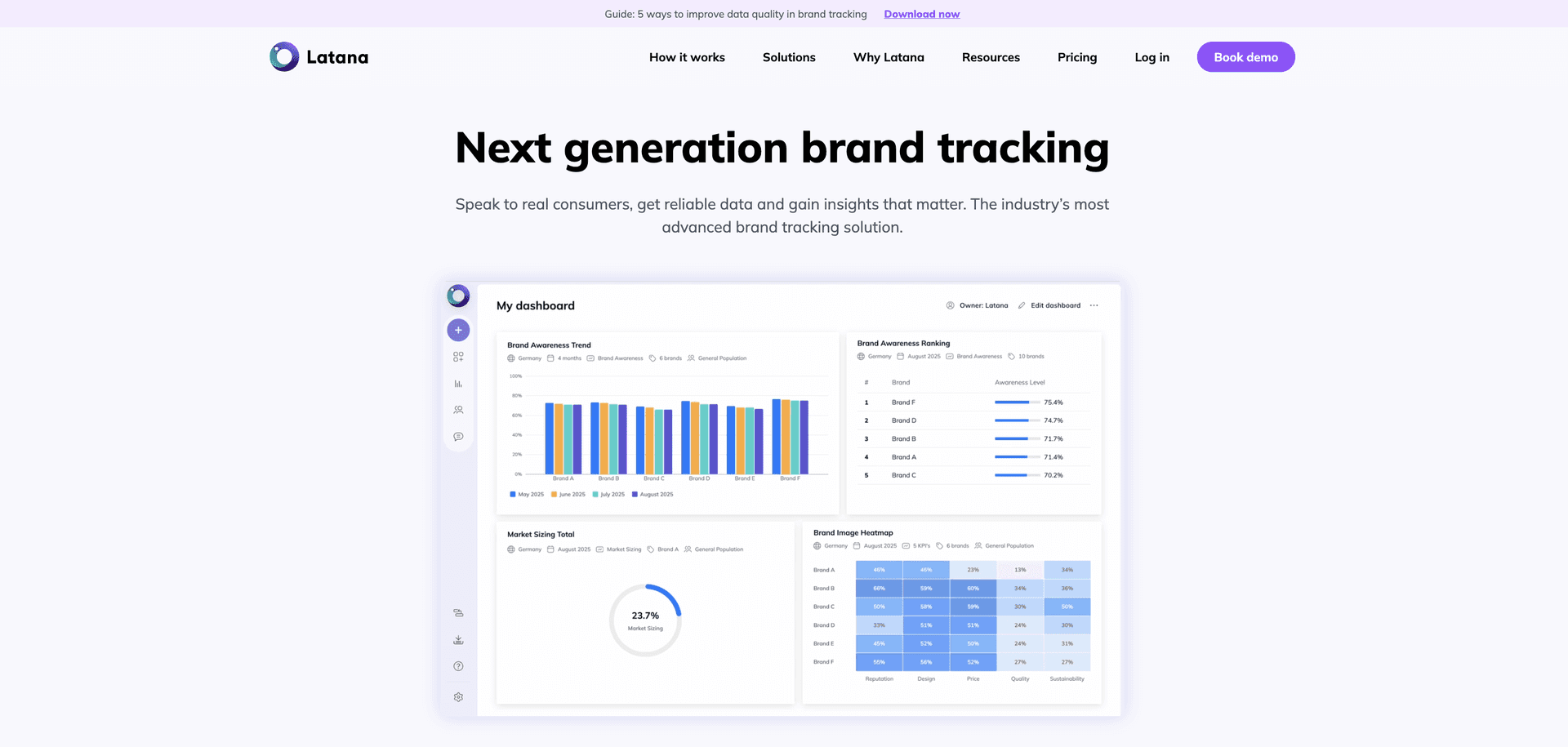
Method and sample: Non-incentivised mobile survey sampling combined with MRP statistical modelling. Rather than reporting raw counts, MRP borrows statistical strength across markets and demographics to estimate what a segment thinks when the raw sample in that segment is too thin to read directly. Latana's published Essential plan cites monthly updates drawing on up to 25,000 interviews per brand, per market, per year.
Markets and cadence: 150+ markets globally. Monthly dashboard refresh.
Features: Brand Health Tracking, Purchase Funnel Tracking, Ad Awareness Tracking, Brand Perception and Associations, Competitor Benchmarking, Audience Segmentation, and Brand Strategy Planning. Margins of error are displayed alongside the numbers, which is more statistical honesty than most analysis tools in this category offer.
Pricing: Essential from €7,900 (or ~$9,100) per market per year (4 brands, 2 segments). Pro from €18,900 (or $22,000) per market per year (6 brands, 3 segments, funnel metrics, trend-line models, KPI predictions). Custom on request (up to 50 brands, 10 segments). Contracts start at 12 months. Note that the figures are starting prices: Latana states the final per-market price depends on market complexity, audience incidence rates, and the size of the brands being tracked.
Support: Standard SaaS onboarding plus in-person training options.
Best for: Multi-market B2C brands who need to read specific demographic or psychographic segments, and who have someone internally who can defend a modelled number to leadership.
Pros:
Statistical depth. MRP is legitimate, well-established methodology, and it genuinely solves the small-segment problem that every tracker runs into.
Global. 150-plus markets is among the broadest coverage available at this tier.
Transparent. Margins of error are shown in the interface rather than buried in an appendix.
Cons:
Modelled, not counted. Numbers are estimates produced by a statistical model, not head counts.
Inconsistent claims. Market count differs between their own marketing pages and pricing page.
4. BERA
BERA is a brand equity measurement platform focused on predictive scoring, acquired by The Harris Poll under Stagwell in 2024.
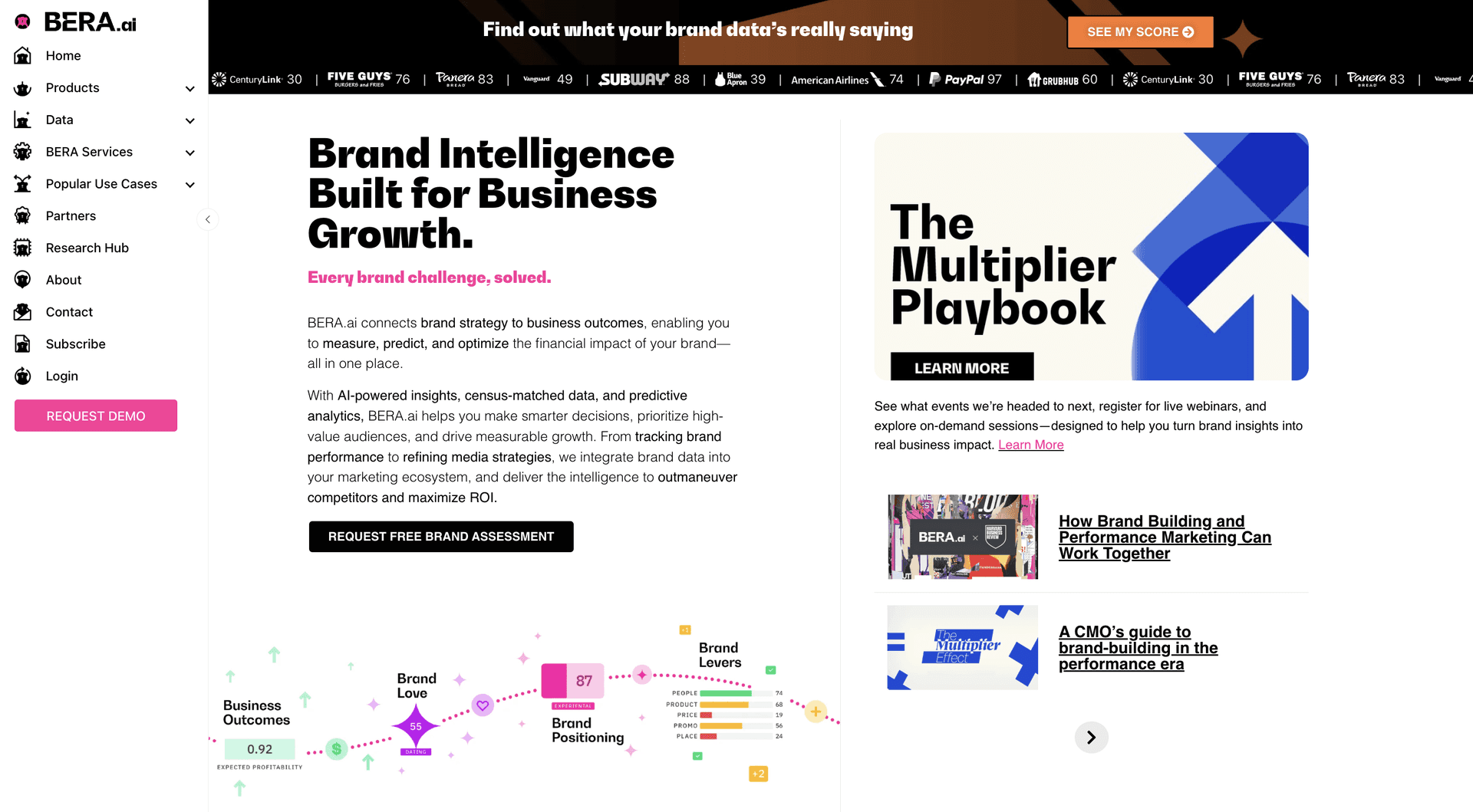
Method and sample: Survey-based, organised around a proprietary equity framework that scores brands on predictive dimensions rather than a plain funnel. The pitch is forward-looking: not just how your brand appears today, but what current perception implies about future performance.
Markets and cadence: US-led coverage. Continuous.
Features: Proprietary equity scoring, predictive modelling, and benchmarking against a large brand comparison database.
Pricing: Not published.
Support: Enterprise account model.
Best for: US brands who want brand equity scoring and predictive modelling, particularly for board-level brand management conversations.
Pros:
Equity framing. Scores brand strength rather than funnel position, which could travel better in a CFO conversation than an awareness percentage shift.
Benchmarks. A large brand database for cross-category context.
Cons:
Proprietary scoring. The index is BERA's own, which makes it hard to reconcile against key brand tracking metrics your team already reports, and hard to replace if you leave.
US-centric. Less multi-market breadth than the global trackers, which matters if brand consistency across regions is the problem you are solving.
5. Behavio
Behavio is a wave-based brand measurement tool using implicit association testing, priced at $4,600 a year for twice-yearly measurement and $12,500 for quarterly.
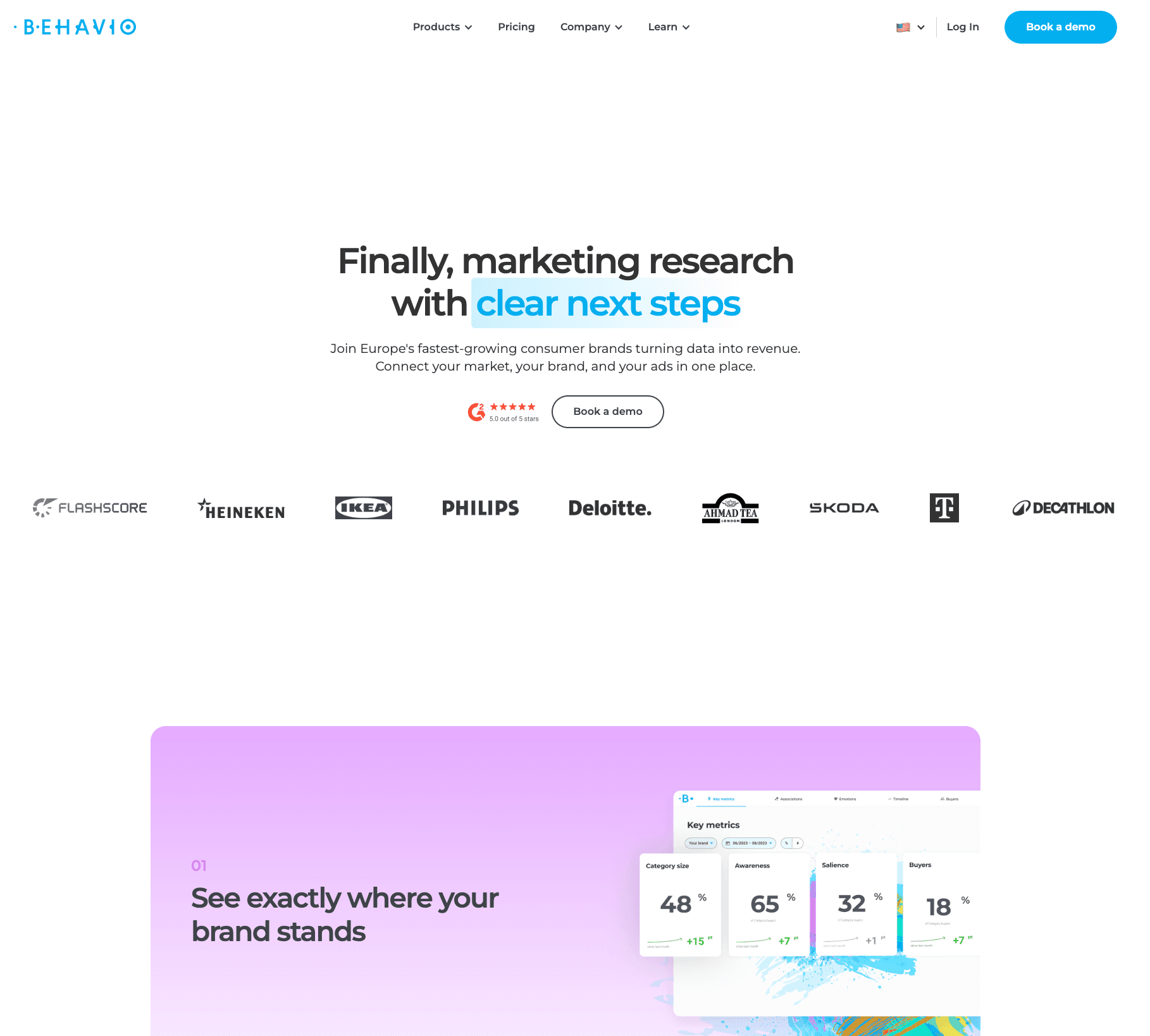
Method and sample: Implicit association testing on a representative sample, using reaction times rather than declarative survey answers. The argument is that measuring how fast someone links your brand to an attribute captures instinctive association that a considered survey answer smooths over. It is a real method with real academic support behind it.
Markets and cadence: Europe-led. Measurement lands twice a year or quarterly depending on plan. First results within 14 days of kickoff.
Features: Implicit association testing as the core method, brand association mapping, and an expert summary of recommended actions included in every plan. Feature depth is deliberately narrow given the low price.
Pricing: $4,600 a year for biannual waves. $12,500 a year for quarterly waves. Published openly, which is rare in this category and to their credit.
Support: Expert summary included with every wave.
Best for: Brands new to brand tracking who want a low-commitment read on brand perception twice a year, and who understand they are buying a study rather than a tracker.
Pros:
Transparent. Published pricing at the lowest entry point in the category. Very few competitors do this.
Different. Implicit testing measures something declarative surveys genuinely miss.
Guided. Every plan includes an expert summary of what to do next.
Fast first read. Results within 14 days of kickoff.
Cons:
Not continuous. Fieldwork runs in periodic bursts, so twice a year means two data points. If a competitor launches between waves, that period is invisible and always will be. Infrequent, wave-based tracking does not give insights professionals confidence as the brand evolves over time. Note that while Behavio's own comparison table describes its cadence as continuous, it does not match its published biannual and quarterly plans in pricing.
Thin sample. Small base sizes at the entry tier, which limits segment reading.
Narrow features. Minimal functionality beyond the core method, so it will not carry a full brand management programme.
Limited coverage. Europe-led, so global consistency is not on offer.
6. Morning Consult
Morning Consult Intelligence is a syndicated brand tracking platform collecting more than 30,000 interviews a day across 45+ markets and 4,000+ brands.
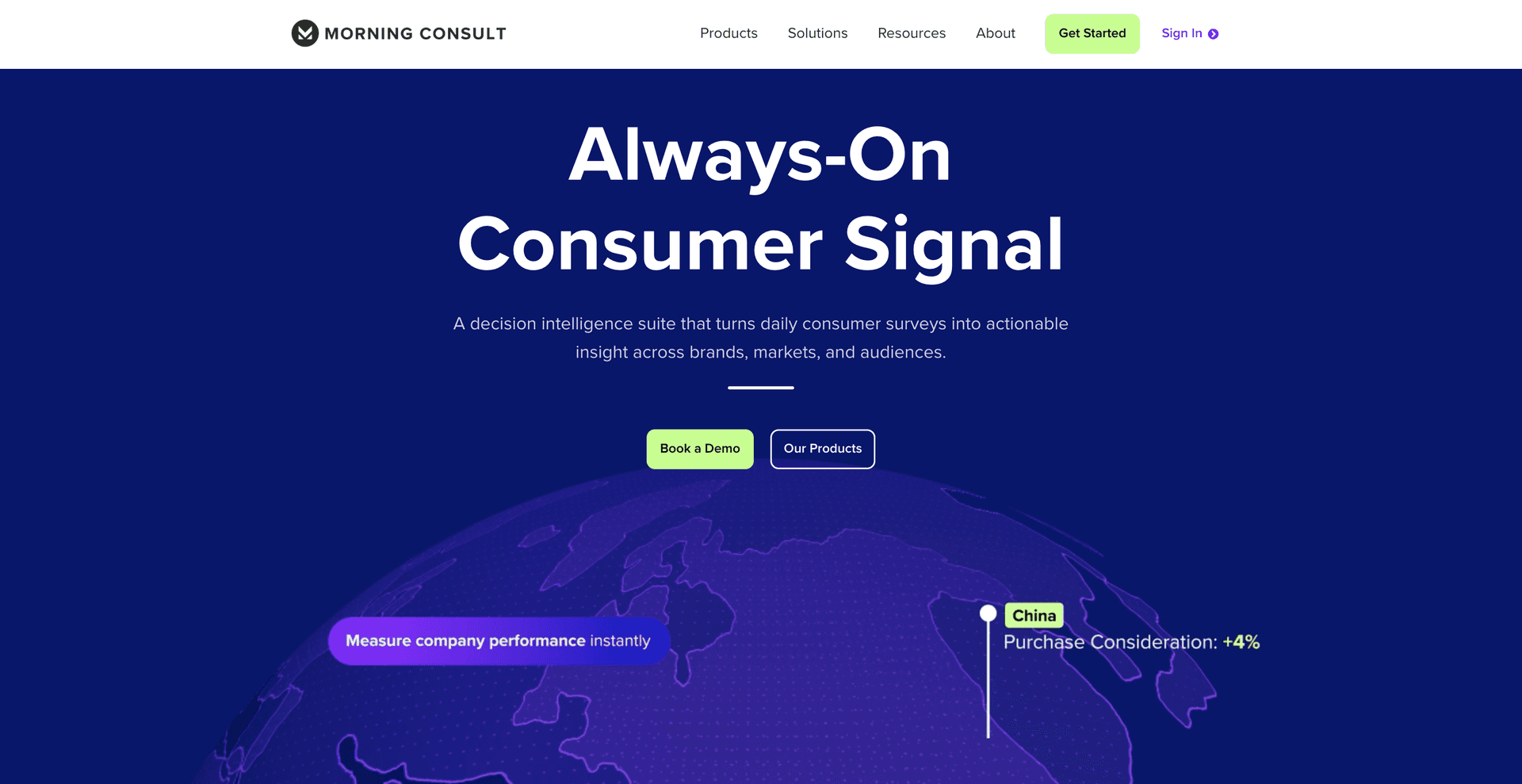
Method and sample: Daily online survey collection against a standard syndicated metric set, including favourability, trust, purchase consideration, and a composite Reputation Score. Their 2026 Most Trusted Brands analysis spans more than 3,200 brands, averaging over 10,000 surveys per brand per year.
Markets and cadence: 45+ markets, daily.
Features: A fixed syndicated metric set covering brand reputation, favourability, trust, and purchase consideration, plus category and competitor benchmarking across a large brand universe. Ships AI agents and MCP connectors for querying the data directly, which is genuinely ahead of the rest of the field. Metric definitions are published.
Pricing: Not published. Enterprise contracts.
Support: Enterprise account teams and analyst support.
Best for: Large enterprises who need a daily read on standard reputation metrics and broad benchmark context across many brands at once.
Pros:
Daily. Collection cadence nobody in the automated tracker tier matches.
Transparent method. Published methodology and metric definitions.
Breadth. Enormous brand and category coverage, so competitive context comes free.
AI-forward. MCP connectors and query agents make the data easy to work with.
Cons:
Syndicated by design. Their metrics, their brand list, their category definitions. If your category is not one of theirs, the data will not describe your market.
Not built for your questions. Custom questions and your own competitive set are not the design centre.
Do the division. 10,000 surveys per brand per year across 45+ markets works out to roughly 200 to 250 per brand per market per year. While the headline number seems large, the cell you actually read is not.
Quote-based pricing. Enterprise contracts.
7. YouGov BrandIndex
YouGov BrandIndex is a daily syndicated brand tracker drawing on a proprietary panel of over 30 million members across 55+ markets and 27,000+ brands.
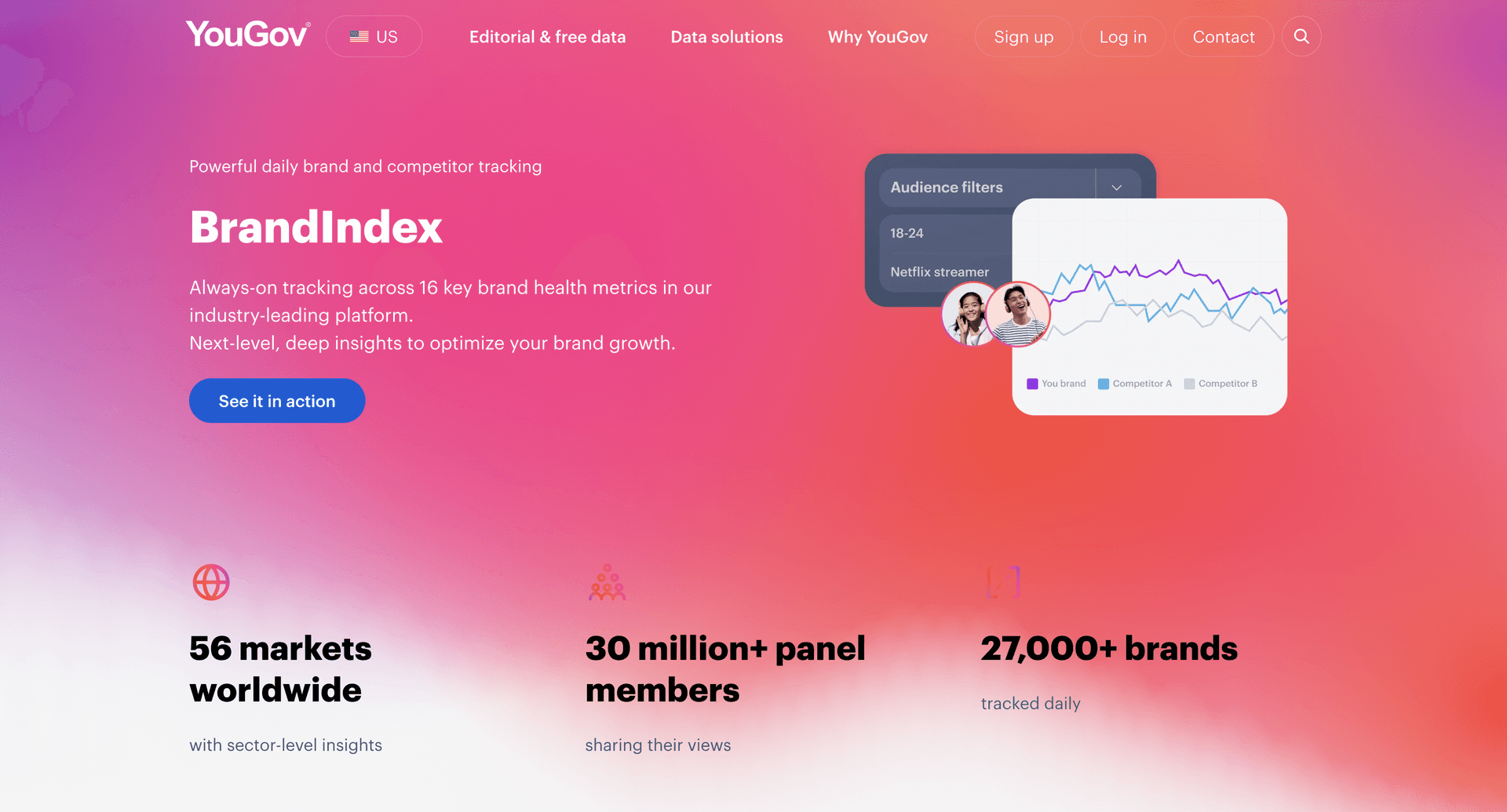
Method and sample: Daily online surveys from YouGov's own panel, reported across 16 brand health metrics covering the full journey from awareness to satisfaction and recommendation.
Markets and cadence: 55+ markets, daily refresh.
Features: 16 fixed metrics in three groups: media and communication, brand perception, and purchase funnel. Filters by demographics, psychographics, media consumption, and customer status. Custom trigger questions can be added. BrandIndex Voices, launched in early 2026, layers AI-moderated conversational interviewing on top of the tracker to add open-ended explanation.
Pricing: Not published.
Support: Enterprise account and consultant model.
Best for: Comms and reputation teams who need to see how a news event moves public perception within days.
Pros:
Owns its panel. Not renting one, which gives more control over data quality than most competitors have.
Historical depth. Over 15 years of continuous data on some brands. Nobody newer can match it, and it is the single strongest reason to choose YouGov.
Daily granularity. You can watch brand reputation move around a PR event almost in real time.
Coverage. 27,000-plus brands give immediate competitive context.
Cons:
Fixed metric set. 16 metrics decided by YouGov, so fit to your specific category structure is limited.
Explanation is bolted on. The core tracker tells you a metric moved. BrandIndex Voices adds the why, but it is a separate layer rather than a diagnostic structure built into the tracking insights themselves.
Thin cells. Sample depth per brand per market is modest once you divide the global totals, the same arithmetic problem every syndicated platform has.
Quote-based pricing. Nothing published.
8. Kantar (BrandZ, BrandDynamics)
Kantar runs one of the largest brand equity databases in market research, covering 21,000+ brands across 540+ categories and 55+ markets through BrandZ and BrandDynamics.
Method and sample: Survey panels plus the Meaningful Distinct Salient framework, validated against sales data. Kantar Marketplace offers a faster automated layer on top of the traditional custom business.
Markets and cadence: Global. Custom waves, typically quarterly or biannual once the study is designed. Note that Kantar Brand Dynamics is now marketed as offering daily tracking on the Profiles Audience Network with AI-assisted modelling.
Features: BrandZ for brand valuation and financial linkage, BrandDynamics for equity diagnostics on the MDS framework, and Kantar Marketplace for faster automated studies. The custom business has no fixed feature list, which is the point of the tier.
Pricing: Not published. Reportedly $100,000 to $500,000+ per year.
Support: Analyst teams embedded with your organisation, per wave.
Best for: Global enterprises with dedicated insights teams, six-figure budgets, and a board that expects a financially linked brand valuation.
Pros:
Unmatched benchmarks. The largest brand equity database in existence, and the reason boards ask for BrandZ by name.
Authority. Genuine methodological credibility, validated against sales outcomes.
Analyst layer. Senior researchers working alongside your team, not a support queue.
Truly global. Cross-market comparability at a scale nobody else operates at.
Cons:
Slow. Three to six months to first insight on a custom study. By the time the wave lands, the decision it was meant to inform has usually been made.
Expensive. Six-figure contracts, often multi-year.
Static output. Decks compiled by hand between waves rather than a system you can query when a question comes up on a Tuesday.
Assumes capability. You need an in-house insights function to commission the study and interpret what comes back.
9. Ipsos
Ipsos delivers full-service custom brand health tracking through proprietary frameworks including Brand Value Creator, with global fieldwork and analyst support.
Method and sample: Survey panels plus proprietary diagnostic frameworks, designed per client rather than selected from a menu.
Markets and cadence: Global. Custom waves.
Features: Brand Value Creator as the flagship equity framework, plus bespoke diagnostic modules built for each engagement. There is no fixed feature list. The flexibility is what you are paying for.
Pricing: Not published, typically six figures.
Support: Full-service. Research consultants design the study, run fieldwork, and present findings.
Best for: Enterprises needing bespoke diagnostic research where the specific study design matters more than speed to insight.
Pros:
Genuinely custom. Study design built around your question, not a template you configure.
Global infrastructure. Fieldwork capability almost anywhere you operate.
Senior expertise. Strong analyst support where the local office is strong.
Cons:
Uneven delivery. Quality varies meaningfully by local office and by the team assigned to your account, which is difficult to assess before signing.
Slow. Custom waves take months, so the tracker reports after the decision window has closed.
Expensive. Six figures before you have seen a number.
Deck-shaped output. You receive a presentation, not a system you can interrogate as new questions arise.
10. Qualtrics
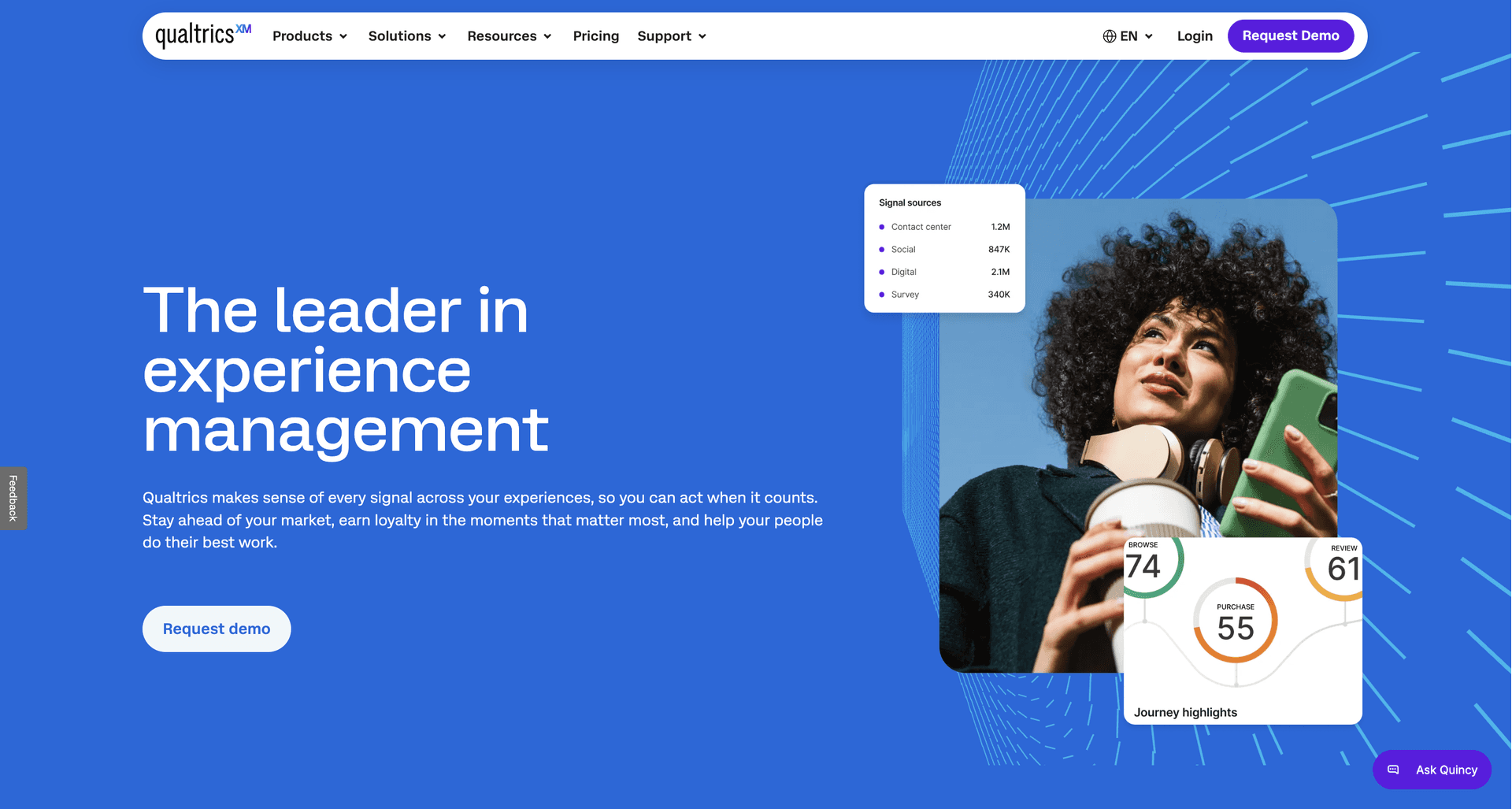
Qualtrics offers brand tracking as a module inside a broader experience management platform, sold on enterprise licences that commonly run into six figures.
Method and sample: You design the questionnaire, you choose the sample, you run the analysis, you interpret the brand tracking insights. Panel is bought separately or brought by you. Qualtrics brand tracker is a capability you assemble, not a product you subscribe to.
Markets and cadence: Global. Depends on the cadence your team can sustain consistently.
Features: Not a tracker's feature list. You get a survey builder, audience and quota management, Stats iQ for statistical analysis, Text iQ for coding open-ended responses, and dashboarding. Building your brand tracking program on top of these components is part of your insights team's responsibility.
Pricing: Enterprise licence. Reportedly around $450,000 for a base package with 4,000 samples, often on multi-year contract locks.
Support: Platform support and implementation services. No research design layer included by default.
Best for: Enterprises already standardised on Qualtrics for CX and EX, with a research team capable of designing and running a tracker properly.
Pros:
Total control. Every question, screen, and quota is yours to set and change whenever you want.
Connected. Brand data sits alongside customer and employee experience data in one system.
Mature. A well-supported enterprise platform with serious analysis tools behind it.
Efficient if you already own it. Marginal cost is low when the licence is already paid for.
Cons:
A tool, not a tracker. You supply the research design, sampling logic, weighting, and analysis. The platform will happily let you run a flawed study to completion.
No expert layer. Nothing in the product tells you whether a movement is real or whether your question wording introduced bias.
Expensive for one job. Hard to justify on brand tracking alone at that licence level.
Continuity risk. In-house programmes decay when the researcher leaves or the quarter gets busy, and comparability is the first thing lost.
11. Attest
Attest is a self-serve consumer research platform with flat per-market pricing and a brand tracker built on top of its survey product.
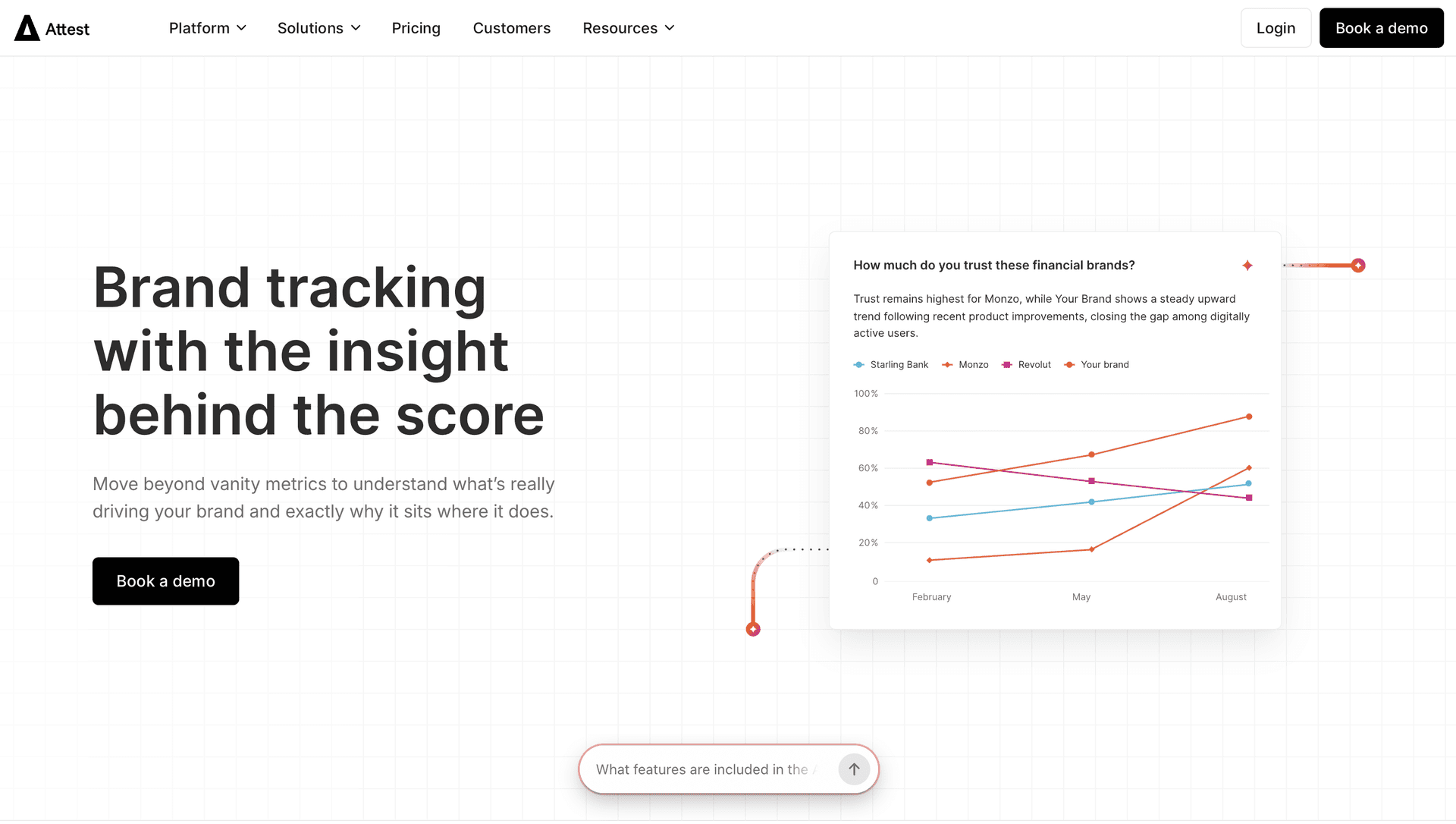
Method and sample: Self-serve survey fielding against Attest's panel network, with a tracking layer for recurring waves.
Markets and cadence: 58+ markets. You set the cadence.
Features: Survey builder with audience targeting across the panel network, brand tracker templates for recurring waves, automated significance testing, and research expert support included at every plan level.
Pricing: Published plans with flat pricing across markets. One of very few vendors in this comparison to publish figures at all.
Support: Research experts included at every tier rather than sold as an upgrade.
Best for: Teams who want fast self-serve research generally, with brand tracking as one of several jobs rather than the main one.
Pros:
Price transparency. Published, flat across markets, no negotiation theatre.
Fast. Results in hours for a one-off survey.
Expertise included. Research support at every plan level, not upsold.
Flexible. No forced annual structure for ad hoc work.
Cons:
General tool, tracking layer. The tracker sits on a survey platform, so tracker-specific structure such as category entry point analysis is lighter than a dedicated product.
Design is on you. Question wording, competitive set, and sampling decisions are yours to make and defend.
Shallow benchmarks. Less category comparison depth than dedicated brand tracking tools.
Continuity depends on you. Like any self-serve product, the tracker only stays comparable if someone keeps running it the same way.
12. Zappi
Zappi is a consumer insights platform whose brand health tracker runs monthly waves of 400+ respondents with benchmarking against up to 15 competitor brands.

Method and sample: Automated survey waves against standardised templates. Monthly waves of 400+ respondents per the product announcement.
Markets and cadence: 30+ markets. Monthly waves.
Features: A templated brand health tracker with competitor benchmarking against up to 15 brands, connected to Zappi's concept testing, ad testing, and packaging testing modules in the same platform. The integration with creative testing is the main reason to choose it.
Pricing: Quoted per brand.
Support: Platform support with research services available.
Best for: Insights teams already running Zappi for creative testing who want tracking in the same environment, alongside the same benchmarks.
Pros:
Connected workflow. Brand tracking sits next to concept and ad testing, so you can see whether the creative you tested moved the brand.
Fast setup. Templated design means you are in field quickly.
Broad benchmarking. Up to 15 competitor brands in the comparison set.
Cons:
Thin waves. 400+ respondents per month is a small base once you split it by market, age, or region. Segment reads will not be reliable.
Wave-based, not continuous. Monthly waves are better than quarterly, but fieldwork still runs in bursts rather than continuously.
Templated. Limited room for custom questions or category-specific design.
Per-brand pricing. Costs scale awkwardly across a portfolio, which is exactly when brand management teams need tracking most.
Other software and agencies for brand health tracking
Below are other noteworthy companies that include brand tracking as part of their solution suite. Most are not specialists and are best fit for their existing customers who want visibility into how their category buyers think.
Tool | Category | Note |
quantilope | Automated research suite | Strong advanced methods; brand tracking is one module |
Toluna | Panel plus platform | Large panel, tracking sold as a service layer |
ProQuo AI | AI-led tracker | Always-on tracking plus asset testing |
Suzy | Consumer insights platform | Fast iterative research, lighter tracking |
NIQ / Nielsen | Custom agency | Strongest where you need retail sales data alongside brand |
GfK | Custom agency | Now part of NIQ, strong in tech and durables |
User Intuition | AI-moderated qual | Diagnostic depth, not a quantitative tracker |
Pollfish | DIY survey | Templates for brand studies, pay per response |
Frequently asked questions
What is the best brand tracking software?
It depends on your cadence, markets, and budget. Timelaps suits mid-market and enterprise B2C brands wanting continuous multi-market tracking with category entry points at published pricing. Tracksuit suits challenger brands wanting a simple dashboard. Kantar and Ipsos suit enterprises with in-house insights teams and six-figure budgets.
What's the difference between brand tracking and social listening?
Brand tracking surveys a representative sample of category buyers on a set schedule, measuring what people think. Social listening scans public posts and news for mentions, measuring what people say. Tracking captures the silent majority who never post. Listening captures the vocal minority who do. Most serious programmes run both.
Is AI visibility tracking the same as brand tracking?
No. AI visibility tools measure whether large language models mention your brand in answers. Brand tracking measures whether real category buyers know, consider, and choose your brand. Both are legitimate. They sample different populations and answer different questions, so neither substitutes for the other.
How much does brand tracking software cost?
Roughly $4,600 a year for wave-based tools up to $500,000 for full-service agency programmes. Continuous automated trackers typically run $15,000 to $50,000 per region per year. Timelaps publishes $15,000 for Start and $30,000 for Scale per region per year.
How many survey responses do you need for brand tracking?
The number that matters is completed interviews for your brand, in your market, in one month, not the vendor's global total. Ask for that figure directly. Below roughly 100 per cell, monthly movements are usually noise rather than signal.
How often should you measure brand health?
Ask two questions, not one: how often data is collected, and how often it's reported. Continuous collection with monthly reporting is the practical standard for brands running always-on media. Twice-yearly measurement is a study, not a tracker, and won't let you attribute movement to specific campaigns.
How long does it take to set up a brand tracker?
Automated platforms field in days to weeks. Timelaps' fastest recorded time from client interest to in-field data collection is 2.5 days. Full-service agency studies typically take three to six months from brief to first insight.
Can you do brand tracking with Google Analytics or an SEO tool?
No. Analytics and SEO tools measure people who already found you. Brand tracking measures the whole category, including buyers who have never visited your site and never will. They answer different questions.


