
What is Brand Tracking? Everything You Need to Know About Brand Health Tracking
-
12
mins read





Authored: Apr. 2026. Last updated: Aug. 2026.
Written by Henk Pretorius and Harry Zhang, cofounders of Timelaps.
Brand tracking is the continuous measurement of how consumers in your category perceive, remember, and choose your brand, compared to competitors, over time. The insight industry standard for brand health tracking is to use a survey for a representative sample of audiences to ask questions and analyze brand metrics such as awareness, consideration, preference, and associations, turning brand marketing from a cost center into a quantifiable, managed asset. Modern brand tracking runs always-on rather than quarterly, and increasingly uses AI to improve sampling, analysis, and data quality. Revenue is a lagging indicator. Brand is the leading one.
Brand is back. McKinsey's State of Marketing Europe 2026 report, published in November 2025, surveyed 500 senior marketing leaders across France, Germany, Italy, Spain, and the UK. Branding was ranked the #1 priority for 2026.

Understandably, since an econometric study of 135 international companies from 2005 to 2024, combining Brand Finance data with Bloomberg financials, found that every $1 increase in brand value correlates with a $1.76 gain in turnover and a $0.16 rise in net income.
Kantar's BrandZ data shows that stronger brands command higher average prices than their category competitors. And the compounding effect matters most: a strong brand lowers CAC, improves marketing ROI, and creates demand before demand shows up in sales reports.
Which is why brand tracking is having its moment. You wouldn't run paid search without CTR, CPC, and CPA. Brand tracking is the equivalent for long-term growth.
This guide is for brand and insights managers trying to figure out what brand tracking actually is in 2026, what to measure, what to pay for, and what to ignore.
What is brand tracking?
Brand tracking is the ongoing measurement of how your brand performs in consumers' minds, including awareness, consideration, preference, associations, and purchase intent, against competitors, over time.
It works by surveying representative samples of your target audience on a repeating cadence. Quarterly, monthly, weekly, daily. The same questions, the same sampling methodology, wave after wave. That consistency is what turns individual data points into a trend line. And it's the trend line (not any single wave) that tells you whether your brand marketing is actually working.
Most definitions stop there. The real definition is sharper and more practical: brand tracking is the data layer that lets brand marketing justify itself to finance. It's what separates brands that can defend their budgets from brands that can't.
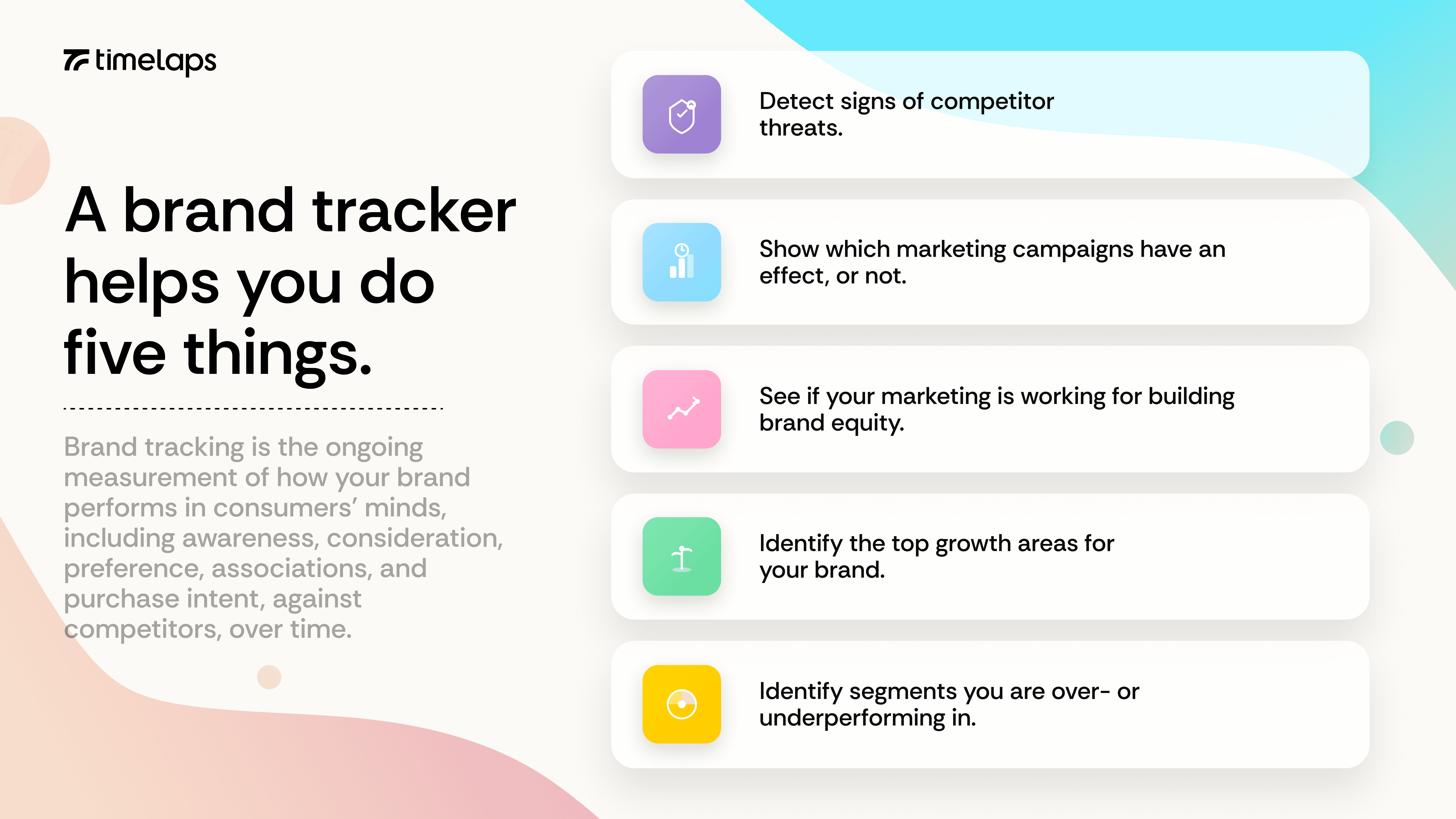
Practically, a good tracker helps you do five things:
See if your marketing is working for building brand equity.
Show how your brand is affected by category shifts and competitor activity, not just your own marketing
Identify segments you are over- or underperforming in.
Detect signs of competitor threats.
Identify the top growth areas for your brand.
Why is brand tracking important?
Brand tracking matters because brand is the only part of the marketing budget that doesn't come with an obvious ROI number attached. Performance marketing has ROAS. Demand gen has a pipeline. Brand marketing has… vibes, unless you measure it.
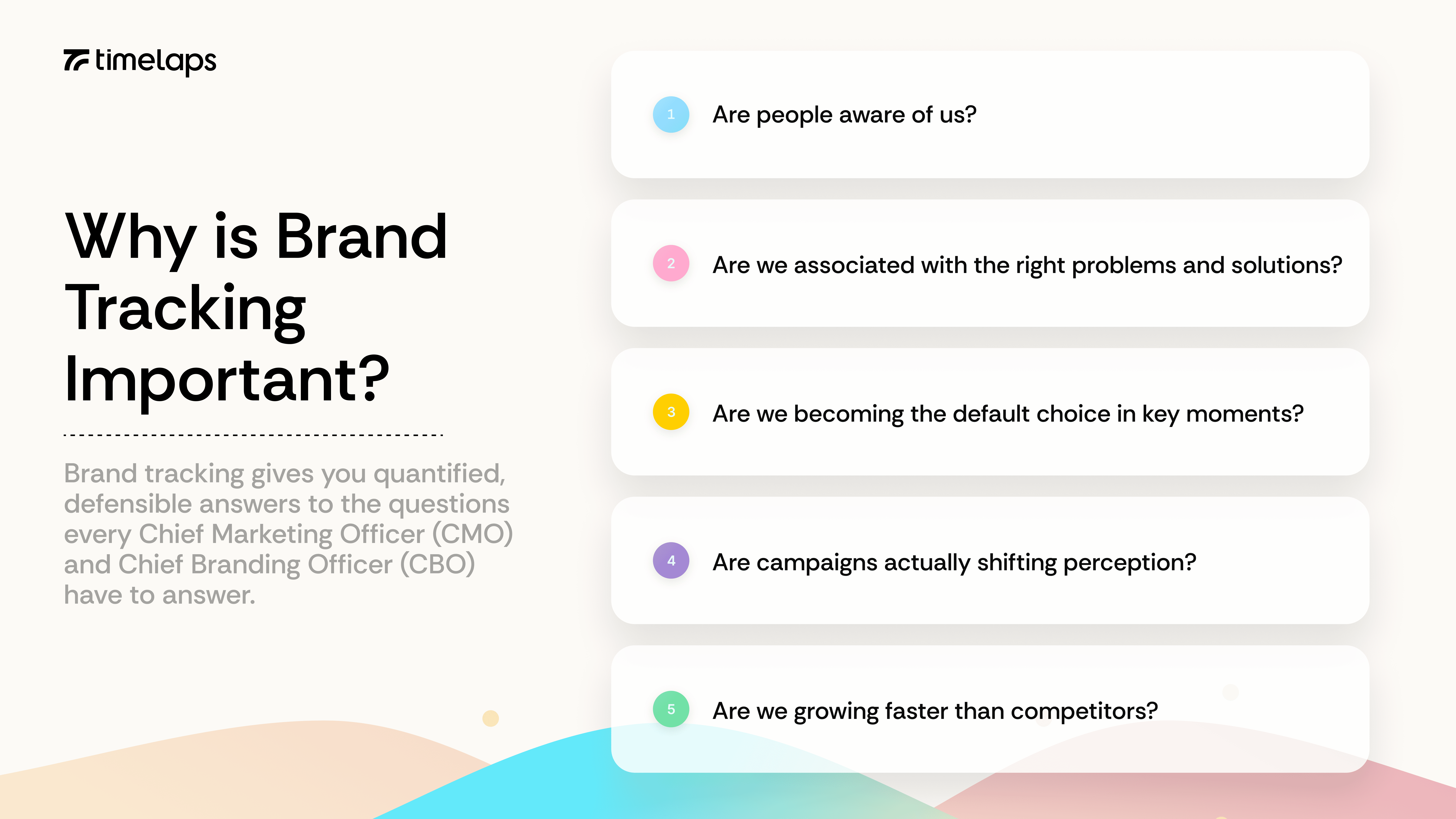
A tracker fixes that. It gives you quantified, defensible answers to the questions every Chief Marketing Officer (CMO) and Chief Branding Officer (CBO) have to answer:
Are people aware of us?
Are we associated with the right problems and solutions?
Are we becoming the default choice in key moments of the customer journey?
Are paid and PR campaigns actually shifting perception?
Are we growing faster than competitors in brand health?
Without a tracker, every one of those answers is a guess. With one, they're quantifiable metrics and actionable brand insights backed by data.
More importantly, brand tracking shows you what demand looks like before it shows up in sales figures. Revenue is the lagging indicator. Brand is the leading one.
By the time weakening brand equity shows up in your P&L, you've already lost 6-12 months of ground you didn't know you were losing. A tracker surfaces that signals early.
There's also the macro context. The CFO-CMO tension is at its sharpest point in a decade. Marketing budgets were the first thing cut in the 2023–2024 slowdown, and brand spend was the first thing inside marketing to go. Brand managers who could quantify their equity over time kept their budgets. Those who couldn't, didn't.
Who needs brand health tracking?
Brand tracking makes sense for organizations where brand equity is a meaningful asset.
It is especially powerful for companies where branding affects valuation, pricing power, or sales conversion in a way you can't fully capture through performance metrics alone.
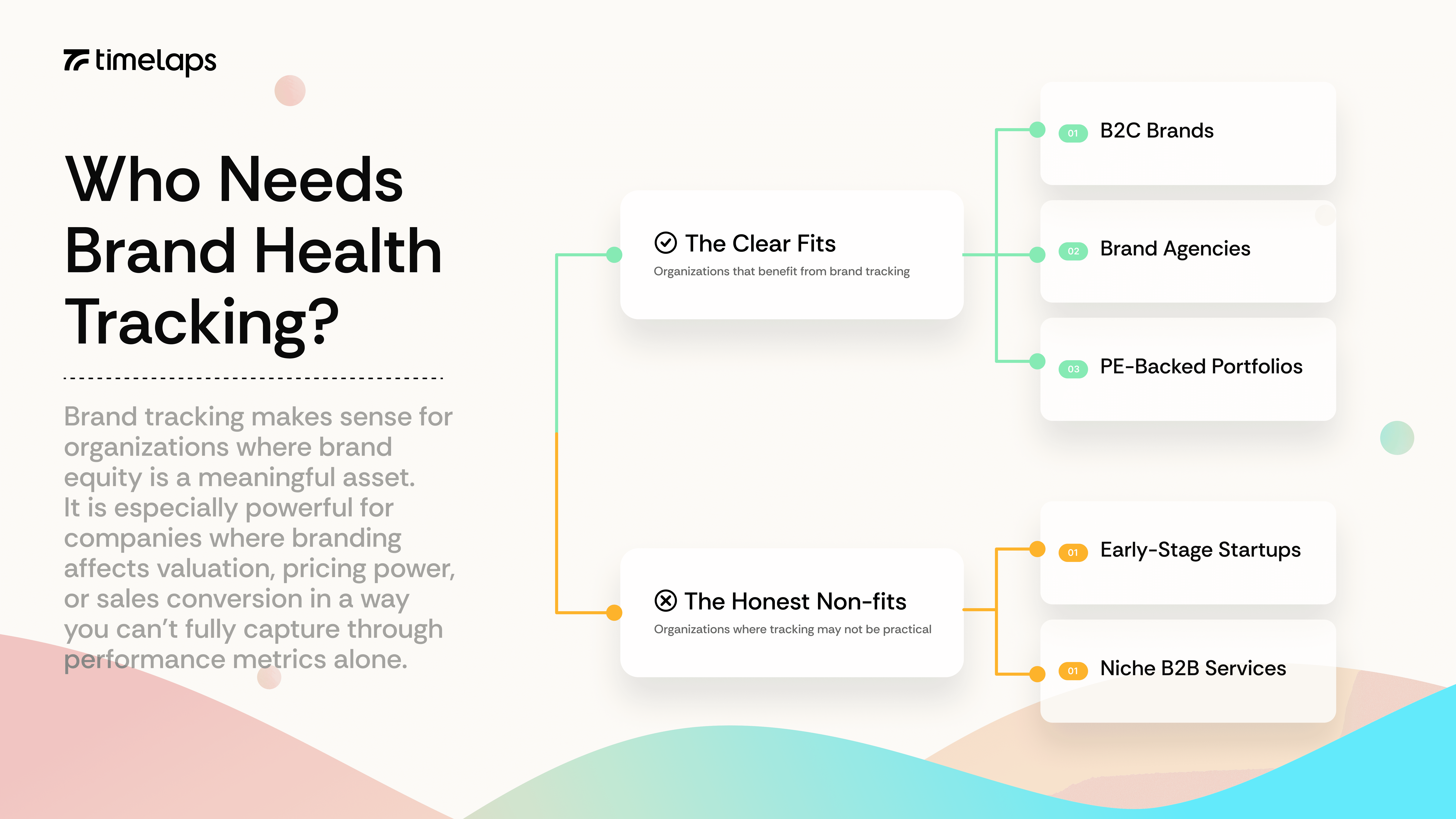
The clear fits:
B2C brands with discretionary brand marketing spend. CPG, DTC, retail, hospitality, QSR, consumer finance, telco, automotive. If your CMO has a brand budget and you have a branding or insights team, you NEED a tracker.
Brand agencies managing client brand health. Agencies that lead brand strategy for multiple clients need a consistent measurement layer across the portfolio. Shared methodology, shared benchmarks.
PE-backed portfolios where brand equity is a valuation lever. If a brand is part of the exit story, it needs to be measured.
The honest non-fits:
Early-stage startups without a brand budget yet. You don't need formal brand tracking research. You are not large enough for customers in your category to “know how you are.” There are other solutions that we would recommend if branding is important to you.
B2B infrastructure and institutional services because these categories operate in a niche, high-trust, and long-cycle environment. Decision-makers of the target audience are hard and expensive to reach. Volume would also be too small to obtain a representative sample. Standard survey panels (which serve more B2C brands) have difficulty accessing niche, senior-level personas, leading to low response rates, high cost per response, and statistically insignificant results to draw meaningful conclusions.
Key metrics in a brand tracker.
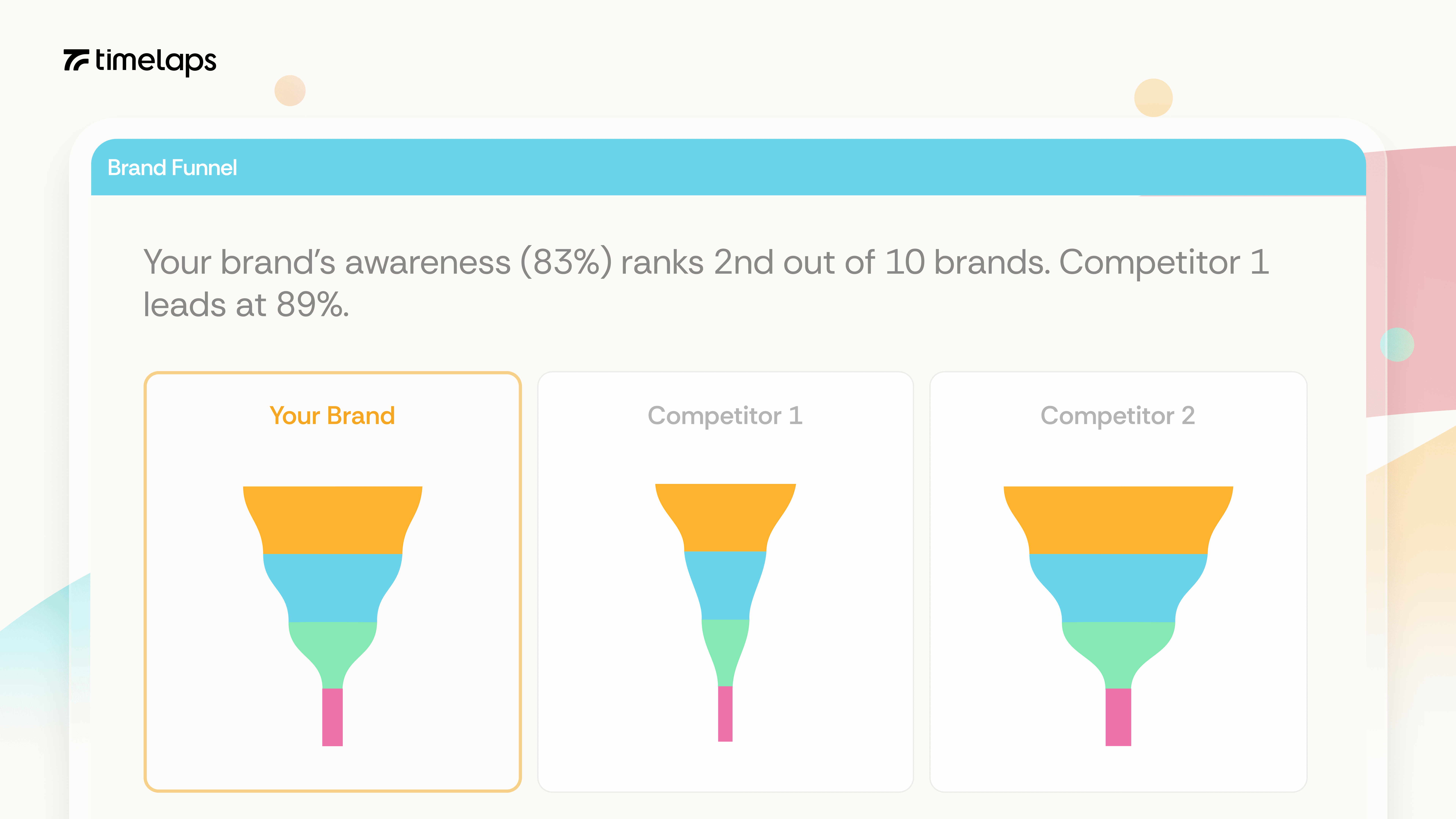
A brand tracker measures the full funnel and more. The traditional metrics are the tried-and-tested measures that trackers have been measuring for decades. The modern metrics after them are where the category is actually moving, and where most legacy trackers haven't caught up.

Traditional funnel metrics.
Awareness is the discovery phase. Can people recall or recognize your brand? This can be measured in unaided awareness ("name a brand of [category]") or aided awareness ("have you heard of [brand]?").
Consideration is the research phase. Consideration measures whether people would actually consider buying your brand once they are aware of you. This is where customers recognize a need and actively evaluate your brand against competitors.
Conversion is the action phase, where a customer decides to buy, subscribe, or sign up.
Loyalty moves to the retention phase. The focus shifts from acquiring a customer to keeping them satisfied and encouraging repeat purchases. If they had to pick one brand in the category, would it be yours?
Advocacy is the pinnacle of the customer journey. Loyal customers become enthusiastic fans who actively promote your brand. It captures whether existing customers would recommend your brand. An example metric is NPS (Net Promoter Score), which remains one of the most-used cross-category metrics.
Diagnostic Metrics.
Diagnostic measures are deeper metrics that cover more areas of brand health and attempt to answer why the main metrics are moving.
Brand associations are the classic diagnostic layer in trackers: do people associate your brand with the right qualities?
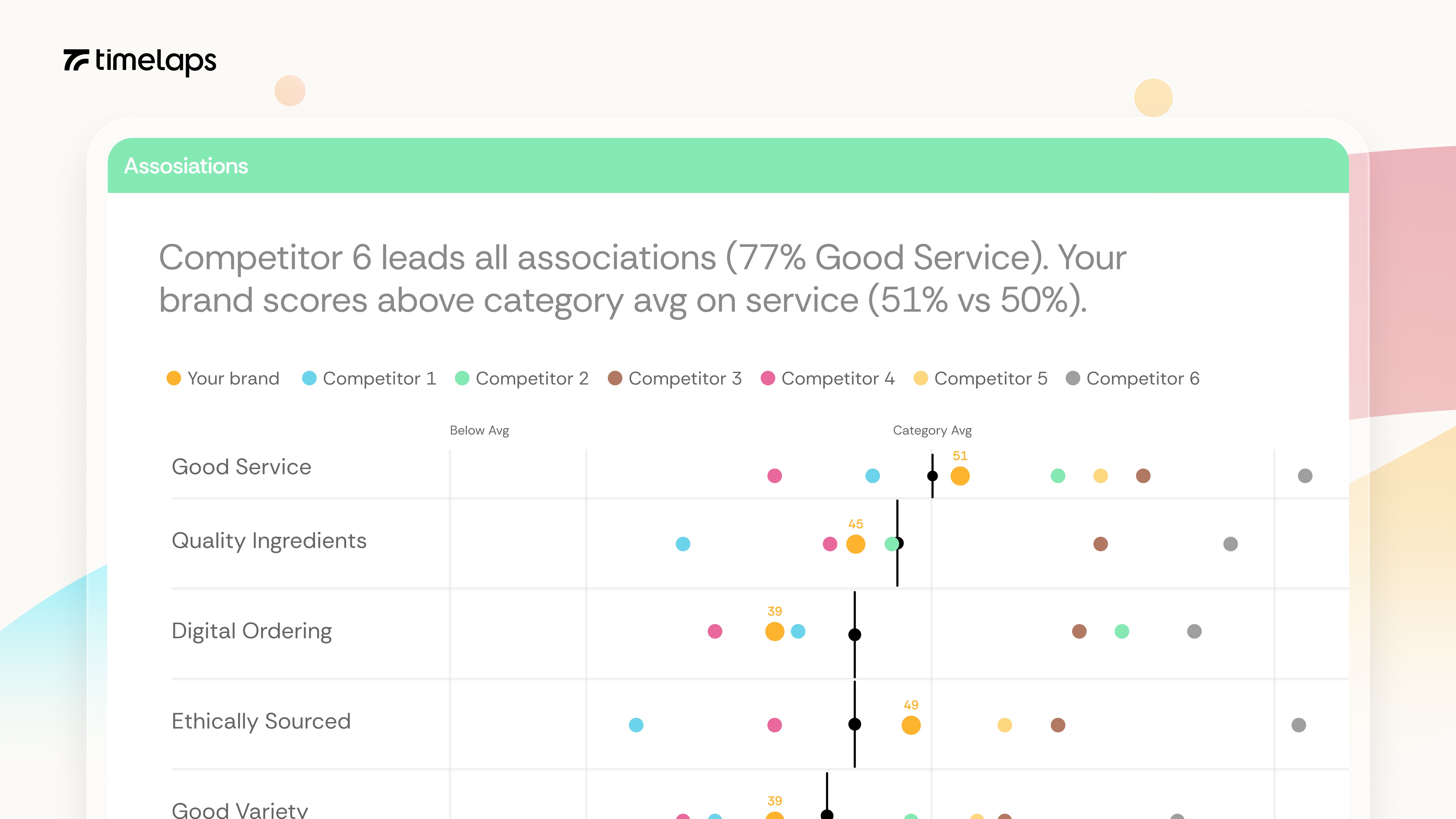
Associations. Brand associations are the classic diagnostic layer in trackers: do people associate your brand with the right qualities? A modern tracker measures associations across attributes that matter for your category, such as premium, trustworthy, fun, expert, accessible, innovative, and benchmarks each one against direct competitors. Awareness tells you who knows you. Associations tell you what they think when they know you. A brand with 60% awareness as "the cheap one" is in a structurally different position than a brand with 60% awareness as "the premium choice." Same number, completely different P&L. Associations are also what events, sponsorships, and creative campaigns are designed to move.
Conversion. A modern brand tracker reports the conversion rates between funnel stages: awareness to consideration, consideration to recent purchase, and recent purchase to preference. This turns the funnel from a snapshot into a diagnostic. A brand with strong awareness but weak awareness-to-consideration conversion has a positioning problem. A brand with strong consideration but weak consideration-to-purchase conversion has a distribution or price problem. The conversion view is what tells you where in the funnel your brand is leaking.
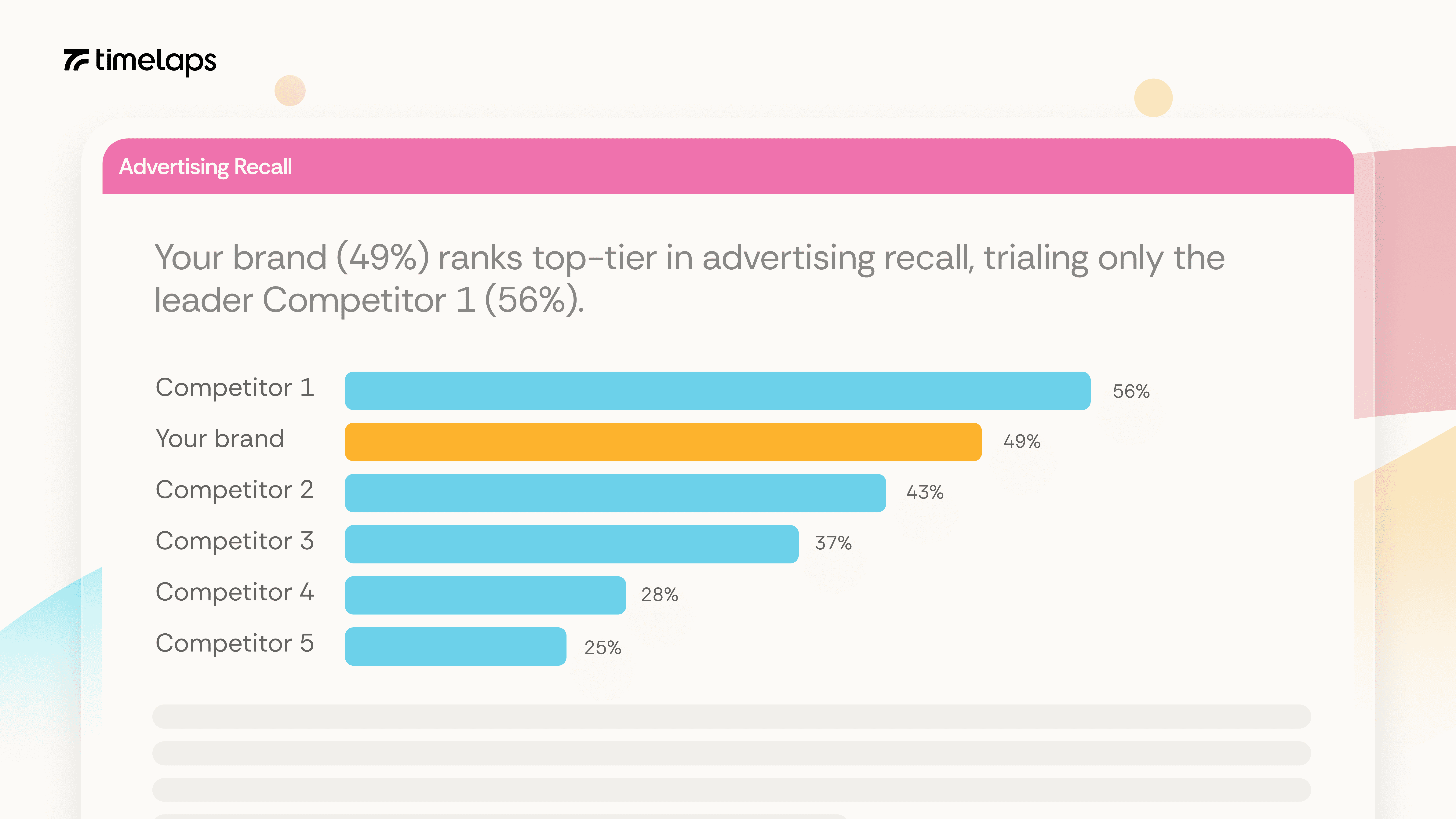
Advertising recall. Did people actually see and remember your advertising? Advertising recall is the cleanest proxy for whether your media investment is landing.
Word-of-mouth (WoM). The organic layer between advocacy and awareness. A good tracker measures what people have heard about your brand from someone else — positive, negative, or nothing. High positive WOM relative to ad spend means you're building equity efficiently. High "have not heard" means you're invisible in conversation. Negative WOM means there's a problem the funnel won't show. NPS tells you whether customers would recommend it. WOM tells you whether the market actually hears it.
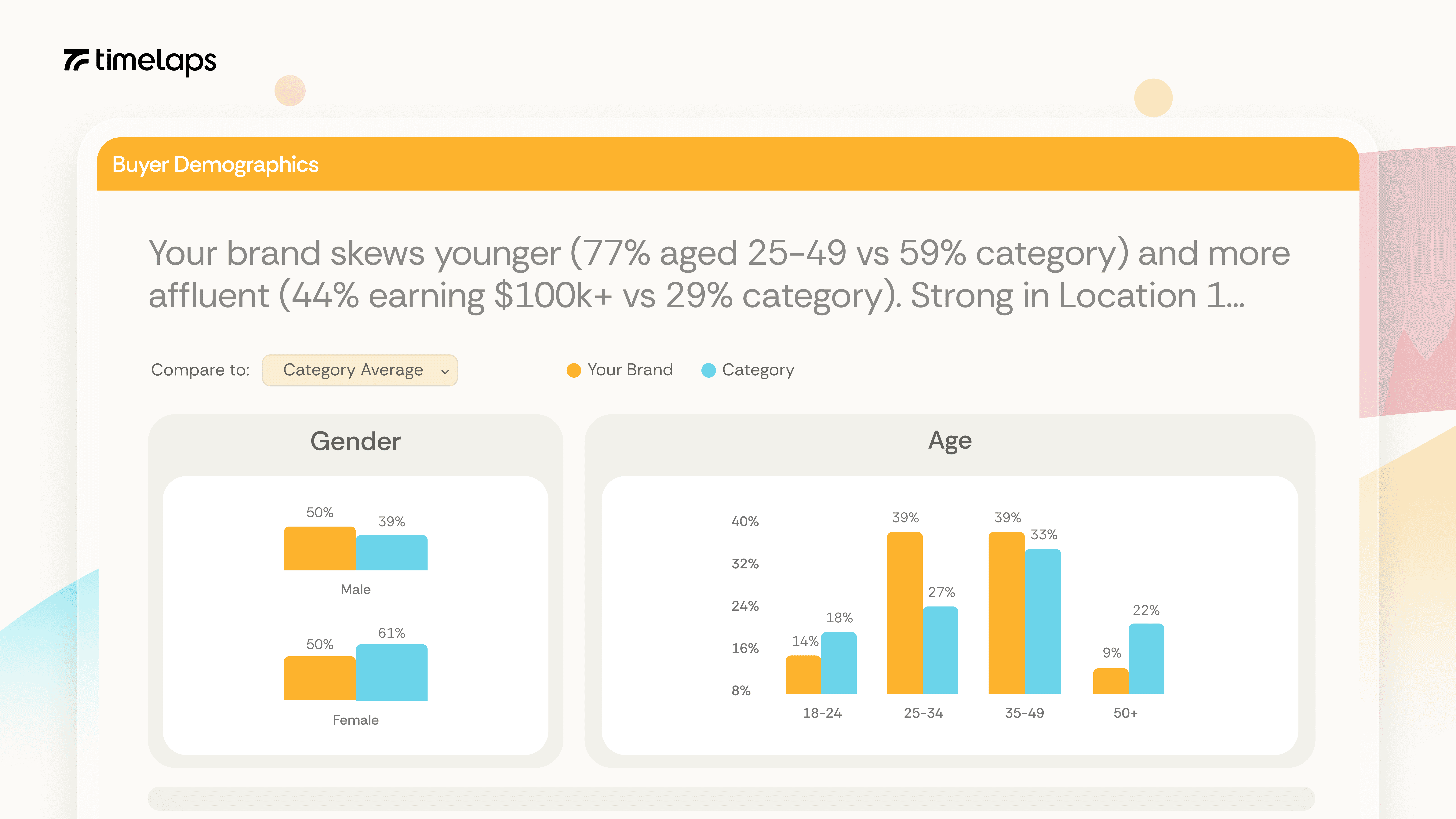
Buyer demographics. Audience composition for current buyers, compared against category baselines and competitors. Who is actually buying your brand? You will know their age, gender, geography, income, household composition, and how that audience profile diverges from the category average and other competitors.
Media indexing. Which channels does your brand's audience over- or under-index on versus the category? A brand whose audience over-indexes on AI chatbots needs a different media mix than one whose audience lives on traditional TV.
Modern brand tracking metrics.
The traditional metrics tell you whether your brand is getting stronger. A modern brand tracker in 2026 can bring measurement to the next level, providing actionable insights that drive decision-making.
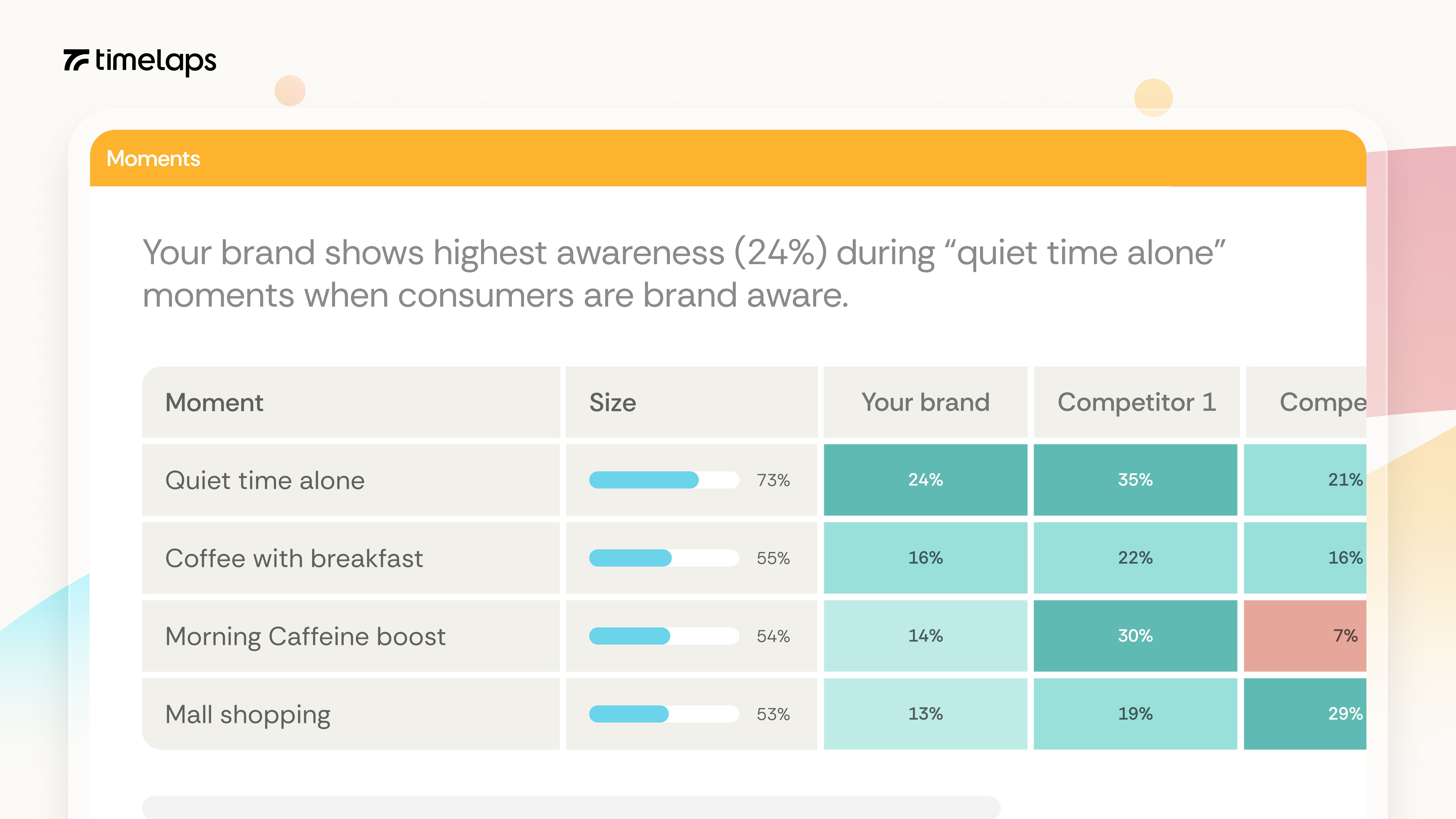
Moments (Category Entry Points). Arguably, the single most actionable metric added to brand tracking in the last decade. Moments, or category entry points, the term coined by Byron Sharp and Jenni Romaniuk at the Ehrenberg-Bass Institute, refer to the needs, contexts, and occasions that trigger category thinking.
A coffee brand, for example, would include moments such as "quiet time alone," "morning caffeine boost," "socializing," "road stop," and dozens of others. A modern tracker measures which moments consumers associate with the category overall (category moment size) and which ones each brand is winning or losing.
Awareness tells you if people know you. Moments tell you when they think of you (win!) and when they don't (lose!), compared to competitors. Monitoring how the metrics change over time is key to answering the question: Is our brand strategy working?
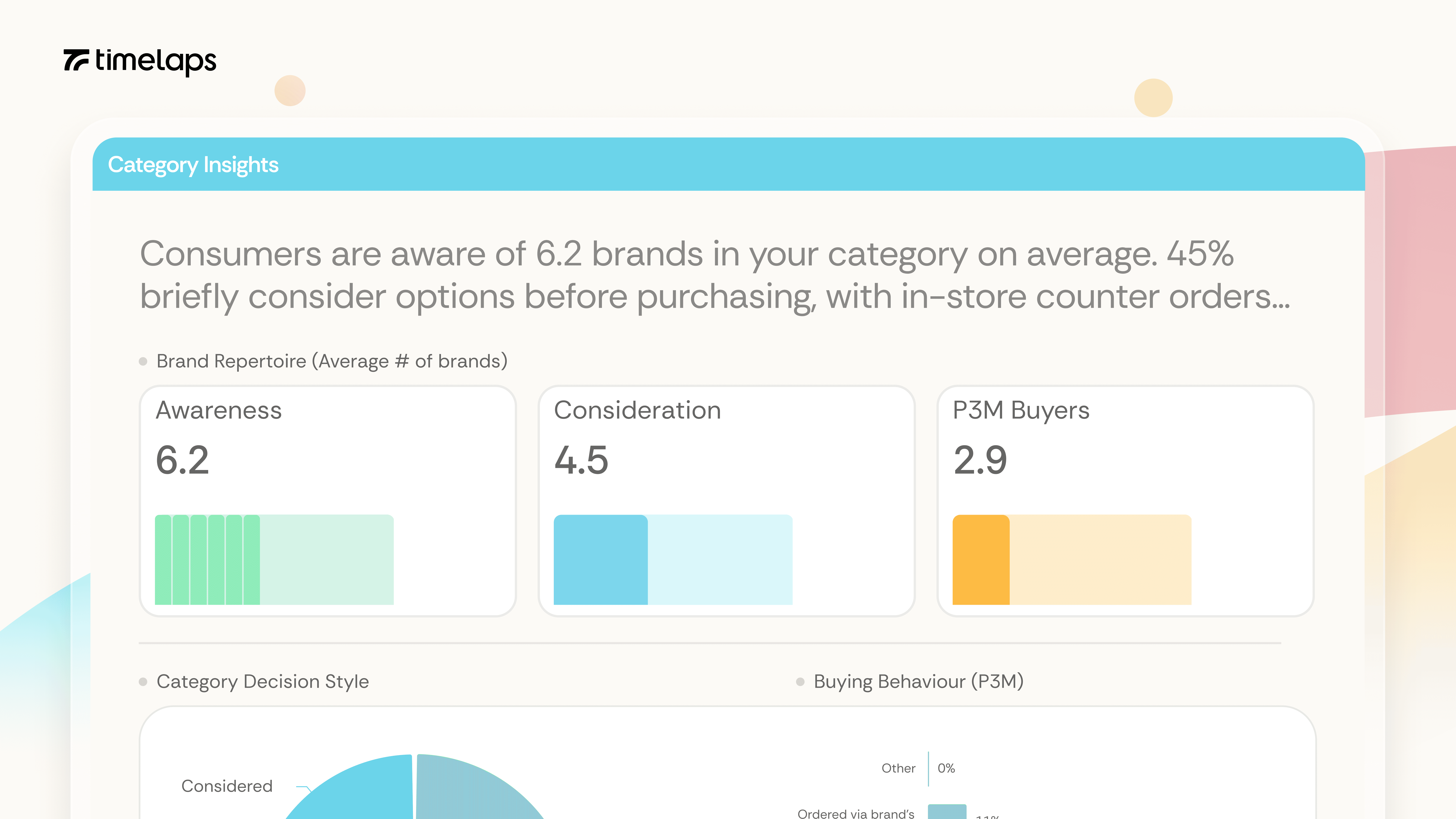
Category insights. The context layer that gives every other metric meaning. A good tracker measures the shape of the category itself: how many brands the average consumer is aware of (brand repertoire), how the category is purchased (automatic vs. briefly considered vs. deeply considered), and which channels dominate (in-store, delivery app, drive-through, direct-to-brand). Without this context, you're looking at your brand's awareness score in isolation. With it, you know whether a 40% awareness number is a ceiling or a baseline.
Brand tracking vs. social listening.
If you have searched “what is brand tracking” or “what is a brand tracker” on Google, Reddit, AI chatbots, or other platforms, you might have noticed that the three terms get used interchangeably.
They shouldn't. Brand tracking is very different from brand monitoring and social listening. Mistaking one for the other could be one of the most common and most expensive mistakes.
Brand Tracking | Social Listening | |
|---|---|---|
What it measures | Awareness, perception, preference, etc., in representative samples of your category | Unstructured conversation about your brand or category online. |
Data Source | Survey responses collected from a representative group of category consumers | Public social, forums, news, blogs. |
Sample | Representative, weighted, controlled, often census-matched. | Census of public conversation. |
Time horizon | Longitudinal (weeks to years). | Real-time. |
Primary question it answers | Is my brand strategy working (i.e., getting better)? | What are people saying about my brand? |
Typical buyer | Brand and insights executives / managers. | Social media managers. |
What it can't do | React immediately. | Tell you what the silent majority (non-posters) think and do. |
The trap is that monitoring and listening tools are cheaper and feel faster, so brand managers get pressured into treating them as brand tracking.
They aren't. A social listening tool can tell you that 10,000 people posted about your rebrand. It cannot tell you whether the 100 million people who didn't post now think better or worse of you. Only a brand tracker using a survey-based methodology with a large, representative enough sample can confidently.
For a full comparison, check out our new article: "Social Listening vs Brand Tracking: Why Social Listening Tools Measure the Wrong Things."
How brand tracking works: methodology.
This section is for the buyers who've read ten "what is brand tracking" articles and still can't tell the difference between two solutions or service providers. One of the primary differences (the other is the metrics they track / features they include) is almost always the methodology.
Sampling. The single most important variable. A tracker is only as good as the source it samples from. Look for keywords like representative sampling against census demographics (i.e., census matching) and quota controls for age/gender/region/income. Convenience samples from one-off survey panels can give you precise numbers about the wrong people.
Question consistency. The metrics only mean something if the questions don't change. Research-grade trackers could allow custom question handling upfront but would recommend locking question wording wave-to-wave. If your vendor "optimizes" question phrasing between waves, your trend data could likely be noise.
Cadence. Quarterly was the gold standard for two decades. Markets today move faster than a quarterly wave can detect, which means quarterly trackers miss the early signal on every campaign, crisis, and competitor move. Modern brand trackers can consistently track and report insights on a monthly basis.
Data quality and fraud detection. Panel fraud is the quiet epidemic of the online research industry. Bots, speeders, straight-liners, and increasingly LLM-generated responses. Any tracker worth paying for has active fraud detection, quality-control trap questions, and advanced data cleansing algorithms, not just CAPTCHA.
Latest in brand science. Most dashboards still report awareness and consideration as if it's 2010. The real edge in brand science over the last decade has moved to category entry points (the moments, needs, and contexts that trigger category thinking) and mental availability, frameworks from the Ehrenberg-Bass Institute that are genuinely actionable in a way top-of-funnel metrics aren't. Modern trackers should surface which CEPs your brand is winning, losing, or missing entirely. If your tracker can't tell you which moments your brand gets considered in, you're measuring a lagging indicator of a lagging indicator.
For a deeper dive on the technical aspects, check out our ultimate guide on brand tracking methodology: "Brand Tracking Methodology: Survey, Panel, and Sample Size (2026)."
How often should you track your brand performance?
Over the past few decades, quarterly or biannually have been considered as the standard. According to Hanover Research, 82% of companies still conduct brand tracking studies twice a year to capture market changes. The industry benchmark practice in the past is now considered increasingly risky by modern marketers, especially in the AI era.
A common issue with tracking too infrequently is the delayed visibility into the overall brand health while investing in various campaigns. A major consumer brand client of Timelaps recounted their experience working with a leading market research agency: “We are expecting the next PPT in the coming month (March 2026), but the fieldwork was done online last August (6 months ago).”
For most consumer brands, biannually or even quarterly is outdated. Monthly is the new baseline. “Always-on” (or "continuous") is the competitive standard to track changes over time.
Cadence | When it fits | When it fails |
|---|---|---|
Annual | Low-velocity categories (B2B infrastructure, some institutional services). | Anything consumer-facing. You'll miss every campaign window and competitor move. |
Quarterly | Legacy default, still defensible for stable categories with predictable seasonality. | Fast-moving CPG, DTC, anything with active campaigning. Quarterly data can't detect a 6-week trend. |
Monthly | The 2026 default for fast-growing incumbent or challenger B2C brands. | When you need to measure a campaign that only runs for 4 weeks. |
How much does brand tracking cost?
Real numbers, because nobody in this category wants to publish them.
Tracker type | Typical annual cost | What you get | Hidden costs |
|---|---|---|---|
Legacy agency trackers (e.g., Kantar, Ipsos, Nielsen custom) | $100K – $500K+ | Custom study, quarterly deliverable, senior researcher time, bespoke methodology. Designed to make it hard to switch. | Long lead times, low speed to insight, change requests billed hourly. |
Enterprise research platforms (e.g., Qualtrics, YouGov custom) | $60K – $450K+ annual license | Self-service platform access, panel access often separate. | Internal researcher headcount ($120K–$180K/year per person); usually 1–2 FTEs to run the tracker properly. This is the line item few organizations budgets for, yet it often exceeds the license cost. |
Always-on, done-for-you, SaaS trackers (e.g., Timelaps, Tracksuit, Latana) | $10K – $60K/year per market | Always-on dashboard, customizable framework, built-in panel, fast setup. | Varies heavily by the market and category (some markets and categories are much harder to get quality panels), number of respondents, size of competitor set, and features. |
DIY survey tools (e.g., SurveyMonkey, Typeform + own panel) | Under $10K | Survey distribution only | All methodology, sampling, weighting, and analysis is on you; often costs more in internal time than it saves in license fees. |
The legacy agency price point is what most brand and insights managers are comparing against when they shop for a tracker.
Many companies want to build “internal capability” by trying to do everything in-house and opting in the enterprise platform route. The real cost is hiring researchers and associates to run it, plus the ongoing admin load (survey programming, weighting, reporting, QA) and human errors. It's the same problem as buying Salesforce and then needing to hire three specialists to actually use it.
For Timelaps' pricing, see our pricing page. For a full breakdown of what brand tracking costs across categories and buying patterns, see our dedicated brand tracking cost guide.
AI's role in brand tracking market research.
While there are still use cases where the AI application is still nascent, high-quality research is significantly more affordable and accessible in 2026 compared to decades ago.
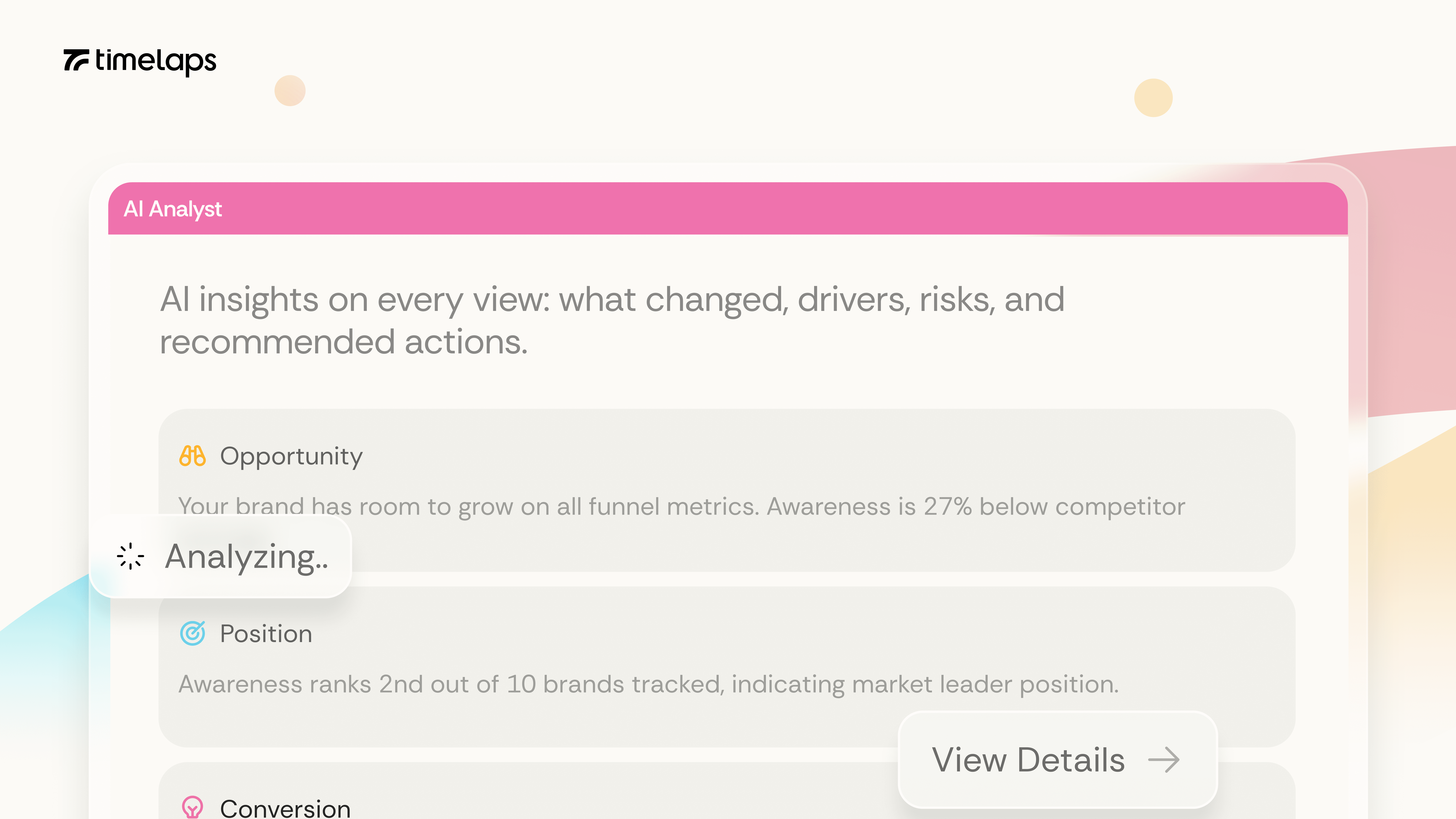
What used to take a traditional tool and research teams months and six- or seven-figure budgets to deliver is now possible in days with the right use of modern tools.
Workflow step | What AI does reliably now | Why it matters |
|---|---|---|
1. Survey design | Acts as a co-design partner with an experienced researcher, surfacing question variants, stress-testing wording for ambiguity and bias, suggesting CEPs to include or cut, generating respondent personas to pressure-test the survey before it ships. Adaptive survey design powers dynamic routing inside the survey itself, so respondents skip irrelevant blocks and total length drops without losing signal. Also handles dynamic translation across markets. | Compresses what was a two-week survey-design cycle into an afternoon.. Adaptive routing improves completion rates and reduces respondent fatigue, both of which directly improve data quality. |
2. Panel recruitment | Operational lift across the recruitment funnel: automating incentive disbursement and qualification logic, targeted recruitment that fills hard-to-reach demographic quotas, behavioral fingerprinting that detects duplicate respondents across multiple panels. | Unglamorous, invisible work, and it's where most of the actual time savings at this step live. |
3. Data cleaning and visualization | AI can be critical in the cleaning step, automating a series of rigorous quality checks. Examples include: Speeder and straight-liner detection at scale. Detection of LLM-generated responses. Cross-wave consistency checks. | Anyone who's worked in the insights industry knows the pain: data cleaning is repeating the same routine process over and over again, and slide formatting is artisanal busywork. |
4. Reporting and sharing | Self-updating dashboard that auto-refreshes as data comes in - easily shareable with colleagues. If needed, traditional formats like PowerPoint and PDF can also be generated automatically based on an uploaded brand guideline (logo, palette, typography). | One of the most underestimated AI steps in brand tracking. |
Frequently asked questions
What is brand tracking, and why is it important?
Brand tracking is the continuous measurement of how consumers perceive, remember, and choose your brand compared to competitors. A brand tracker surveys representative audiences of the category continuously over time, measuring metrics such as brand awareness, brand consideration, brand preference, and brand associations, producing charts and analyses that show whether your brand marketing is working.
The right brand tracking can help companies measure brand health to make data-driven decisions and justify spend that drives long-term growth and competitiveness. With these insights, companies can evaluate the impact various marketing strategies have on the overall brand's health.
How does brand tracking work, including its process and methods?
Brand tracking works by surveying representative samples of a target audience on a repeating cadence (e.g., biannually, quarterly, monthly, etc.) using consistent question wording across waves. The standard process is: define competitive set and metrics, design the survey, recruit a representative panel, run field work at a fixed cadence, clean and weight the data, analyze trends and visualize findings, then report findings to stakeholders in desired formats. The methodology relies on consistent questions, fraud detection, and longitudinal sampling so that wave-on-wave changes reflect real shifts in consumer perception, not noise.
What are the key metrics and KPIs used in brand tracking?
Traditional brand tracking measures overall health through metrics like brand awareness, consideration, purchase intent, and brand associations. While these metrics are essential for answering whether people know and like your brand, they only provide a static snapshot of brand image.
Modern brand tracking moves beyond the baseline to tell you exactly why and where your brand is winning or losing. It introduces actionable diagnostics like Moments (Category Entry Points) to show exactly when consumers think of you, alongside full-funnel conversion rates, deep category context, and advertising recall. By analyzing organic Word-of-Mouth and media indexing, modern tracking turns that static snapshot into a strategic roadmap that proves if your brand marketing is actually working.
What are the benefits of brand tracking studies?
Brand tracking studies give marketing a quantified, defensible answer to three questions every CMO has to answer: is our brand getting stronger, how do we compare to competitors, and did our last campaign actually work? They reveal early signals of brand performance before they show up in sales, identify segments where the brand is over- or under-performing, detect competitor threats, and protect brand budget during downturns. An econometric study of 135 international companies found every $1 increase in brand value correlates with a $1.76 gain in turnover.
How often should brand tracking surveys be conducted?
Most B2C brands should track monthly at a minimum, with always-on tracking preferred for active categories like CPG, DTC, retail, and QSR. Quarterly tracking (the legacy default) now misses too many campaign windows and competitor moves to be reliable for fast-moving brands. Annual tracking is only defensible for very slow-moving categories like B2B infrastructure or institutional services. The right cadence depends on category velocity and marketing activity intensity: more of either pushes you toward higher-frequency tracking.
What is the difference between brand tracking, brand monitoring, and social listening?
Brand tracking measures consumer perception via structured surveys of representative samples in a controlled setting, producing longitudinal trend data on metrics such as awareness, consideration, preference, and more.
Brand monitoring captures mentions of the brand across owned, earned, and paid media channels, most notably reviews, news, and direct mentions.
Social listening analyzes unstructured public conversation on social platforms and forums.
Tracking tells you whether brand perception is shifting across customers in your category. Monitoring tells you whether anyone is talking. Social listening tells you what the vocal minority says (but not the silent majority).
What is the difference between brand tracking and brand audit?
Brand tracking is a continuous measurement that runs on a recurring cadence, producing trend data over time. Brand audit is a one-off diagnostic snapshot conducted at a specific moment, typically before a rebrand, repositioning, or major strategic decision.
What are some common brand tracking tools and software?
Common brand tracking platforms include legacy agencies (e.g., Kantar, Ipsos, Nielsen), typically priced $100K–$1M+ per year for custom studies, enterprise toolings (e.g., Qualtrics) at $100K–$450K+ in licensing plus internal researcher salaries, and done-for-you SaaS trackers (e.g., Timelaps, Tracksuit, Latana, Bera) at $10K–$60K per market per year. DIY survey tools (e.g., SurveyMonkey, Typeform) can run trackers under $10K but require all methodology and analysis work to be done in-house. We evaluated the best brand tracking tool for 2026 in this topic deep-dive article.


