
Brand Tracking Methodology: Survey, Panel, and Sample Size (2026)
-
10
mins read



Authored: Jun. 2026. Last updated: Aug. 2026.
Written by Henk Pretorius and Harry Zhang, cofounders of Timelaps.
Brand tracking methodology is the recurring research process used to measure brand health over time. Five data collection methods dominate: customer surveys, social listening, search traffic, sales analytics, and AI-moderated interviews. But only one of them, survey-based tracking on a representative sample, can measure the people who haven't yet bought, searched, or posted, at the reach and depth tracking required and at an economical cost per respondent. For a top-line read, about 1,000 representative responses are enough; serious always-on trackers field roughly 4,000 per category per year, so the data still holds up after subgroup filtering.
What is brand tracking?
Brand tracking measures a brand’s health. It analyzes how consumers in your category perceive, remember, and choose a brand, compared to its competitors, over time.
Key metrics include brand awareness, brand preference and association, advertising recall, and buyer demographics. Large enterprises and academic institutions field survey-based programs at a sample size of at least 1,000 people. If you're new to brand health tracking, we covered the basics in our 2026 guide to brand tracking.
What is brand tracking methodology?
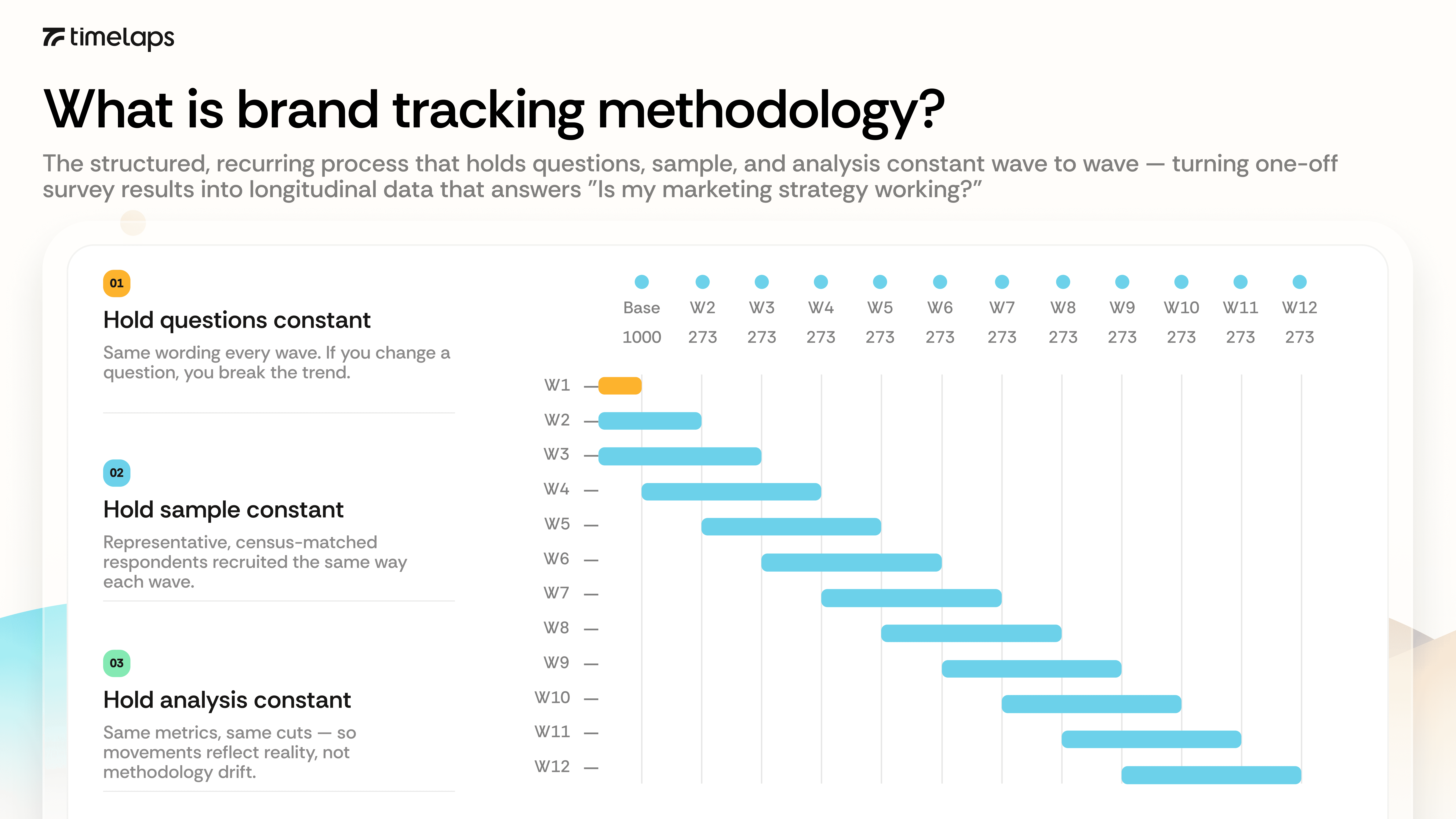
Brand tracking methodology is the structured, recurring research process used to measure brand health over time. By holding the questions, sample, and analysis constant from one wave to the next, it turns one-off survey results into longitudinal data with representative and controlled samples that show whether a brand is growing, holding, or slipping, and answers the question: “Is my marketing strategy working?”
What are the components of a brand tracking methodology?
A brand tracking methodology has four components: what you measure consistently, which metrics you track, how you clean and analyze the data, and how you collect it.

1. Consistent measurement.
The cornerstone of a tracking survey for brand tracking is the consistency of measurement. The same questions, the same scales, the same sampling quotas, fielded at the same intervals (monthly, quarterly, bi-annually, or continuously). Without this, you don't have a trend. Instead, you have a sequence of unrelated studies.
As Dr. Saeideh Bkhshi, researcher at OpenAI and former methodologist at Meta, stated in the article “Survey Research in Practice”:
“The discipline of a tracker is stability. The same instrument, fielded the same way, to a comparable population, with the same mode, at a regular cadence. Every change to any of those is a confound for the trend you’re trying to read.”
As the hypothetical chart below shows, a wording edit between waves (Q1 to Q2 2024) can move the relevance score by more than six points, making it seem as though there is a significant “trend” in place when the real change could be very subtle.

Source: Dr. Saeideh Bkhshi, “Survey Research in Practice” (2026)
2. The core metrics.
A standard tracker measures how consumers move through the buyer's journey, often visualized via a brand funnel: brand awareness, consideration, usage, preference. Some would incorporate diagnostic metrics like association, advertising recall, word-of-mouth, and demographics.
Among all, the most actionable set of metrics, in our view, is Category Entry Points (CEPs, we call them “moments”), coined and developed by Professor Jenni Romaniuk and Professor Byron Sharp at the Ehrenberg-Bass Institute for Marketing Science. CEPs measure the moments that prompt consumers to recognize a need and explore options to buy within a specific product or service category. Timelaps’ ‘Scale’ plan includes detailed modules on Category Entry Points.
3. Data cleaning and analytics.
Raw survey responses aren't research. A research methodology includes cleaning of fraudulent and low-quality responses, weighting to correct demographic skew, and running through statistical analyses.
4. Data collection.
When researchers discuss brand tracking methodology, most focus on data collection: where the responses actually come from. Five sources dominate modern brand tracking: customer surveys, social listening, search traffic & AI visibility, sales analytics, and AI-moderated interviews.
What are the main types of data collection methods?
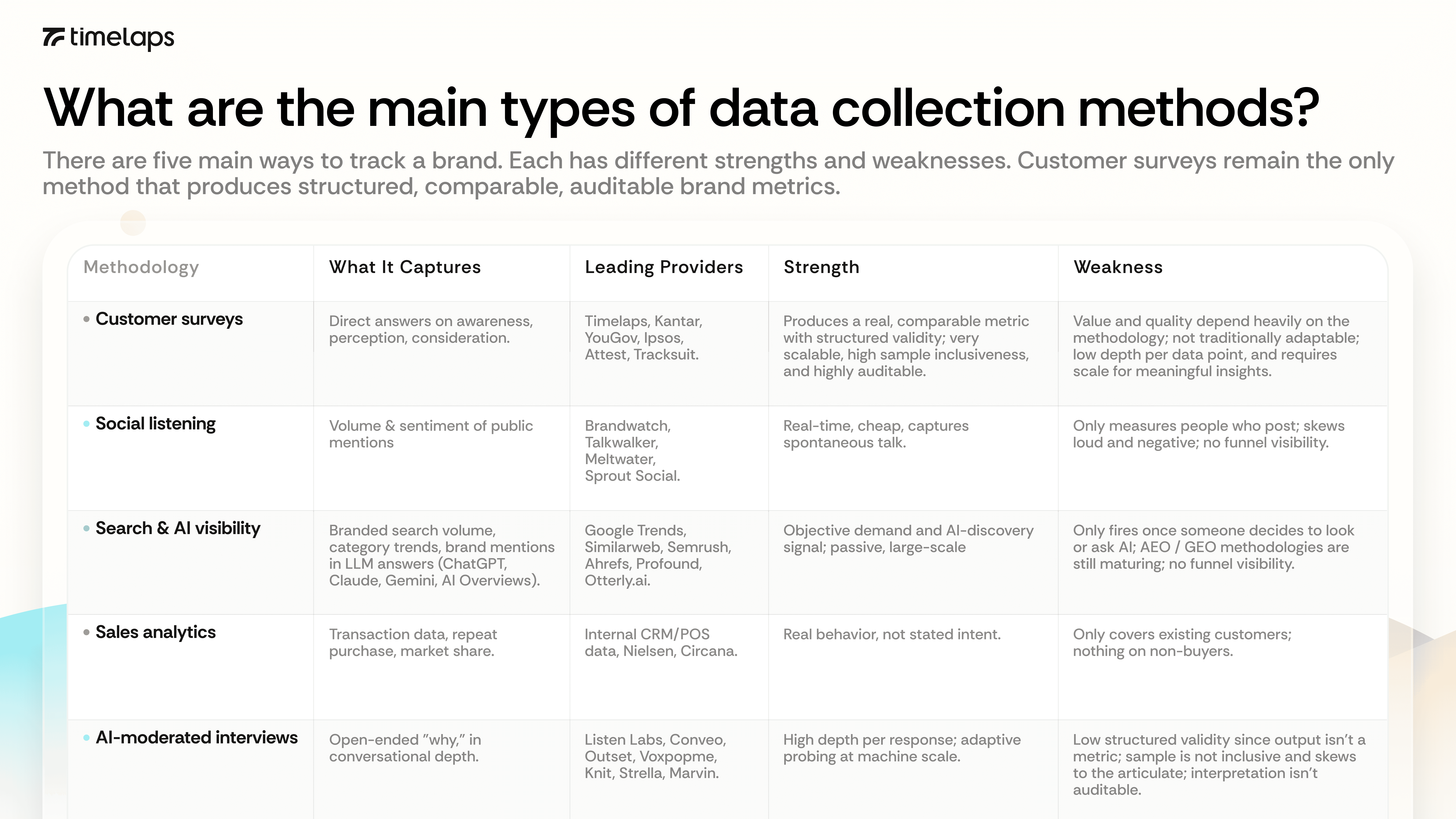
There are five main ways to track a brand. Each has strengths and weaknesses.
Methodology | What it captures | Leading providers | Strength | Weakness |
|---|---|---|---|---|
Customer surveys | Direct answers on awareness, perception, consideration. | Timelaps, Kantar, YouGov, Ipsos, Attest, Tracksuit. | Produces a real, comparable metric with structured validity; very scalable, high sample inclusiveness, and highly auditable. | Value and quality depend heavily on the methodology; not traditionally adaptable; low depth per data point, and requires scale for meaningful insights. |
Social listening | Volume and sentiment of public mentions. | Brandwatch, Talkwalker, Meltwater, Sprout Social. | Real-time, cheap, captures spontaneous talk. | Only measures people who post; skews loud and negative; no funnel visibility. |
Search traffic & AI visibility | Branded search volume, category trends, and brand mentions in LLM answers (ChatGPT, Claude, Gemini, AI Overviews). | Google Trends, Similarweb, Semrush, Ahrefs, Profound, Otterly.ai. | Objective demand and AI-discovery signal; passive, large-scale | Only fires once someone decides to look or ask AI; AEO / GEO methodologies are still maturing; no funnel visibility. |
Sales analytics | Transaction data, repeat purchase, market share. | Internal CRM/POS data, Nielsen, Circana. | Real behavior, not stated intent. | Only covers existing customers; nothing on non-buyers. |
AI-moderated interviews | Open-ended "why," in conversational depth. | Listen Labs, Conveo, Outset, Voxpopme, Knit, Strella, Marvin. | High depth per response; adaptive probing at machine scale. | Low structured validity since output isn't a metric; sample is not inclusive and skews to the articulate; interpretation isn't auditable. |
Why is survey (still) the only method for brand tracking?
As mentioned in the “What is brand tracking methodology” section, a brand tracker relies on tracking surveys. Consistency is the key to a tracking survey, a type of measurement survey that detects change over time. The key is “same instrument, same way, every wave.”
While the other four data collection methods each have a real role, they are still not the right fit for brand tracking tasks specifically.
AI-moderated interviews are adaptive in nature (method designed to ask follow-up questions, and produce more outputs drawn from the more articulated responses) and produce greater qualitative depth compared to traditional surveys. They are ideal supplements to a survey-based brand tracker but not a replacement.
Social listening only hears the vocal minority that posts publicly, skews vocal, extreme, and already engaged, and cannot capture the silent majority by nature. It’s very helpful for some categories (that naturally attract people to post) but not useful for the others.
Search traffic is honest but late. Branded search only fires once someone has decided to look you up. Analytical depth is also surface-level compared to survey results.
Sales analytics tracks real behavior rather than stated intent, but only for people who already buy. It says nothing about the non-customers you need to convert.
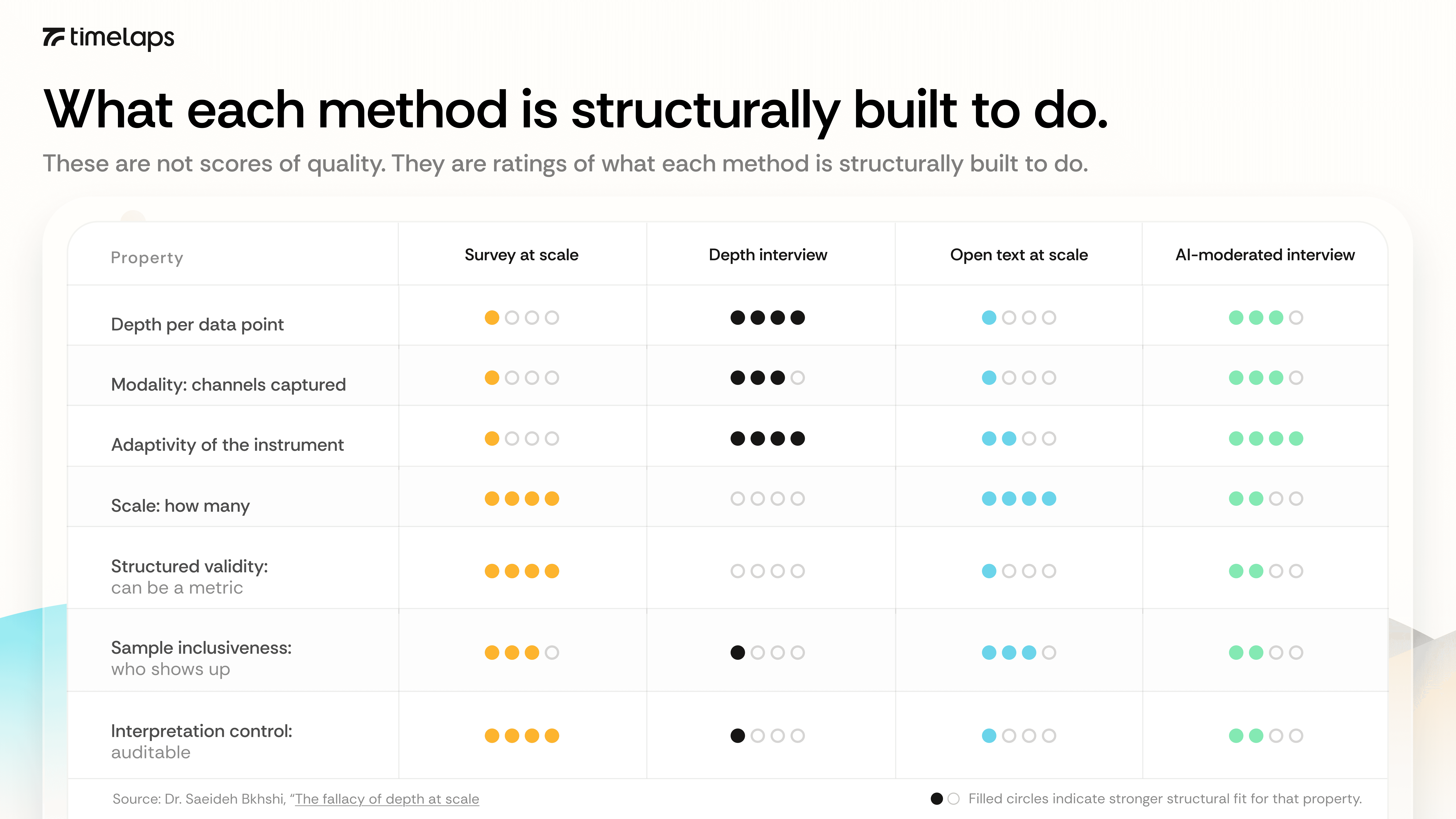
Source: Dr. Saeideh Bkhshi, “The fallacy of depth at scale” (2026)
Where do you find participants to fill out brand tracking surveys?
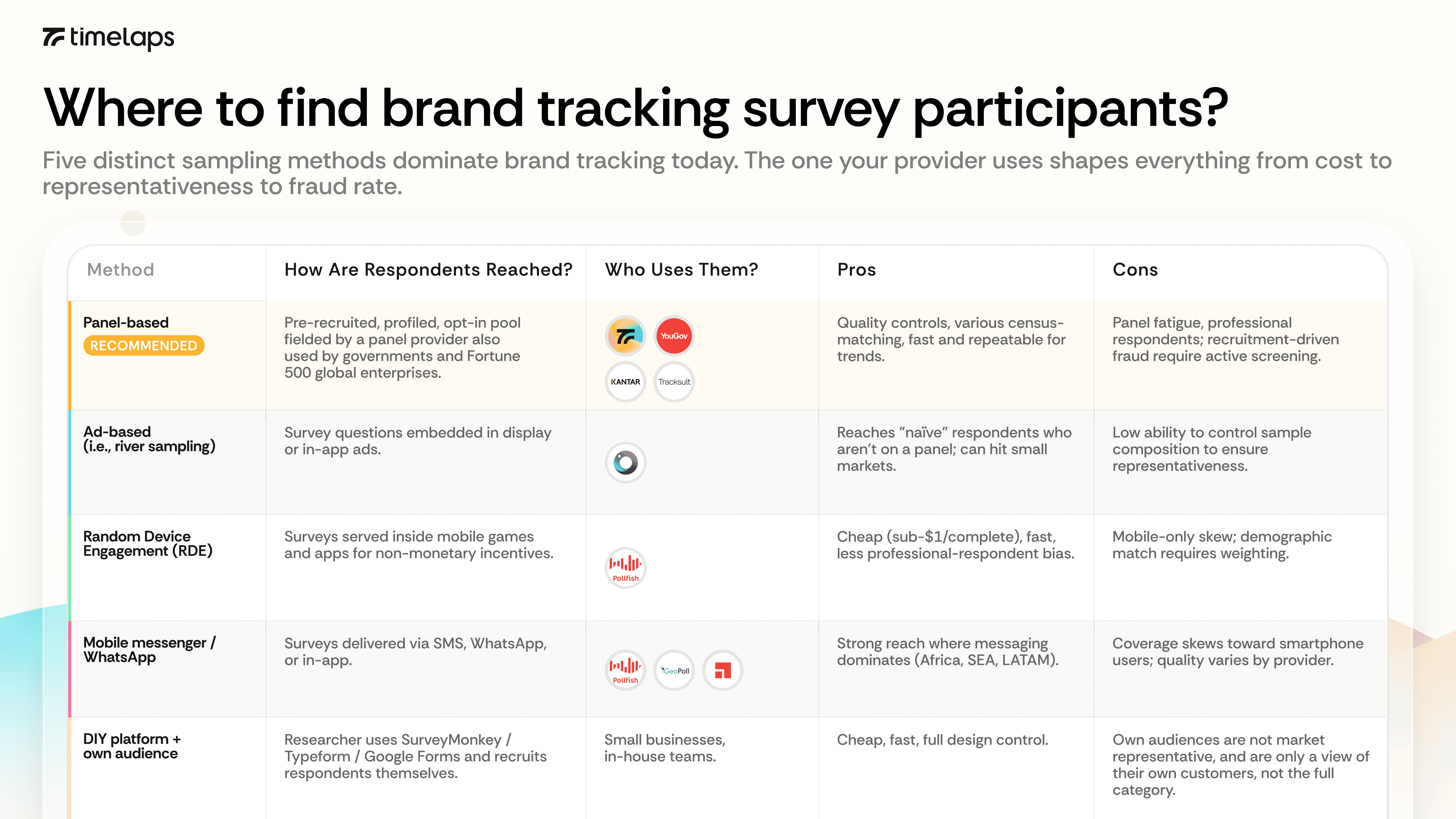
Now that we understand why brand tracking relies heavily on surveys, let’s talk about the participants. The answer to the question, “where do you find participants?” can produce drastically different data quality. Five distinct sampling methods dominate brand tracking today, and the one your provider uses shapes everything from cost to representativeness to fraud rate.
Method | How are | Who uses them? | Pros | Cons |
|---|---|---|---|---|
Panel-based | Pre-recruited, profiled, opt-in pool fielded by a panel provider also used by governments and Fortune 500 global enterprises. | Most serious trackers: | Quality controls, | Panel fatigue, |
Ad-based (i.e., river sampling) | Survey questions | Latana, some agency tools. | Reaches "naïve" respondents who aren't on a panel; can hit small markets. | Low ability to control sample composition to ensure representativeness. |
Random Device Engagement (RDE) | Surveys served | Pollfish, some DIY tools. | Cheap (sub-$1/complete), fast, less professional-respondent bias. | Mobile-only skew; demographic match requires weighting. |
Mobile messenger / WhatsApp | Surveys | Pollfish, | Strong reach | Coverage skews toward smartphone users; quality varies by provider. |
DIY platform + own audience | Researcher uses SurveyMonkey/Typeform/Google Forms and recruits respondents themselves. | Small businesses, in-house teams. | Cheap, fast, | Own audiences |
Panel-based data collection for surveys is the default for tracking for a reason. It's the only method where you can hold the demographic mix constant wave-over-wave, which is the prerequisite for a credible trend line. Ad-based and RDE are fast and cheap but lose representativeness without aggressive weighting.
Be skeptical of "we built our own panel" claims unless a provider can name their recruitment method, demographic management, and fraud controls. A panel that's actually just an email list isn't a panel. The economics of a panel are fundamentally different from those of market research software or an agency.
To assess panel quality, the right question to ask a provider isn't "do you use a panel," but "how do you reach respondents, how do you validate them, and how do you keep the demographic mix consistent over time?" Here’s the gold standard guide with 37 questions to help buyers to assess panel quality from ESOMAR (European Society for Opinion and Marketing Research).
In our recent article evaluating the best brand tracking tools for 2026, we emphasized panel quality as a core pillar in evaluating a brand health tracker.
Where does consumer data come from? A guide to understanding research panels.
What is a research panel?
A research panel is a managed pool of pre-recruited respondents who've agreed to take surveys in exchange for points, prizes, or small cash incentives. Good panels know each panelist's verified demographics, screen continuously for fraud and bots, and can field a representative sample on demand across hundreds of categories.
The major commercial panels in brand research:
Dynata: 60M+ panelists, AI-powered fraud detection. Used by enterprises like Amazon, General Motors, and JP Morgan Chase. Timelaps's primary panel provider.
Toluna: 70M+ panelists across 70+ countries; first-party panel with a proprietary fielding platform.
Cint: programmatic sample marketplace aggregating ~270M reachable respondents across third-party panels; acquired Lucid in 2021.
PureSpectrum: programmatic sample marketplace; sources first-party suppliers via automated routing across exchanges.
Prolific: ~200K active panelists; built for academic and behavioral research, used heavily in methodological studies.
Dalia: ad-based intercept recruitment via mobile and web ads.
Pollfish: Random Device Engagement (RDE) network; surveys served inside mobile apps for in-app rewards.
Why use a panel?
A few teams try to recruit their own respondents for every wave. It’s challenging and not recommended for smaller enterprises and most mid-market players for four reasons:
Representativeness. A panel maintains profiles on hundreds of millions of people and census-matches data on age, gender, region, and income. A self-recruited sample skews toward whoever you can reach: existing customers, social followers, or email subscribers. Insights generated from a skewed sample is naturally biased.
Speed. A panel can field a representative national sample in 24 to 48 hours. DIY recruitment takes weeks for the same sample, if it works at all.
Quality control. Reliable panel providers invest in fraud detection, attention checks, and professional-respondent screening at scale.
Trend continuity. Tracking depends on the same methodology month after month for years. Continuous panel management, such as adding new panelists, rotating tired ones, and calibrating across waves, keeps the demographic mix stable so trend lines stay comparable.
What does a panel cost?
Costs vary enormously by audience, market, and provider overhead, but the rough ranges in 2026:
General population, developed markets: roughly $2.5–$10 per completed survey from a quality panel.
Mobile/RDE: starts around $0.95 per response, 100-complete minimum.
Dynata: custom incidence-based pricing, typically scaling by sample size and targeting difficulty.
Hard-to-reach audiences (B2B decision-makers, niche consumers): $30–$100+ per complete.
For a brand tracker fielding 4,000 responses per category per year, that's roughly $10K–$40K in panel cost alone, depending on audience difficulty (“incidence rate”). The gap between Timelaps's $15K entry tier and a $75K–$250K legacy custom tracker is mostly markup, not panel quality.
DIY tool vs research-grade tool vs full-service tracker.
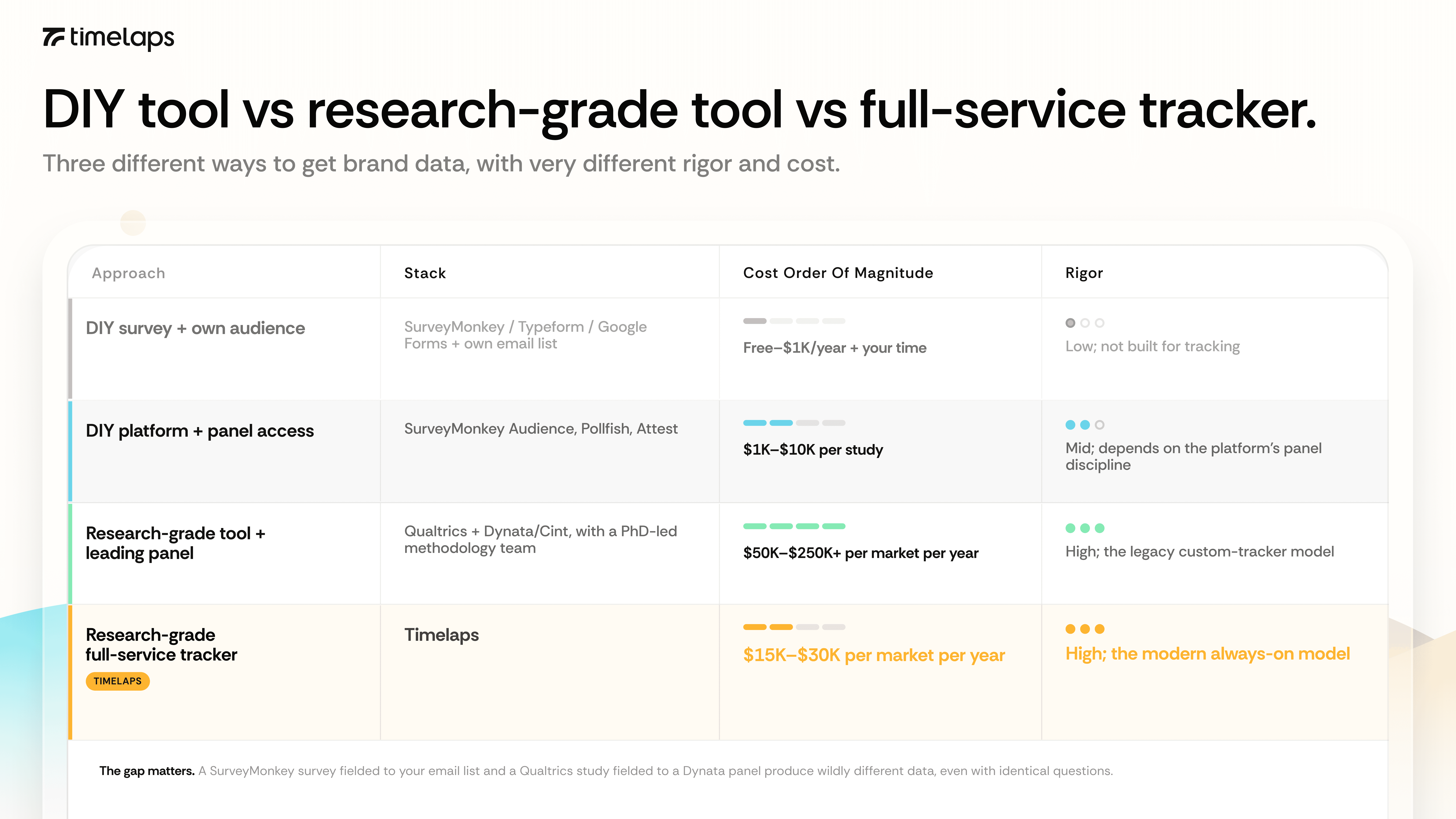
Three different ways to get brand data, with very different rigor and cost.
Approach | Stack | Cost order of magnitude | Rigor |
DIY survey + own audience | SurveyMonkey / Typeform / Google Forms + own email list | Free–$1K/year + your time | Low; not built for tracking |
DIY platform + panel access | SurveyMonkey Audience, Pollfish, Attest | $1K–$10K per study | Mid; depends on the platform's panel discipline |
Research-grade tool + leading panel | Qualtrics + Dynata/Cint, with a PhD-led methodology team | $50K–$250K+ per market per year | High; the legacy custom-tracker model |
Research-grade full-service tracker | Timelaps | $15K–$30K per market per year | High; the modern always-on model |
While pricing is important, the rigor decides the validity of a study. A SurveyMonkey survey fielded to your email list and a Qualtrics study fielded to a Dynata panel produce wildly different data, even with identical questions.
How big a sample does brand tracking actually need?
For a single top-line number, a representative sample of about 1,000 people is the typical threshold. That's roughly a ±3% margin of error, and it's why national polls survey a country of hundreds of millions with about 1,000 respondents.
Decide on a sample size based on the margin of error and your budget.
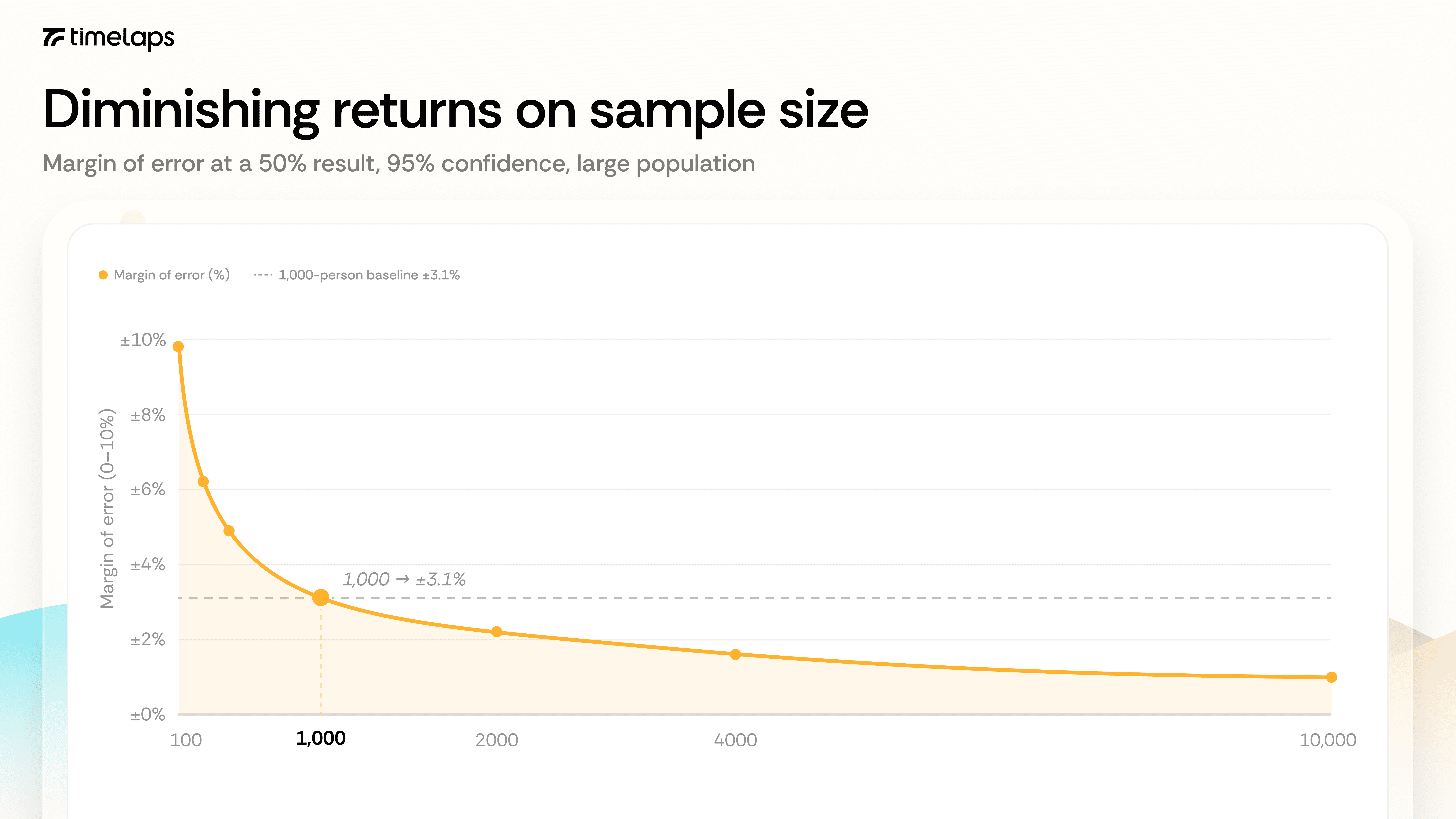
Many people think you need an insane sample size for the data to be representative. The margin of error does shrink with sample size, but with sharply diminishing returns.
Sample size | Margin of error (95% confidence) |
100 | ±9.8% |
250 | ±6.2% |
400 | ±4.9% |
500 | ±4.4% |
1,000 | ±3.1% |
2,000 | ±2.2% |
4,000 | ±1.5% |
10,000 | ±1.0% |
Margin of error at a 50% result, 95% confidence, large population.
MIT puts it cleanly: a 1,000-person sample gives about a ±3.1% margin; doubling it to 2,000 only gets you to ±2.2%; you'd need 10,000 people to reach ±1%. You quadruple the cost to halve the error. Gallup says the same thing in plainer terms: past a point, accuracy improves only marginally with bigger samples.
So if 1,000 gets you a solid top-line number (±3.1% margin of error at 95% confidence), why would a serious tracker ever field more?
Why do enterprises still want more samples?
A 1,000-sample reads the headline well enough. Most brand health questions a CEO and CMO ask: "Is brand awareness moving?" "Are we getting closer to the category leader?" "Did the campaign land among our target personas?" are answered cleanly at that base. For most companies (especially mid-market, challenger brands), that's the right size.
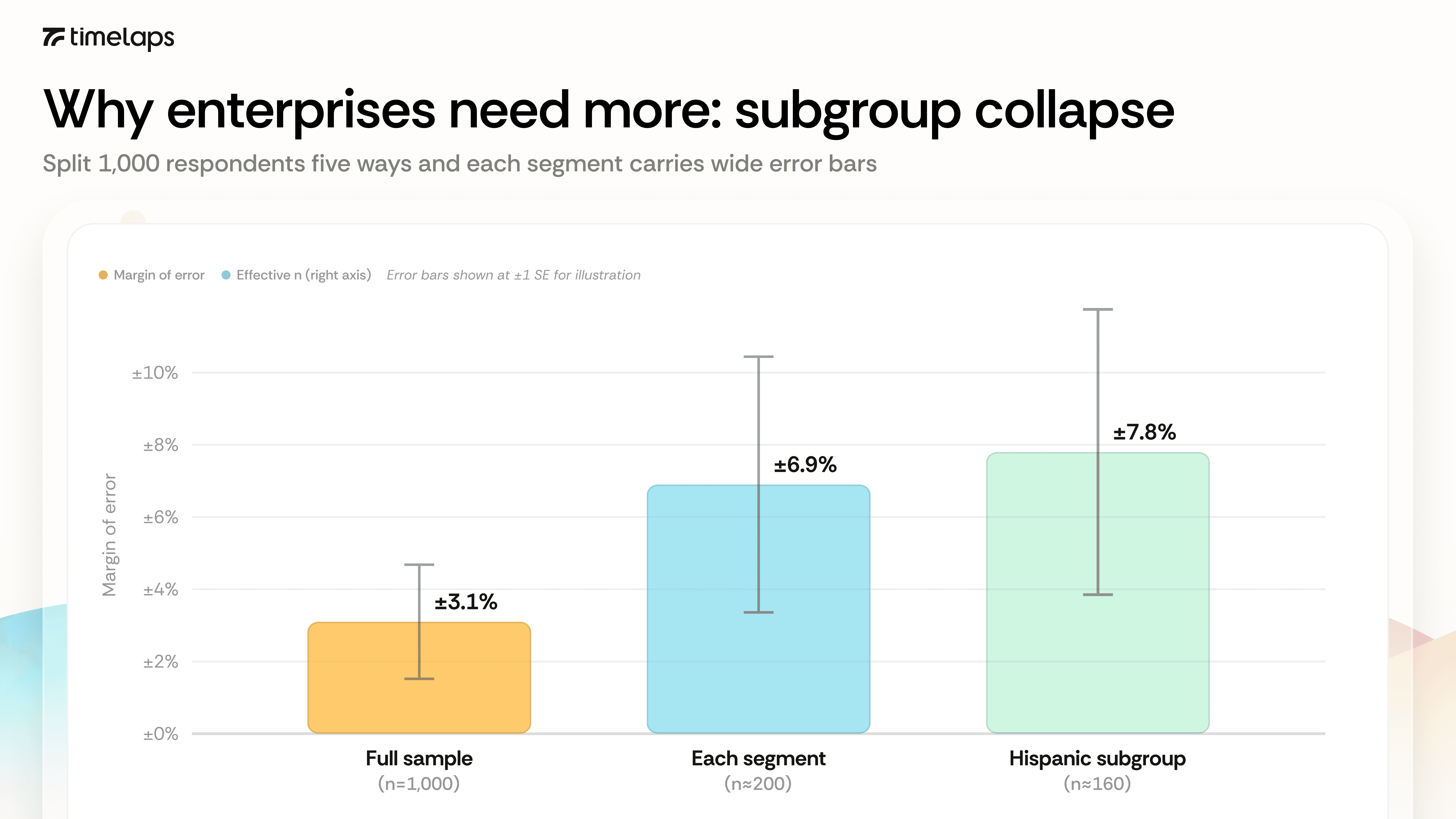
Three situations call for going deeper:
Granular subgroups. The moment you ask "what's awareness among 25–34 urban women?" your effective sample collapses. Split a 1,000-person sample across five segments, and you've got 200 each, a ±7% margin, wide enough to hide most real movement. Pew gives the textbook example: in a 1,067-person sample, a subgroup like Hispanics works out to roughly 160 people, a ±8-point margin, and ±16 points for the difference between two options. This is exactly why pollsters field 600 to 1,800 people for the same headline margin: they need enough bodies in each subgroup to read it at all. If your strategy turns on segment-level reads, you want a larger base.
Detecting small movements quickly. Brand metrics move slowly. A few points a year is a real result. If each wave carries ±5–7% of sampling noise, a genuine three-point gain only surfaces clearly after you pool several waves together. Larger continuous samples shorten that detection window, which matters when you're running active campaigns and need to know whether the work is landing in weeks, not quarters.
External publication. Numbers that leave the room, such as board decks, investor reports, PR campaigns, and category benchmarking, face a higher bar than numbers used internally. A wider confidence interval is fine in a strategy meeting and untenable in a press release. Sample depth buys you the right to publish.
Why does Timelaps recommend 4,000 samples per year for continuous brand tracking?
4000 samples per year isn't an arbitrary number. Fielding ~4,000 per category per year, collected continuously, buys you the things thin samples can't deliver: stable subgroup reads, clean trend lines to detect small movements, and a base deep enough to survive being cut, quoted in a board deck, and published as external reports.
A single monthly wave of ~300 responses is directional, about ±5.7% on its own. An always-on tracker doesn't read one wave in isolation. It collects continuously and lets you pool.
A single month (~300): ±5.7%, a directional read.
A rolling quarter (~900): ±3.3%, a confident read.
A full year (~4,000): ±1.5%, fine-grained enough to cut by subgroup.
Continuous collection lets you trade time resolution for precision depending on the question. Need a fast pulse? Read the latest month. Need a defensible subgroup cut? Pool the quarter or the year. A quarterly study can't do this. It gives you four fixed snapshots a year and nothing in between.
If you want to see census-matched, always-on tracking using a research-grade methodology in practice, book a call or explore the demo. Pricing is transparent and public, starting at $15,000 per market per year.
Frequently Asked Questions.
What is the best methodology for brand tracking?
Survey-based tracking on a representative sample is the standard for brand health.
How is brand tracking data collected?
Most brand tracking data is collected through online surveys sent to a representative, census-matched panel of consumers, sourced from providers like Dynata.
What sample size do you need for a brand tracking survey?
About 1,000 responses give a ±3% margin of error on a top-line metric, enough for a single read. To analyze subgroups or detect small changes over time, you need more, which is why serious always-on trackers field over 3,000 per category per year, collected continuously and pooled into rolling windows.
Is social listening a substitute for brand tracking?
No. Social listening only measures people who post publicly, who skew vocal and are already engaged. It's a strong complement to survey-based tracking and a weak replacement for it.
Can AI-moderated interviews replace brand tracking?
Not for brand tracking. AI interview tools like Listen Labs, Conveo, and Outset produce rich qualitative depth fast, but their output isn't standardized or representative enough to give comparable, quantitative trend numbers. Use them as follow-ups and explain why a metric moved, not to measure whether it did.


