
Timelaps for Financial Services
Continuous brand tracking for financial services companies.
Continuous brand tracking for financial services companies.
In banking, payments, and consumer finance, people tap the first brand that comes to mind. You spend heavily to be the default, but awareness, consideration, and preference are infamously difficult to measure and quantify. Timelaps tracks them continuously, in every market you operate.

Finance leaders know the importance of branding.
The same conversations happen inside every financial services brand that cares about its customers. finance brand we talk to.
Legacy brand tracking is breaking.
Perception in finance moves on a headline. Your tracker moves once a quarter.
Slow time to value.
Slow time to value.
Slow time to value.
Price tags built for multi-billion
incumbents, not challengers.
Price tags built for multi-billion
incumbents, not challengers.
Price tags built for multi-billion
incumbents, not challengers.
Social buzz mistaken for real,
representative demand.
Social buzz mistaken for real,
representative demand.
Social buzz mistaken for real,
representative demand.
Require additional resources
to make sense of the data.
Require additional resources
to make sense of the data.
Require additional resources
to make sense of the data.
A viral moment you can feel but cannot measure.
A viral moment you can feel but cannot measure.
A viral moment you can feel but cannot measure.
Insights that arrive after the decision.
Insights that arrive after the decision.
Insights that arrive after the decision.


Brand tracking on auto-pilot.
Brand intelligence, reimagined for modern consumer finance in the AI era.

Cheaper
5x more accessible than traditional alternatives.

Better
Research-grade insights from 4,000 real consumers.

Faster
Set up in days.
Always-on. Self-updating.

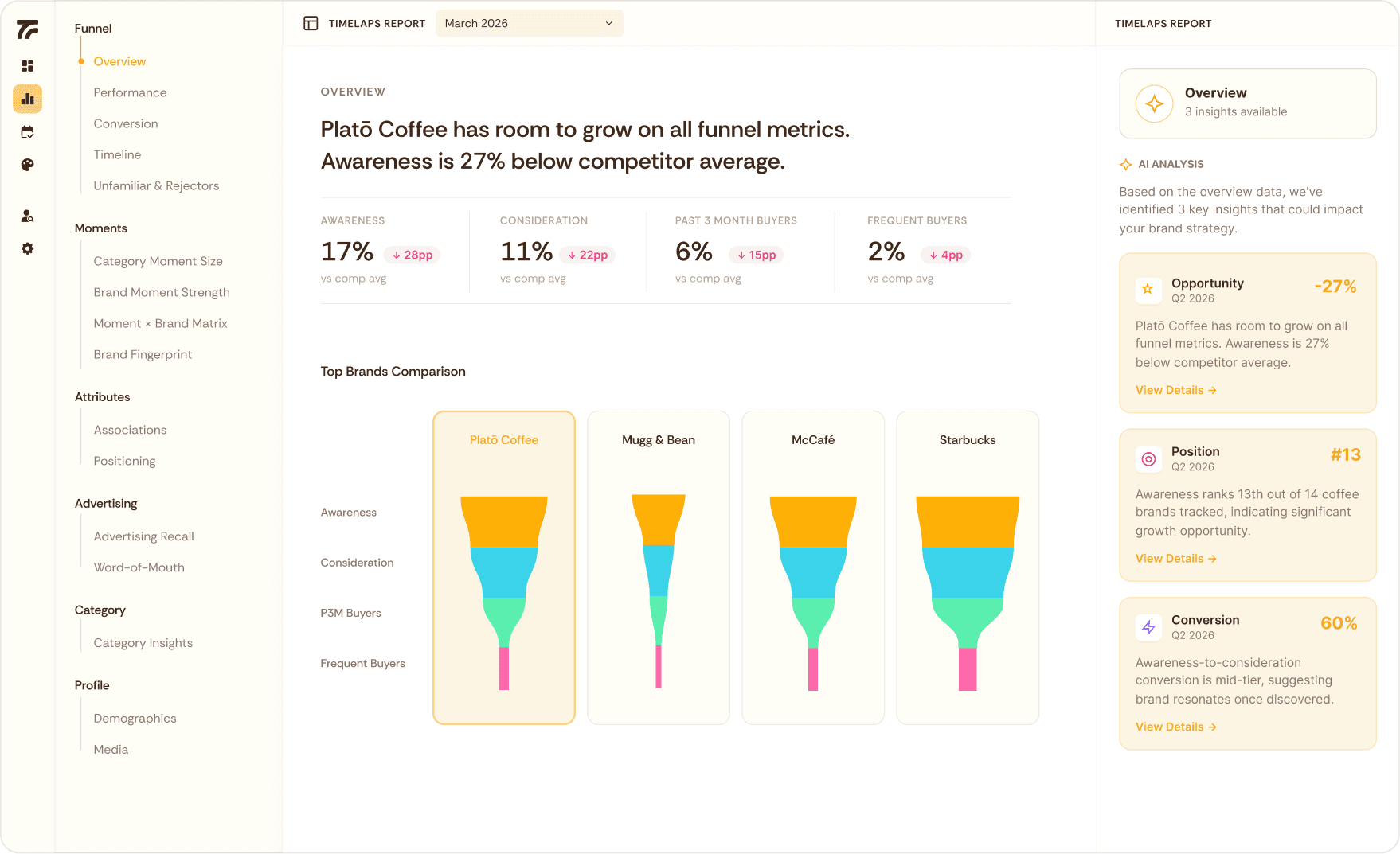
What makes Timelaps different?
What makes Timelaps different?
Timelaps is a modern brand tracking and insight platform designed to replace slower, more expensive traditional agency tracking with always-on insights.
Without Timelaps
Slow. Expensive. Stale.
How traditional brand tracking holds financial services companies back.

3-6 months to first insight.
Quarterly updates. Decisions made with out of date data.
Six-figure price tags. Most companies are priced out.
Rigor depends on which analyst you get.
Insights buried in dense PPTs.
With Timelaps
Real-time. Accessible. Always-on.
How financial services companies actually operate.

Set up in days, not months.
Always-on. Continuous tracking.
At least 5x more affordable than traditional agencies.
Research-grade with the latest brand science built-in.
Board-ready, self-updating dashboard.

Without Timelaps
Slow. Expensive. Stale.
How traditional brand tracking holds financial services companies back.
3-6 months to first insight.
Quarterly updates. Decisions made with out of date data.
Six-figure price tags. Most companies are priced out.
Rigor depends on which analyst you get.
Insights buried in dense PPTs.
With Timelaps
Real-time. Accessible. Always-on.
How financial services companies actually operate.
Set up in days, not months.
Always-on. Continuous tracking.
At least 5x more affordable than traditional agencies.
Research-grade with the latest brand science built-in.
Board-ready, self-updating dashboard.
Without Timelaps
Slow. Expensive. Stale.
How traditional brand tracking holds financial services companies back.
3-6 months to first insight.
Quarterly updates. Decisions made with out of date data.
Six-figure price tags. Most companies are priced out.
Rigor depends on which analyst you get.
Insights buried in dense PPTs.
With Timelaps
Real-time. Accessible. Always-on.
How financial services companies actually operate.
Set up in days, not months.
Always-on. Continuous tracking.
At least 5x more affordable than traditional agencies.
Research-grade with the latest brand science built-in.
Board-ready, self-updating dashboard.
Fast set-up,
ongoing value.
Onboard in days. Get actionable insights from real consumers in your category continuously.

01
Set up your tracker
Our AI analyst and brand research expert co-design your study. Tailored to your brand, category, and market.
02
03
04
Fast set-up,
ongoing value.
Onboard in days. Get actionable insights from real consumers in your category continuously.
01
Set up your tracker
Our AI analyst and brand research expert co-design your study. Tailored to your brand, category, and market.
02
Always-on fieldwork
Your tracker never stops collecting. Quality-controlled responses from 4,000+ real consumers in your category are selected.
03
Continuous insights
Your dashboard self-refreshes monthly with actionable insights and beautiful visualizations.
04
Share & Act
Share a dynamic storytelling dashboard, instead of a stale PDF, directly with your team.
Fast set-up,
ongoing value.
Onboard in days. Get actionable insights from real consumers in your category continuously.
01
Set up your tracker
Our AI analyst and brand research expert co-design your study. Tailored to your brand, category, and market.
02
Always-on fieldwork
Your tracker never stops collecting. Quality-controlled responses from 4,000+ real consumers in your category are selected.
03
Continuous insights
Your dashboard self-refreshes monthly with actionable insights and beautiful visualizations.
04
Share & Act
Share a dynamic storytelling dashboard, instead of a stale PDF, directly with your team.
Why financial services companies choose Timelaps.
See where you're winning or losing in real-time, so you can make million-dollar decisions on-time.

Own the moments money decisions get made.
Paycheck. Big purchase. The trip abroad. Track which financial moments (category entry points) each brand owns, and find the big ones nobody has claimed. That's where a campaign buys the most growth per dollar.

Catch a shift before the numbers do.
A regulation headline or viral complaint. See perception move while you can still respond.

See the tap you're winning or losing.
When you're an option at the pay button, track consideration, preference, and associations against every other option and understand the "why" behind every loyal and missed category buyer.
The Financial Services category is ready to shift toward modern brand intelligence.
People choose the brand they already know and trust: at checkout, at signup, at switching time. Yet awareness, consideration, preference, associations, and category entry points (moments they buy), the things that decide the tap, go unmeasured.

1.7x
Banks in the top 20% for customer advocacy grow revenue 1.7x faster globally, and 2.6x faster in North America. Brand advocacy is a quantifiable growth engine.
Source: Accenture Global Banking Consumer Study, 2025
1.7x
60% of brand sales is projected to be done by wholesale, far ahead of brand’s own stores (11%) and websites (6%), pushing brand discovery onto a shelf where you don’t own the data.
Source: Accenture Global Banking Consumer Study, 2025

32%
32% of BNPL users first discovered the option at checkout and 34% from friends and family, versus under 20% from ads.
Source: PartnerCentric, 2025

11%
Only 11% of marketers can comprehensively prove the business impact of their brand marketing
Source: Marketing Week, 2025
FAQs.
Can’t find the answer you’re looking for?
Reach out to our team: hello@timelaps.io.
Can you measure Category Entry Points and mental availability?
Yes. We build Category Entry Points into the questionnaire, mapping the moments, needs, and occasions that trigger category buying. Then we track how easily your brand comes to mind across them. The result is a clear read on your mental availability versus competitors, not just whether people have heard of you.
Can you measure trust and reputation directly, not just awareness?
Yes. We ask real consumers how much they trust your brand with their money, how they'd describe you, and what they associate you with, tracked continuously. You see reputation as a number that moves, not a vibe you infer from complaints.
Can you measure brand health by segment, since each brand serves a different customer?
Yes. Every metric can be cut by the segments that matter to you: age, income, usage frequency, current provider, and more. You see where you're strong, where you're invisible, and which segment is quietly switching away.
What quality controls and fraud detection do you use?
Every response runs through multiple layers: attention and consistency checks, speeding and straight-lining detection, duplicate and bot screening, and panel-side fraud filters. Low-quality responses are removed before anything reaches your dashboard, so you're acting on clean data.
Do you support multi-market tracking with consistent methodology?
Yes. We run the same methodology across every market, with census-matching applied per country, so results are comparable market to market. Track one region or many, and trust that a move in one country means the same as a move in another.
Can you track different segments, from Gen Z first-timers to prime borrowers?
Yes. Every metric can be cut by the segments that matter to you: age, income, usage frequency, current provider, and more. You see where you're strong, where you're invisible, and which segment is quietly switching away.
How do you measure the why behind a shift, not just the what?
When a number moves, the AI Analyst connects it to the underlying drivers: which perceptions, audiences, moments, or campaigns shifted alongside it. Instead of only seeing that consideration dropped, you see what moved with it, so you know where to act.
Can you catch a shift after a regulation or news event, in near real time?
Yes. Because fieldwork never stops, a headline's effect on your brand shows up in the next monthly read, not next year's audit. You see whether the story actually moved perception or just made noise, while you can still respond.
Can you tie brand building to a measurable lift when there's no click to attribute?
Yes. That's the core use case. Word of mouth and checkout discovery don't leave a click trail, but they do move awareness, consideration, and preference. We measure those directly among category buyers, so brand spend gets a number even when attribution can't give it one.
FAQs.
Can’t find the answer you’re looking for?
Reach out to our team: hello@timelaps.io.
Can you measure Category Entry Points and mental availability?
Yes. We build Category Entry Points into the questionnaire, mapping the moments, needs, and occasions that trigger category buying. Then we track how easily your brand comes to mind across them. The result is a clear read on your mental availability versus competitors, not just whether people have heard of you.
Can you measure trust and reputation directly, not just awareness?
Yes. We ask real consumers how much they trust your brand with their money, how they'd describe you, and what they associate you with, tracked continuously. You see reputation as a number that moves, not a vibe you infer from complaints.
Can you measure brand health by segment, since each brand serves a different customer?
Yes. Every metric can be cut by the segments that matter to you: age, income, usage frequency, current provider, and more. You see where you're strong, where you're invisible, and which segment is quietly switching away.
What quality controls and fraud detection do you use?
Every response runs through multiple layers: attention and consistency checks, speeding and straight-lining detection, duplicate and bot screening, and panel-side fraud filters. Low-quality responses are removed before anything reaches your dashboard, so you're acting on clean data.
Do you support multi-market tracking with consistent methodology?
Yes. We run the same methodology across every market, with census-matching applied per country, so results are comparable market to market. Track one region or many, and trust that a move in one country means the same as a move in another.
Can you track different segments, from Gen Z first-timers to prime borrowers?
Yes. Every metric can be cut by the segments that matter to you: age, income, usage frequency, current provider, and more. You see where you're strong, where you're invisible, and which segment is quietly switching away.
How do you measure the why behind a shift, not just the what?
When a number moves, the AI Analyst connects it to the underlying drivers: which perceptions, audiences, moments, or campaigns shifted alongside it. Instead of only seeing that consideration dropped, you see what moved with it, so you know where to act.
Can you catch a shift after a regulation or news event, in near real time?
Yes. Because fieldwork never stops, a headline's effect on your brand shows up in the next monthly read, not next year's audit. You see whether the story actually moved perception or just made noise, while you can still respond.
Can you tie brand building to a measurable lift when there's no click to attribute?
Yes. That's the core use case. Word of mouth and checkout discovery don't leave a click trail, but they do move awareness, consideration, and preference. We measure those directly among category buyers, so brand spend gets a number even when attribution can't give it one.
FAQs.
Can’t find the answer you’re looking for?
Reach out to our team: hello@timelaps.io.
Can you measure Category Entry Points and mental availability?
Yes. We build Category Entry Points into the questionnaire, mapping the moments, needs, and occasions that trigger category buying. Then we track how easily your brand comes to mind across them. The result is a clear read on your mental availability versus competitors, not just whether people have heard of you.
Can you measure trust and reputation directly, not just awareness?
Yes. We ask real consumers how much they trust your brand with their money, how they'd describe you, and what they associate you with, tracked continuously. You see reputation as a number that moves, not a vibe you infer from complaints.
Can you measure brand health by segment, since each brand serves a different customer?
Yes. Every metric can be cut by the segments that matter to you: age, income, usage frequency, current provider, and more. You see where you're strong, where you're invisible, and which segment is quietly switching away.
What quality controls and fraud detection do you use?
Every response runs through multiple layers: attention and consistency checks, speeding and straight-lining detection, duplicate and bot screening, and panel-side fraud filters. Low-quality responses are removed before anything reaches your dashboard, so you're acting on clean data.
Do you support multi-market tracking with consistent methodology?
Yes. We run the same methodology across every market, with census-matching applied per country, so results are comparable market to market. Track one region or many, and trust that a move in one country means the same as a move in another.
Can you track different segments, from Gen Z first-timers to prime borrowers?
Yes. Every metric can be cut by the segments that matter to you: age, income, usage frequency, current provider, and more. You see where you're strong, where you're invisible, and which segment is quietly switching away.
How do you measure the why behind a shift, not just the what?
When a number moves, the AI Analyst connects it to the underlying drivers: which perceptions, audiences, moments, or campaigns shifted alongside it. Instead of only seeing that consideration dropped, you see what moved with it, so you know where to act.
Can you catch a shift after a regulation or news event, in near real time?
Yes. Because fieldwork never stops, a headline's effect on your brand shows up in the next monthly read, not next year's audit. You see whether the story actually moved perception or just made noise, while you can still respond.
Can you tie brand building to a measurable lift when there's no click to attribute?
Yes. That's the core use case. Word of mouth and checkout discovery don't leave a click trail, but they do move awareness, consideration, and preference. We measure those directly among category buyers, so brand spend gets a number even when attribution can't give it one.