
Why Social Listening Tools Measure the Wrong Things.
-
9
mins read



Authored: Apr. 2026. Last updated: June 2026.
Written by Henk Pretorius and Harry Zhang, cofounders of Timelaps.
Social listening measures public posts from a small, vocal slice of internet users. The social media monitoring tool is built to catch and resolve PR issues quickly and spot social media trends before they peak, and it does the job well. Brand tracking surveys a representative sample of actual category buyers on a repeating cadence. It measures your brand's health and how your brand performs in consumers' minds. Both tools have a place. The problem is that most marketers use social listening as if it were brand tracking.
What social listening actually measures (and what it doesn't).
Social listening tools scrape public posts across social media platforms such as X, Reddit, TikTok, Instagram, and YouTube. Social listening helps count brand mentions, perform sentiment analysis, track hashtags, monitor keywords, and flag spikes in conversation volume. Examples of social listening tools like Brandwatch, Sprout Social, Meltwater, Talkwalker, Hootsuite, and Sprinklr all do versions of this.
Social listening is real, and it can be very valuable for some brands.
Where it shines is in fast-moving, public-facing situations where speed matters more than statistical rigor. A trending complaint that could spiral into a PR crisis. A viral moment that needs an in-the-room response. A sensitive cultural conversation your brand has been pulled into without warning. An influencer post gaining momentum hour by hour. These are the cases social listening was built for, and on these, it's hard to beat. The job is to catch the signal early, respond before it compounds.
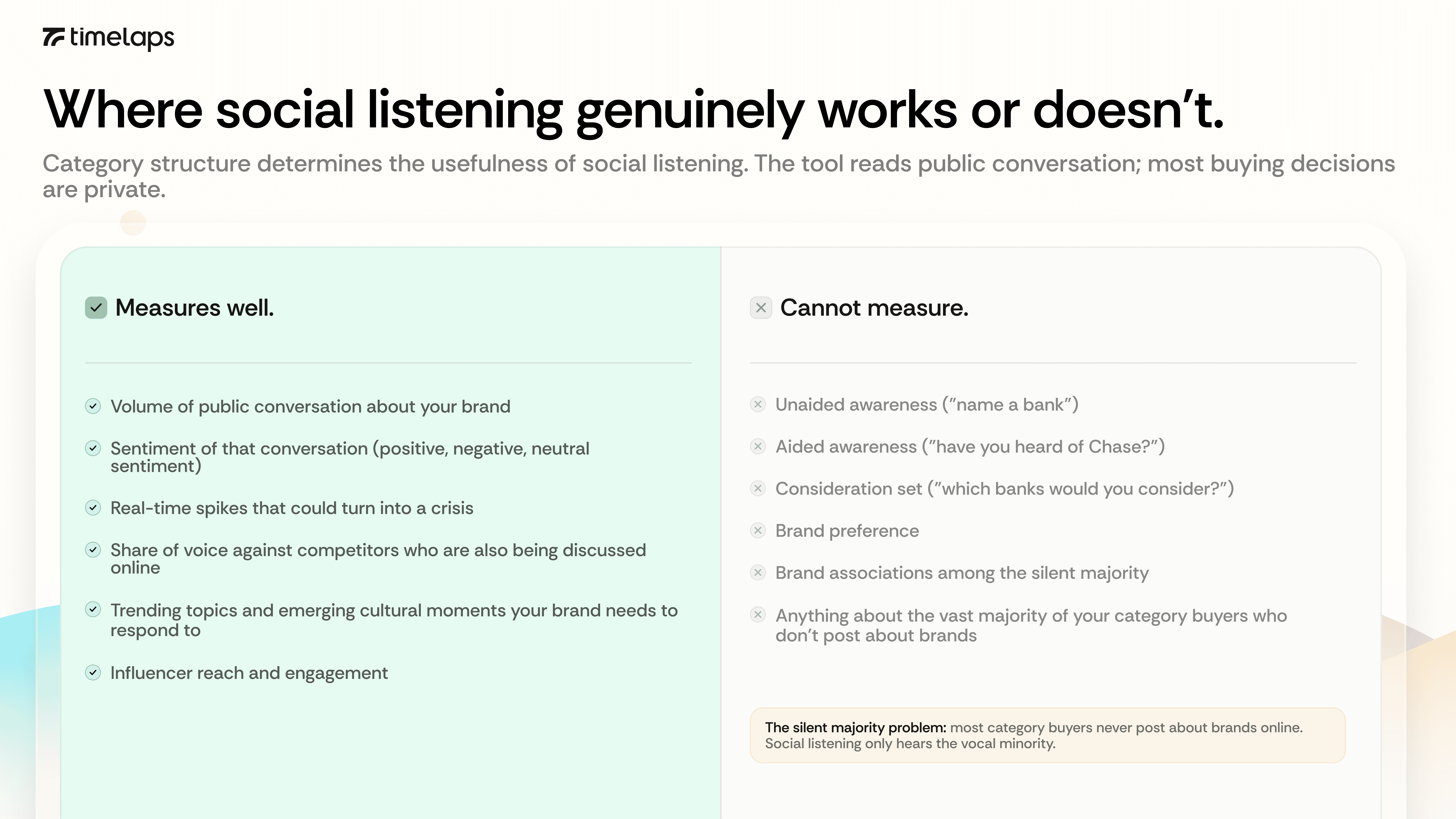
Here's what social listening data measures well.
Volume of public conversation about your brand.
Sentiment of that conversation (positive sentiment, negative sentiment, neutral sentiment).
Real-time spikes that could turn into a crisis.
Share of voice against competitors who are also being discussed online.
Trending topics and emerging cultural moments your brand needs to respond to.
Influencer reach and engagement.
Here's what social listening data cannot measure.
Unaided awareness ("name a bank").
Aided awareness ("have you heard of Chase?").
Consideration set ("which banks would you consider?").
Brand preference.
Brand associations among the silent majority.
Anything about the vast majority of your category buyers who don't post about brands.
That second list is brand health. The first list is crisis response, PR, and trend management. Both matter. They're just not the same job, and conflating them is the most expensive mistake in modern measurement.
Two problems: reach and depth
Every critique of social listening as a brand tracker collapses into two failures. The data doesn't reach the right people, and the data isn't deep enough to be diagnostic.
Problem 1: Reach. You're hearing the loudest 1%, not the buying 99%.
Most of your category buyers do not post about your category online. Most people don't post about brands publicly at all, and the ones who do skew toward complaint, praise extremes, or campaign participation. If you sell something people don't naturally talk about in public, like a checking account, a homeowners policy, toilet paper, or laundry detergent, you're not measuring a vocal minority. You're measuring an unrepresentative sliver of a vocal minority.
The technical term is selection bias. The practical term is: you're listening to the wrong room.
It gets worse. Dark social, the conversations that happen in iMessage, WhatsApp, Slack, Discord DMs, and group chats, is now where most brand discussion actually happens. Social media listening tools can't see any of it. Word of mouth has moved private, and the measurement hasn't caught up.
So when a social listening dashboard tells you sentiment is up 12%, what it really means is: among the small fraction of your category who posts publicly, the people we could scrape are saying nicer things this month. That's a useful PR signal. It's not a brand health signal.
Problem 2: Depth. Sentiment barely scratches the surface of brand insights.
Even if reach weren't broken, the metrics social listening produces aren't the metrics brand strategy needs.
Sentiment tells you how people feel about your brand in the moments they post. It doesn't tell you whether they'd consider buying you. It doesn't tell you whether they remember you when they're standing in the aisle. It doesn't tell you what you're associated with in their head. It's not representative nor actionable enough to inform strategy for the brand's target audience.
Here's a side-by-side comparison of what relevant insights each tool surfaces.
Brand Tracking | Social Listening | |
|---|---|---|
What it measures | Awareness, perception, preference, associations, and other diagnostic metrics in representative samples of your category. | Brand name mentions, keyword and topic trends, and other unstructured conversations about your brand or category online. |
Primary data source | Survey responses collected from a representative group of category consumers. | Public social, forums, news, blogs. |
Sample | Representative, weighted, controlled, often census-matched. | Census of public conversation. |
Time horizon | Longitudinal. Brand tracking requires consistency of measurement and data over time. | Real-time. |
Primary question it answers | Is my brand strategy working (i.e., getting better)? | What are people saying about my brand? |
Typical buyer | Brand and insights executives / managers. | Social media managers. |
What it can't do | React immediately. | Tell you what the silent majority (non-posters) think and do. |
Predictive of revenue | Strong, decades of evidence. | Weak, situational. |
Best for | Brand, marketing, strategy, insights, data. | PR, crisis, content, community. |
Cost | Upfront investment required. At least $15K per year for representative sampling. | Free tier available to $50K+ per year; ~$50 to $1,000 per month for most SMBs (100 employees or less). |
Where social media listening is actually useful: a category guide.
Many "social listening is broken" arguments overreach. Social listening isn't broken everywhere. It's broken in specific places, useful in others, and partially useful in a third group.
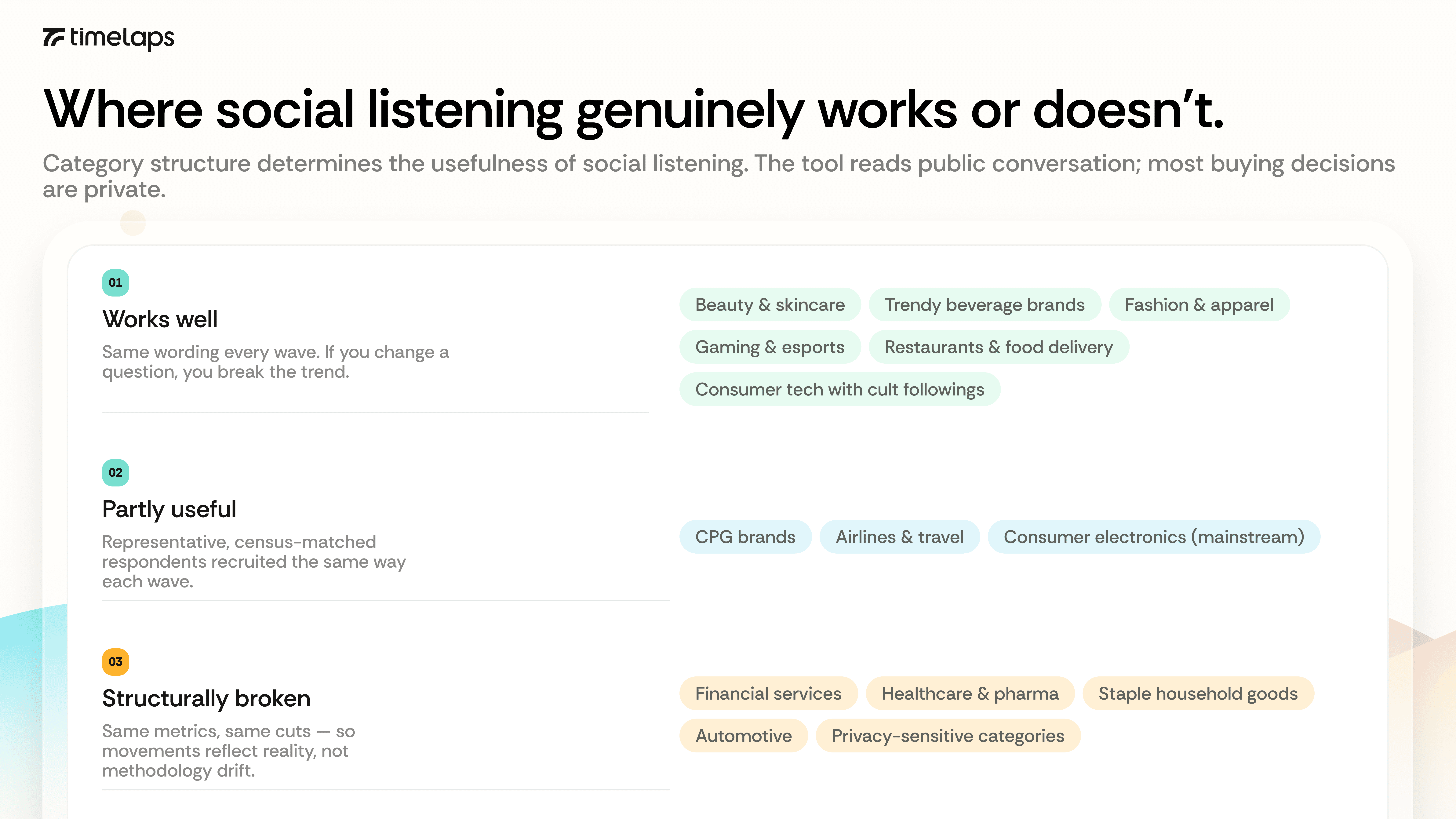
Categories where social listening genuinely works.
Social listening tools move the needle in categories where potential customers post often, share honest feelings, and speak freely online. They matter most when PR, crisis response, and trend tracking strongly affect brand results.
Ice cream, snack, confectionery, trendy beverage brand. High-frequency, emotional, photogenic.
Fashion and beauty brand. Identity-driven, visual platforms reward posting.
Restaurants, food delivery, hospitality brand. Built-in posting moment (the meal).
Entertainment, streaming, gaming brand. Fandoms and communities live online.
Consumer tech brand with cult followings. Apple, Tesla, Nintendo.
If you're a DTC ice cream brand, you should use social listening. People post about ice cream. Effective social listening will give you real social data and actionable insights that drive business growth. Sentiment swings actually mean something because the customer base lives on the platforms you're scraping.
What's noteworthy is that these categories tend to also benefit the most from brand tracking. Tracking mentions will help the social and PR team monitor industry trends and online conversations. Tracking brand health will help the brand and marketing team measure the impact of brand investments that build long-term brand equity, which cannot be meaningfully measured via social listening or other traditional channels.
Categories where social listening is partially useful.
CPG with active fandom. Fans post, but the median buyer is often silent.
Travel and airlines. High posting volume, but skewed heavily toward complaints.
Mass retail. Useful for campaigns and PR, not for share-of-mind.
Consumer electronics outside the cult tier. Some signal, lots of noise.
Building your social listening strategy is worthwhile here, but you can't run brand strategy off it.
Categories where social listening is structurally broken.
These are categories where social listening will systematically mislead you, no matter how good the tool. They share three traits: the topic is (1) private, complex, or taboo; (2) the purchase is considered; and (3) the buyer has no incentive to post across social media channels.
Financial services. Banks, credit cards, wealth management, insurance. People don't post about their checking account. When they do, it's usually a complaint.
Healthcare, pharma, and medical devices. Privacy, stigma, regulation. The posts that exist are unrepresentative.
Staple household goods. Toilet paper, laundry detergent, dish soap. No one posts about these in any volume.
Automotive. High consideration, low public posting outside enthusiast pockets.
Legal and professional services. Same dynamics as healthcare and finance.
Social listening on these categories isn't 80% accurate. It's measuring something else entirely.
We keep meeting brands in this third group who are paying anywhere from $500 to $5K per month ($6K to $60K per year) for a social listening tool they barely open. They were really shopping for brand tracking. They just didn't know it had a different name.
What brand tracker measures that social listening tool can't: brand health.
If social listening is built for the public conversation, brand tracking is built for the private one. The conversation that happens inside a buyer's head when they're deciding what to buy.
You measure that by asking. Not by scraping.
An effective brand tracker recruits a census-matched, representative sample of your category buyers, people who have bought or could buy in your category, and asks them the questions that actually predict purchase, such as:
Awareness. "Which of the following [category brands] have you heard of?"
Consideration. "Which of the following [category brands] would you consider buying from?"
Usage. "Which of the following [category brands] have you purchased from in the past 3 months?" Note that this question varies by category.
Preference. "How often do you buy from each of these brands?"
Brand associations. "Which of these [category brands] do you associate with the following qualities?"
None of these is derivable from a scrape of public posts. They're a different kind of data, collected from a different kind of person, for a different kind of decision.
If you're looking to select a brand tracker, we evaluated the best brand tracking software tools for 2026.
"Use both" is only half right.
Most balanced takes on this topic land on the same compromise. Use both since they measure different things.
Half-right.
Social listening AI tools give meaningful insights to brands in categories that naturally attract social media conversations. PR teams need it. Crisis response teams need it. Digital marketing managers need it. Community managers need it. We are not telling anyone to cancel their subscription.
The problem isn't that brands use social listening. It's that they use it as brand measurement, because for a long time, real brand measurement was too slow and too expensive. Marketers reached for social listening as a brand health tool not because it was the right tool, but because the right tool was out of reach.
Social listening was built for marketing operations. It got promoted into brand strategy by default. That's the misuse worth fixing, not the existence of the category.
A simple guide to tell which one you actually need.
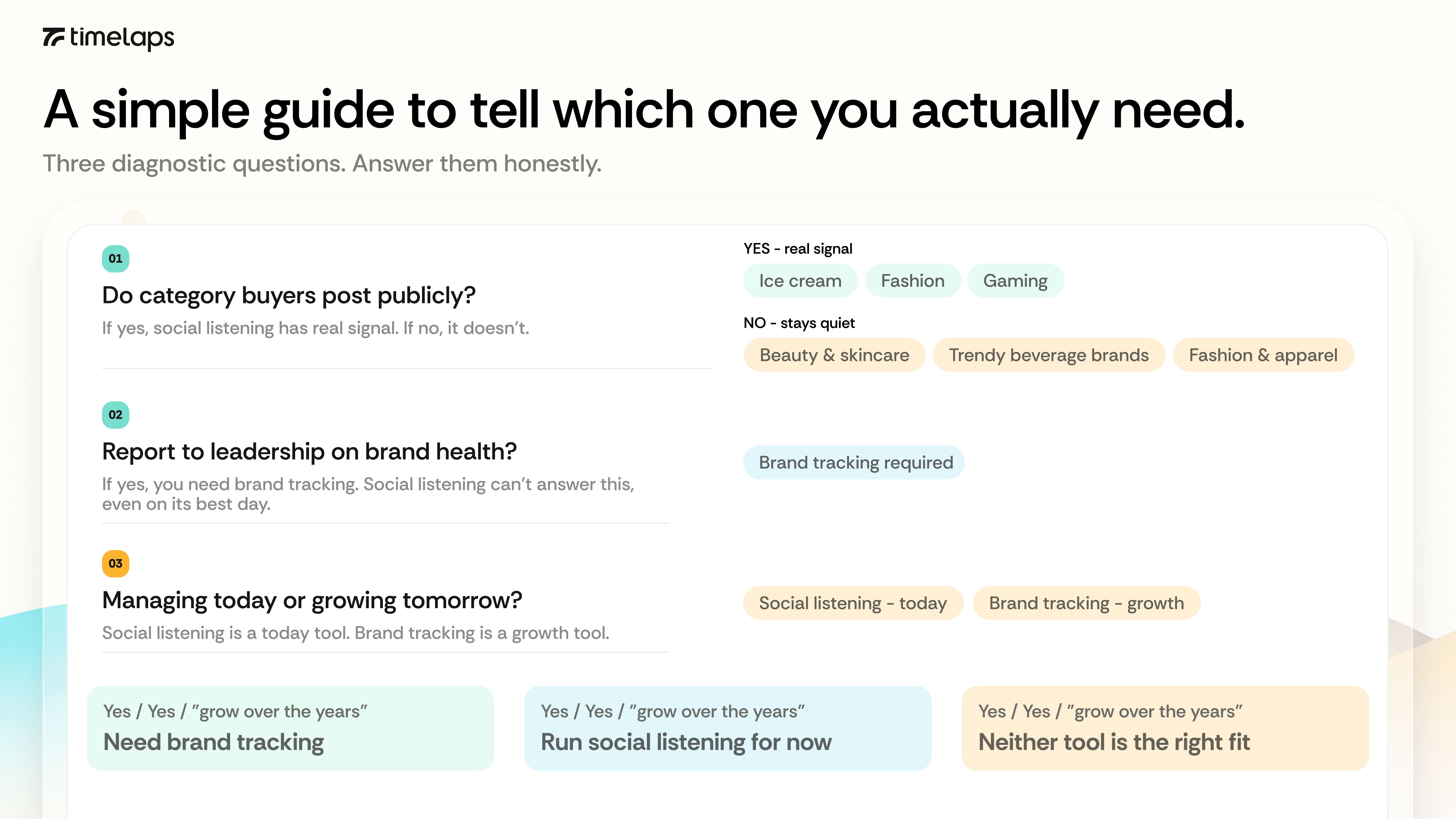
Three diagnostic questions. Answer them honestly.
Do your category buyers post about your category in public? If yes (ice cream, fashion, gaming), social listening has a real signal. If no (banks, insurance, staples), it doesn't.
Do you need to report to leadership on whether the brand is growing or shrinking in the market's mind? If yes, you need brand tracking. Social listening cannot answer this question, even on its best day.
Is your role focused on "managing today" or "growing tomorrow"? Social listening is a today tool. Brand tracking is a growth tool.
If you answered "yes/no," "yes," and "grow over the years," you need brand tracking. If you answered "yes," "no," and "managing today," run social listening for now. If you answered "no" and "no" for the first two questions, neither is the right tool.
Most brands sit in the middle and need both for different jobs. The key is to pick the right tool for the right job.
Frequently Asked Questions
What is the purpose of social listening tools?
Teams use social listening tools to track relevant conversations about their brand, competitors, and category across social platforms, forums, and news sites. Common social listening examples include Brandwatch, Sprout Social, Meltwater, and Hootsuite. They're built to help PR, social, and community teams catch issues early, monitor sentiment around campaigns or crises, identify trending topics worth responding to, and measure influencer reach. They're operational tools for managing the public conversation in real time.
What are the key metrics social listening tracks?
The core KPIs are mention volume, sentiment (positive, negative, neutral), share of voice, reach, engagement, and trending topics or hashtags. More advanced platforms add influencer scoring, geographic and demographic breakdowns of posters, and competitive benchmark data on the same metrics. These are useful key performance indicators for social and PR teams. None of them tell you what your category buyers actually think, feel about your brand message, or do at the point of purchase.
What are the limitations or disadvantages of social listening?
Reach and depth. Social monitoring only captures people who post publicly about brands, which is a small and skewed slice of any category. What social listening gives you is descriptive data on the loudest posters, not the silent majority who actually drive revenue. It can't see dark social (private chats and DMs), can't measure what non-posters think, and can't surface diagnostic brand metrics like awareness, consideration, or preference. Sentiment scores also often misread sarcasm, slang, and context.
Is social listening biased?
Yes, structurally. It captures only people who post publicly about brands, which is a small and unrepresentative slice of any category. Even within that slice, the data is skewed toward complaints, praise extremes, and people participating in giveaways or campaigns. Dark social, meaning private chats, DMs, and group threads, is invisible to it entirely. That said, a social listening approach can still be helpful in the right categories and use cases.
What does social listening miss?
The people who don't post. Which, in most categories, is the vast majority of buyers. It also misses private conversations, considered purchases, and any brand metric (awareness, consideration, preference) that requires asking a direct question. If you want to refine your brand strategy based on what the broader market actually thinks, social conversations alone won't get you there.
Is social listening good for B2B?
Mostly no. B2B buyers don't post about vendor evaluations publicly. The posts that exist on LinkedIn and elsewhere are dominated by vendor marketing, not an honest buyer signal.
How do you measure brand health without social listening?
By asking real category buyers, regularly, with a representative sample. That's what a brand health tracker does. The metrics to measure are unaided awareness, aided awareness, consideration, preference, and brand associations. Always-on trackers like Timelaps run continuously; legacy solutions like Kantar and Ipsos run quarterly or biannually. Both beat social listening for measuring what people actually think.
Can social listening replace a brand tracker?
No. Social listening measures public conversation among posters; brand tracking measures awareness, consideration, and preference among category buyers. The two datasets don't overlap meaningfully, and only the second one predicts revenue. You can run social listening without brand tracking, but you cannot run brand strategy without brand tracking.
Timelaps runs research-grade, always-on brand health tracking in 82 markets at the most accessible price. Worth a look if you've been using social listening to do a different job.
Timelaps runs research-grade, always-on brand health tracking in 82 markets at the most accessible price. Worth a look if you've been using social listening to do a different job.


