
Timelaps for Consumer Electronics
Continuous brand tracking for hardware brands.
Continuous brand tracking for hardware brands.
You are building a category and a brand at the same time. Brand awareness and trust are the whole game. Timelaps tracks whether people know you, believe you, and would choose you over the alternatives, continuously, at the most accessible price in the market.
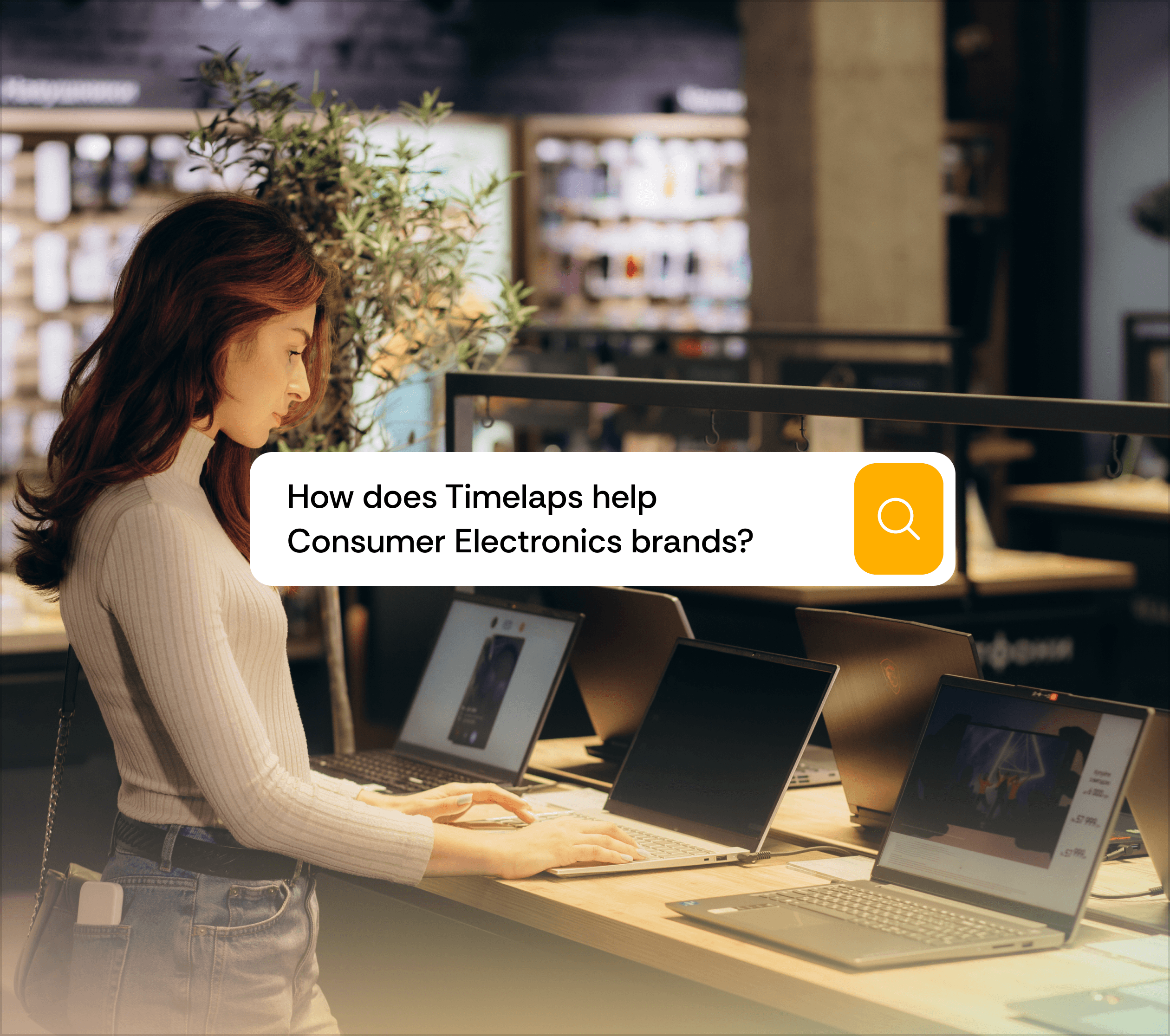
Consumer electronics leaders know the importance of branding.
The same conversations happen inside every user-centered consumer electronics team we talk to.
Legacy brand tracking is breaking.
You ship and iterate in weeks. The old trackers move in quarters and cost more than a product line.
Slow time to value.
Slow time to value.
Slow time to value.
Price tags built for multi-billion
incumbents, not challengers.
Price tags built for multi-billion
incumbents, not challengers.
Price tags built for multi-billion
incumbents, not challengers.
Social buzz mistaken for real,
representative demand.
Social buzz mistaken for real,
representative demand.
Social buzz mistaken for real,
representative demand.
Require additional resources
to make sense of the data.
Require additional resources
to make sense of the data.
Require additional resources
to make sense of the data.
A viral moment you can feel but cannot measure.
A viral moment you can feel but cannot measure.
A viral moment you can feel but cannot measure.
Insights that arrive after the decision.
Insights that arrive after the decision.
Insights that arrive after the decision.


Brand tracking on auto-pilot.
AI-native brand intelligence, built for hardware brands.

Cheaper
5x more accessible than traditional alternatives.

Better
Research-grade insights from 4,000 real consumers.

Faster
Set up in days.
Always-on. Self-updating.

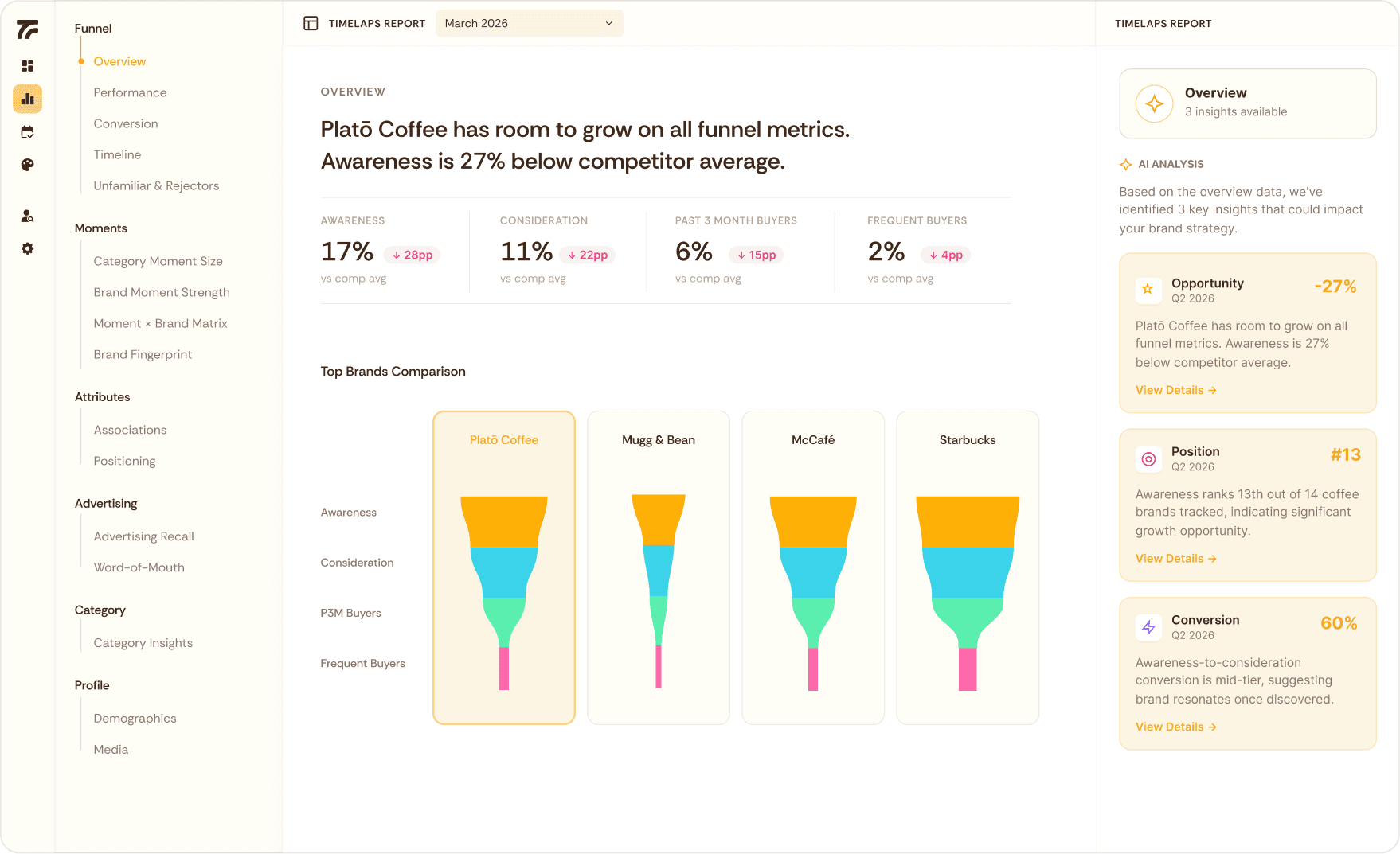
What makes Timelaps different?
What makes Timelaps different?
Timelaps is a modern brand tracking and insight platform designed to replace slower, more expensive traditional agency tracking with always-on insights.
Without Timelaps
Slow. Expensive. Stale.
How traditional brand tracking holds hardware teams back.

3-6 months to first insight.
Quarterly updates. Decisions made with out of date data.
Six-figure price tags. Most companies are priced out.
Rigor depends on which analyst you get.
Insights buried in dense PPTs.
With Timelaps
Real-time. Accessible. Always-on.
How modern hardware teams actually operate.

Set up in days, not months.
Always-on. Continuous tracking.
At least 5x more affordable than traditional agencies.
Research-grade with the latest brand science built-in.
Board-ready, self-updating dashboard.

Without Timelaps
Slow. Expensive. Stale.
How traditional brand tracking holds hardware teams back.
3-6 months to first insight.
Quarterly updates. Decisions made with out of date data.
Six-figure price tags. Most companies are priced out.
Rigor depends on which analyst you get.
Insights buried in dense PPTs.
With Timelaps
Real-time. Accessible. Always-on.
How modern hardware teams actually operate.
Set up in days, not months.
Always-on. Continuous tracking.
At least 5x more affordable than traditional agencies.
Research-grade with the latest brand science built-in.
Board-ready, self-updating dashboard.
Without Timelaps
Slow. Expensive. Stale.
How traditional brand tracking holds hardware teams back.
3-6 months to first insight.
Quarterly updates. Decisions made with out of date data.
Six-figure price tags. Most companies are priced out.
Rigor depends on which analyst you get.
Insights buried in dense PPTs.
With Timelaps
Real-time. Accessible. Always-on.
How modern hardware teams actually operate.
Set up in days, not months.
Always-on. Continuous tracking.
At least 5x more affordable than traditional agencies.
Research-grade with the latest brand science built-in.
Board-ready, self-updating dashboard.
Fast set-up,
ongoing value.
Onboard in days. Get actionable insights from real consumers in your category continuously.

01
Set up your tracker
Our AI analyst and brand research expert co-design your study. Tailored to your brand, category, and market.
02
03
04
Fast set-up,
ongoing value.
Onboard in days. Get actionable insights from real consumers in your category continuously.
01
Set up your tracker
Our AI analyst and brand research expert co-design your study. Tailored to your brand, category, and market.
02
Always-on fieldwork
Your tracker never stops collecting. Quality-controlled responses from 4,000+ real consumers in your category are selected.
03
Continuous insights
Your dashboard self-refreshes monthly with actionable insights and beautiful visualizations.
04
Share & Act
Share a dynamic storytelling dashboard, instead of a stale PDF, directly with your team.
Fast set-up,
ongoing value.
Onboard in days. Get actionable insights from real consumers in your category continuously.
01
Set up your tracker
Our AI analyst and brand research expert co-design your study. Tailored to your brand, category, and market.
02
Always-on fieldwork
Your tracker never stops collecting. Quality-controlled responses from 4,000+ real consumers in your category are selected.
03
Continuous insights
Your dashboard self-refreshes monthly with actionable insights and beautiful visualizations.
04
Share & Act
Share a dynamic storytelling dashboard, instead of a stale PDF, directly with your team.
Why consumer electronics companies choose Timelaps.
When you are selling a new behavior, not just a device, brand health is the leading indicator of everything. You will feel it immediately.
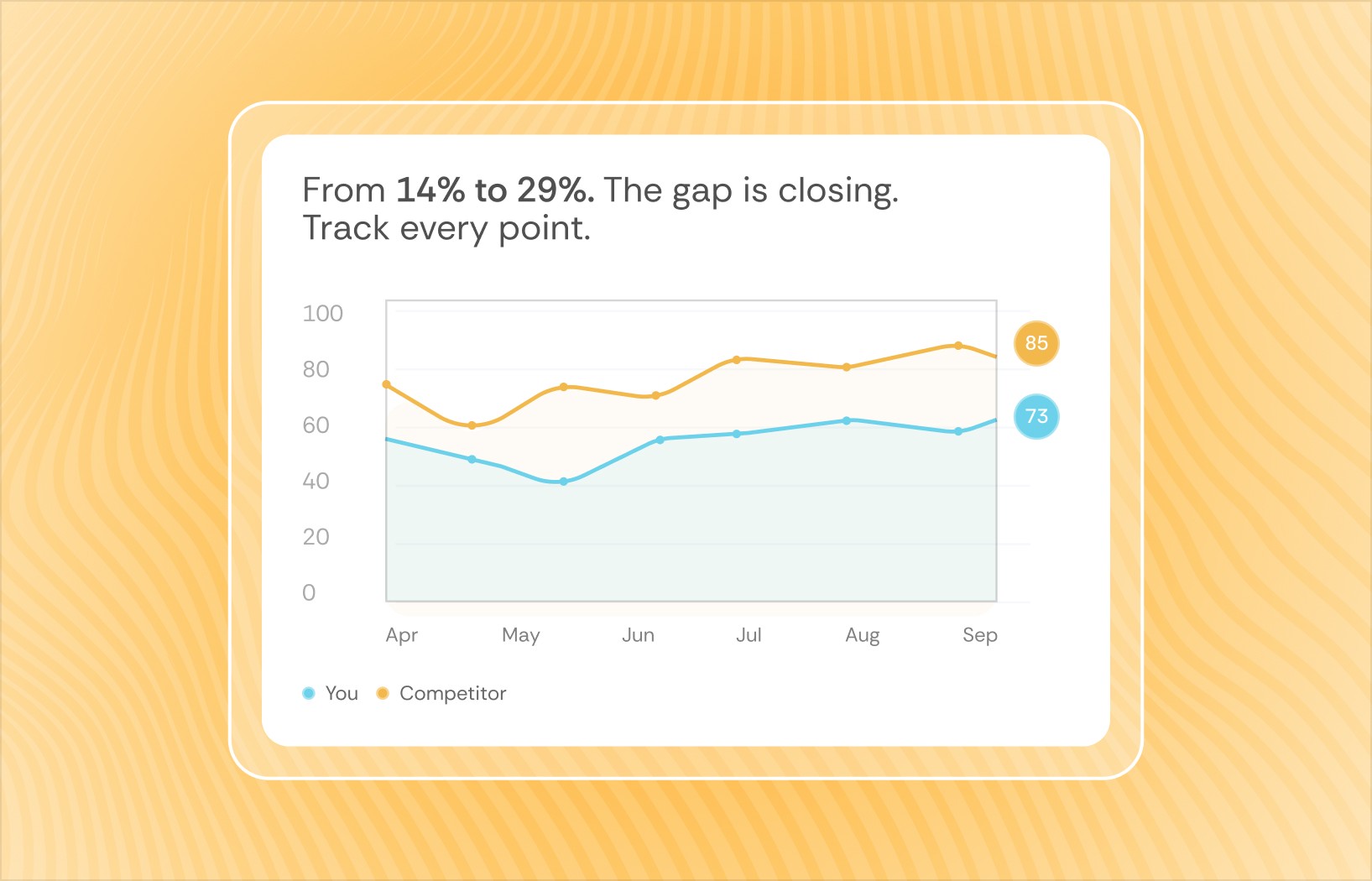
Measure the awareness gap.
Great product, low fame is the classic hardware-challenger trap. See exactly how many people know the category and your name, and watch it move.

Know your standing before the retail push.
See awareness and consideration market by market before you commit to shelves, instead of guessing from your own data.

Track trust, not just trial.
A new hardware brand lives or dies on "is it worth it and will it work." Measure belief and intent, the real barriers before purchase.

Prove you against the alternatives.
You’re innovating in a category where alternatives exist. Quantify how you stack up against the free, built-in option and the other challengers, on the dimensions that actually drive choice.
The category is ready for the shift.
Demand for new categories is real and growing. Yet most challengers are flying blind on whether anyone beyond their own customer list knows the brand or believes it's worth buying.

81%
81% of consumers say they must trust a brand before they will even consider buying it. For an unfamiliar hardware name, that trust is the single steepest barrier to the sale.
Source: industry surveys, 2025
81%
60% of brand sales is projected to be done by wholesale, far ahead of brand’s own stores (11%) and websites (6%), pushing brand discovery onto a shelf where you don’t own the data.
Source: industry surveys, 2025

60%
60% of devices now ship with the incumbent's built-in version of the feature. A challenger's whole job is convincing buyers its name beats the free default.
Source: TechRT, 2026

11%
Only 11% of marketers can comprehensively prove the business impact of their brand marketing
Source: Marketing Week, 2025
FAQs.
Can’t find the answer you’re looking for?
Reach out to our team: hello@timelaps.io.
Can you measure category insights, beyond awareness, for a new product type?
Yes. When you're building a new category, awareness is only the start. We track whether people understand what the product is, what it's for, and why it matters, plus consideration, intent, and the perceptions that decide whether they buy. You see how well the category itself is landing, not just your name.
Can you track trust and purchase intent, the real barriers for new hardware?
Yes. For new hardware, "do I believe it works and is it worth it" is the wall before the sale. We measure trust, perceived value, and purchase intent directly, so you see exactly where buyers stall: never heard of you, don't believe it yet, or interested but not converting.
Can you benchmark us against built-in features and other challenger brands?
Yes. You define the competitive set, and it can include the free, built-in option from the big platforms as well as other challengers. You see how you stack up on the dimensions that actually drive choice, so you know whether you're losing to a rival or to "the default is good enough."
Can you measure awareness market by market before we expand into retail?
Yes. We track awareness and consideration in each market you name, so you know your standing before you commit to shelves or a regional push. You walk into the retail or expansion decision with real numbers, not a guess pulled from your own customer list.
How is the data collected, and what is your sample source, size, and representativeness?
We field continuous online surveys through Dynata, a leading global panel. Samples are census-matched on the dimensions that matter, so respondents reflect your real market, not just current customers. On Scale, that's roughly 4,000 responses per category per year, refreshed monthly, so trends are stable and read in near real time rather than once a quarter.
What quality controls and fraud detection do you use?
Every response runs through multiple layers: attention and consistency checks, speeding and straight-lining detection, duplicate and bot screening, and panel-side fraud filters. Low-quality responses are removed before anything reaches your dashboard, so you're acting on clean data.
Can you tie a campaign or launch to a measurable shift in awareness or consideration?
Yes. Because tracking is always-on, you see the before and after of a launch, a rebrand, a press moment, or a campaign within weeks. You can tell whether that spend actually moved awareness and consideration or just made noise for a week. We'd advise tracking continuously especially for this use case so you can measure the full extent of the campaign's impact.
How do you measure the why behind a shift?
When a number moves, the AI Analyst connects it to the underlying drivers: which perceptions, audiences, campaigns, or competitors shifted alongside it. Instead of only seeing that consideration rose, you see what moved with it, so you know what to repeat or fix.
Do you support multi-country tracking with consistent methodology?
Yes. We run the same methodology across every market, with census-matching applied per country, so results are comparable market to market. Track one region or many, and trust that a move in one country means the same as a move in another.
FAQs.
Can’t find the answer you’re looking for?
Reach out to our team: hello@timelaps.io.
Can you measure category insights, beyond awareness, for a new product type?
Yes. When you're building a new category, awareness is only the start. We track whether people understand what the product is, what it's for, and why it matters, plus consideration, intent, and the perceptions that decide whether they buy. You see how well the category itself is landing, not just your name.
Can you track trust and purchase intent, the real barriers for new hardware?
Yes. For new hardware, "do I believe it works and is it worth it" is the wall before the sale. We measure trust, perceived value, and purchase intent directly, so you see exactly where buyers stall: never heard of you, don't believe it yet, or interested but not converting.
Can you benchmark us against built-in features and other challenger brands?
Yes. You define the competitive set, and it can include the free, built-in option from the big platforms as well as other challengers. You see how you stack up on the dimensions that actually drive choice, so you know whether you're losing to a rival or to "the default is good enough."
Can you measure awareness market by market before we expand into retail?
Yes. We track awareness and consideration in each market you name, so you know your standing before you commit to shelves or a regional push. You walk into the retail or expansion decision with real numbers, not a guess pulled from your own customer list.
How is the data collected, and what is your sample source, size, and representativeness?
We field continuous online surveys through Dynata, a leading global panel. Samples are census-matched on the dimensions that matter, so respondents reflect your real market, not just current customers. On Scale, that's roughly 4,000 responses per category per year, refreshed monthly, so trends are stable and read in near real time rather than once a quarter.
What quality controls and fraud detection do you use?
Every response runs through multiple layers: attention and consistency checks, speeding and straight-lining detection, duplicate and bot screening, and panel-side fraud filters. Low-quality responses are removed before anything reaches your dashboard, so you're acting on clean data.
Can you tie a campaign or launch to a measurable shift in awareness or consideration?
Yes. Because tracking is always-on, you see the before and after of a launch, a rebrand, a press moment, or a campaign within weeks. You can tell whether that spend actually moved awareness and consideration or just made noise for a week. We'd advise tracking continuously especially for this use case so you can measure the full extent of the campaign's impact.
How do you measure the why behind a shift?
When a number moves, the AI Analyst connects it to the underlying drivers: which perceptions, audiences, campaigns, or competitors shifted alongside it. Instead of only seeing that consideration rose, you see what moved with it, so you know what to repeat or fix.
Do you support multi-country tracking with consistent methodology?
Yes. We run the same methodology across every market, with census-matching applied per country, so results are comparable market to market. Track one region or many, and trust that a move in one country means the same as a move in another.
FAQs.
Can’t find the answer you’re looking for?
Reach out to our team: hello@timelaps.io.
Can you measure category insights, beyond awareness, for a new product type?
Yes. When you're building a new category, awareness is only the start. We track whether people understand what the product is, what it's for, and why it matters, plus consideration, intent, and the perceptions that decide whether they buy. You see how well the category itself is landing, not just your name.
Can you track trust and purchase intent, the real barriers for new hardware?
Yes. For new hardware, "do I believe it works and is it worth it" is the wall before the sale. We measure trust, perceived value, and purchase intent directly, so you see exactly where buyers stall: never heard of you, don't believe it yet, or interested but not converting.
Can you benchmark us against built-in features and other challenger brands?
Yes. You define the competitive set, and it can include the free, built-in option from the big platforms as well as other challengers. You see how you stack up on the dimensions that actually drive choice, so you know whether you're losing to a rival or to "the default is good enough."
Can you measure awareness market by market before we expand into retail?
Yes. We track awareness and consideration in each market you name, so you know your standing before you commit to shelves or a regional push. You walk into the retail or expansion decision with real numbers, not a guess pulled from your own customer list.
How is the data collected, and what is your sample source, size, and representativeness?
We field continuous online surveys through Dynata, a leading global panel. Samples are census-matched on the dimensions that matter, so respondents reflect your real market, not just current customers. On Scale, that's roughly 4,000 responses per category per year, refreshed monthly, so trends are stable and read in near real time rather than once a quarter.
What quality controls and fraud detection do you use?
Every response runs through multiple layers: attention and consistency checks, speeding and straight-lining detection, duplicate and bot screening, and panel-side fraud filters. Low-quality responses are removed before anything reaches your dashboard, so you're acting on clean data.
Can you tie a campaign or launch to a measurable shift in awareness or consideration?
Yes. Because tracking is always-on, you see the before and after of a launch, a rebrand, a press moment, or a campaign within weeks. You can tell whether that spend actually moved awareness and consideration or just made noise for a week. We'd advise tracking continuously especially for this use case so you can measure the full extent of the campaign's impact.
How do you measure the why behind a shift?
When a number moves, the AI Analyst connects it to the underlying drivers: which perceptions, audiences, campaigns, or competitors shifted alongside it. Instead of only seeing that consideration rose, you see what moved with it, so you know what to repeat or fix.
Do you support multi-country tracking with consistent methodology?
Yes. We run the same methodology across every market, with census-matching applied per country, so results are comparable market to market. Track one region or many, and trust that a move in one country means the same as a move in another.